Recently, the Union Government has unveiled India’s first comprehensive national counter-terrorism policy — ‘Prahaar’, notified by the Ministry of Home Affairs (MHA).
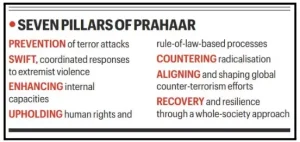
- The policy follows through on a strategic roadmap announced by the Union Home Minister in late 2024 and was finalized following the April 2025 Pahalgam Terror Incident, which acted as a catalyst for refining Inter-Agency Coordination.
About PRAHAAR
- Zero-Tolerance Doctrine: PRAHAAR is built on the unwavering principle of Zero Tolerance Toward Terrorism.
- Whole-of-Government & Whole-of-Society Approach: It expands national security beyond policing to include civil society, technology experts and psychologists.
- Secular & Non-Profiling Framework: The policy affirms the state does not link terrorism to any religion, ethnicity, nationality or civilisation, focusing instead on the criminal and ideological networks of violence.
The 7 Pillars of PRAHAAR
- P – Prevention of terror attacks: Prioritizing Intelligence-Led, Proactive Disruption. It mandates integration of the Multi-Agency Centre (MAC) and Joint Task Force on Intelligence (JTFI) to disrupt Overground Worker (OGW) Networks.
- R – Responses (Swift and Proportionate): Institutionalizing Standard Operating Procedures (SOPs). It ensures local police act as First Responders, supported by the National Security Guard (NSG) for major incidents.
- A – Aggregating internal capacities: Modernizing Law Enforcement Agencies (LEAs) with Artificial Intelligence and advanced weaponry to protect critical sectors like Atomic Energy and Defence.
- H – Human Rights and ‘Rule of Law’ Based Processes: Mandates associating Legal Experts from the First Information Report (FIR) stage to ensure evidence meets judicial standards, maintaining the Rule of Law.
- A – Attenuating the Conditions Enabling Terrorism: Engaging Doctors, Psychologists, and NGOs to address Radicalization. It uses a Graded Police Response to reintegrate misguided youth rather than relying solely on incarceration.
- A – Aligning and Shaping the International Efforts: Strengthening Mutual Legal Assistance Treaties (MLATs) to deny Safe Havens and curb Transnational Terror Financing via anonymous assets like Crypto Wallets.
- R – Recovery and Resilience: A Victim-Centric Approach focused on the rapid restoration of normalcy to defeat the psychological objective of terror: creating long-term Fear and Economic Paralysis.
Why the Need for PRAHAAR?
The formulation of a dedicated national policy was necessitated by several structural and evolving security gaps:
- Lack of a Unified Strategy: Previously, India operated without a single, written National Counter-Terrorism Strategy.
- This led to a fragmented approach where different states and central agencies worked in isolation. PRAHAAR ensures everyone follows the same “playbook” for a coordinated national response.
- High-Tech & Robotics Threats: Terrorism has moved beyond the “gun and grenade” era.
- The Drone Challenge: As seen in recent border incidents, hostile actors frequently use Unmanned Aerial Systems (UAVs) to drop arms and narcotics into Punjab and J&K.
- Cyber-Physical Warfare: There is a growing threat of nation-state hackers targeting India’s “backbone” infrastructure—such as Power Grids, Aviation, and Nuclear Plants—through sophisticated cyber-attacks.
- The Rise of “Hybrid” Threats: Modern warfare has moved into a “Grey Zone” where it is hard to distinguish between local criminals and foreign-backed actors.
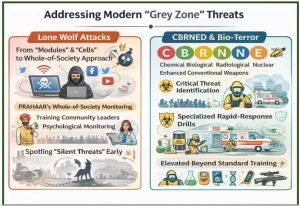 Technological Gap: As seen in the Pahalgam attack (2025), groups now use drones for smuggling and encrypted apps for planning.
- Accountability: PRAHAAR provides the legal power to hold both the local attackers and their foreign handlers responsible.
- The Terror-Crime Nexus: Terrorism is no longer just about ideology; it is a business.
- Narcotics Funding: According to the 2025 MHA Report, nearly 30% of terror funding in border states comes from drug trafficking.
- Logistics: Terrorist groups now hire organized criminal networks for local recruitment and transport, making it harder to distinguish between local crime and national security threats.
- Digital & “White-Collar” Radicalization: Recruitment has moved into the “digital living room.”
- Online Targeting: Educated youth are being targeted through foreign-funded social media and private messaging.
- Community Involvement: Because the police cannot solve this alone, the policy involves psychologists and community leaders to prevent radicalization before a crime is committed.
- Protecting the Economy: As India’s economy grows, its Power Grids, Nuclear Plants, and Space Tech become high-value targets.
- PRAHAAR makes protecting these “critical assets” a top national priority to prevent massive economic disruption.
- High-Risk “CBRNED” Materials: A top-tier priority of PRAHAAR is intercepting attempts by non-state actors to use Chemical, Biological, Radiological, and Nuclear materials.
- These risks, combined with Digital and Explosive (CBRNED) threats, require the advanced detection capabilities that this policy mandates.
- Fixing Legal & Investigation Gaps: Despite previous reforms, the conviction rate for terror cases remains low (around 3%). This is often due to poor evidence collection or a lack of specialized tech.
- Better Evidence: The policy mandates better digital forensics and shared databases (like a National Memory Bank) to ensure terrorists are actually convicted in court.
- Proactive Policing: It shifts the focus from just “reacting” after a blast to using predictive tools to stop attacks before they happen.
| Why No Anti-Terror Policy till now in India?
Historically, India relied on ad-hoc legislative measures rather than a codified national doctrine.
- Federal Friction (7th Schedule): Under the Constitution, “Police” and “Public Order” are State subjects. States often perceived a central policy as an “overreach” by the Union.
- Intelligence Silos: A “Need to Know” culture dominated the IB, RAW, and State ATS, preventing the creation of a Unified Intelligence Architecture.
- Reactive vs. Proactive: Legislation like UAPA (1967) or POTA (2002) was largely punitive (post-event), whereas a “policy” is preventative (pre-event).
- Definitional Ambiguity: Per the Global Terrorism Index (GTI), India struggled to balance definitions between “insurgency,” “militancy,” and “terrorism,” leading to fragmented legal responses.
|
Significance of India’s First anti-terror Policy
The PRAHAAR policy is more than just a new set of rules; it is a fundamental shift in how India protects its citizens.
- A Shift from Defense to Offense: For years, India reacted only after an incident occurred. This policy moves the country into a Proactive Mode, providing a Permanent Roadmap so that security forces are always one step ahead rather than playing catch-up.
- Protecting the Nation’s Wallet: Modern threats aren’t just about physical violence. By specifically naming Ports, Railways, and Atomic Energy, the policy treats Economic Sabotage as a primary act of terrorism, recognizing that damaging India’s growth is a direct attack on its people.
- Uniform Standards Across India: Currently, a big city might have better security than a rural border town. This policy creates a Uniform Structure, ensuring that the Standard of Response is equally high across every state, regardless of local budgets.
- Winning in the Courtroom: Most terror cases fail because of weak paperwork. By bringing in Legal Experts the moment an investigation starts, the government ensures that Evidence is Airtight, aiming to match the High Conviction Rates seen in elite national agencies.
Learning from Global Best Practices
India isn’t working in a vacuum; PRAHAAR adopts the most successful strategies from around the world:
- The Four-Pillar Strategy: Borrowing from the UK’s CONTEST Model, India now focuses on four clear goals:
- Prevent (stopping recruitment),
- Pursue (going after the bad actors),
- Protect (strengthening targets), and
- Prepare (recovering quickly if something happens).
- Zero Tolerance Worldwide: The policy aligns with United Nations Standards, sending a clear message to the world that there is No Justification for violence, effectively stripping away any political or social excuses for terror.
- The Community Approach: Following the Singapore Model, the policy recognizes that the best way to stop extremist ideas is through Community Leaders and Teachers. It treats De-radicalization as a social task, not just a police job.
|
India’s Contemporary Counter-Terrorism Framework
|
| Dimension |
Key Components |
Core Features / Significance
|
| Legal Framework |
Unlawful Activities (Prevention) Act, 1967 |
- Enables designation of individuals and organisations as terrorists, asset attachment and forfeiture, and extended investigation period (up to 180 days) to dismantle complex terror networks.
|
| National Investigation Agency Act, 2008 |
- Grants the NIA nationwide jurisdiction to investigate terror offences without prior State consent, ensuring swift federal intervention in high-impact cases.
|
| National Security Act, 1980 |
- Provides for preventive detention to neutralise threats to national security and public order, particularly where prosecution is not immediately feasible.
|
| Bharatiya Nyaya Sanhita, 2024 (Section 113) |
- Introduces a modernised definition of “terrorist act”, bridging gaps between local policing, intelligence inputs, and central investigations.
|
| Institutional Architecture |
National Investigation Agency (NIA) |
- Serves as the principal federal counter-terror prosecution agency, supported by specialised investigation units and dedicated special courts under UAPA.
|
| National Intelligence Grid (NATGRID) |
- A technology-driven intelligence fusion platform integrating banking, travel, telecom, and immigration databases to detect terror financing and sleeper networks.
|
| Specialised Units (NSG & State ATS) |
- Act as the primary tactical response forces for urban terror incidents, hostage rescue, and high-risk counter-terror operations.
|
| National Security Council Secretariat (NSCS) |
- Headed by the National Security Adviser (NSA), it ensures whole-of-government coordination across defence, intelligence, internal security, and diplomacy.
|
| Strategic Doctrine |
Strategic Autonomy in Response |
- Treats terror attacks as serious national security violations, allowing India flexibility in timing, scale, and nature of response.
|
| Sponsor Accountability |
- Eliminates distinction between terror groups and their state sponsors, holding both equally responsible through diplomatic and strategic measures.
|
| Punitive Deterrence |
- Shifts from deterrence by denial to deterrence by punishment, imposing credible and unacceptable costs to prevent future attacks.
|
| Net Security Approach |
- Frames counter-terror actions as defence of global security norms, strengthening India’s position in multilateral forums rather than bilateral confrontation alone.
|
Constitutional, Legal, and Judicial Anchoring of the Anti-Terror Framework
- Constitutional Mandate: Under Article 355, the Union bears the duty to protect states against “internal disturbance.”
- While “Police” is a State subject (Seventh Schedule), the policy promotes Cooperative Federalism through a Common ATS (Anti-Terrorism Squad) Structure, aiming for operational uniformity.
- Judicial Alignment: The policy integrates with the Bharatiya Nyaya Sanhita (BNS), specifically Section 113, which provides a modernized definition of “terrorist act.”
- It seeks to align with the K.S. Puttaswamy (Privacy) judgment by ensuring data processed through NATGRID and NIDAAN follows strict investigative safeguards.
- Trial-in-Absentia: As per official briefings, Section 356 of the Bharatiya Nagarik Suraksha Sanhita (BNSS) allows for the trial of proclaimed offenders in their absence.
- This measure is projected to compel fugitives to return, provided it remains subject to conformity with principles of natural justice and international legal obligations.
Core Challenges to Overcome
- The Federal Balance: Since State Governments manage the police, a national strategy can be seen as an overreach.
- The challenge is ensuring the Central Government acts as a supportive partner without taking away state authority.
- The Privacy Gap: As criminals hide behind encrypted apps and secret digital tools, the state must find ways to track threats without invading the privacy of law-abiding citizens.
- Prison Radicalization: Jails often become “schools” for crime where dangerous inmates influence others.
- India lacks enough high-security isolation units to stop this cycle of recruitment.
- Resource Inequality: Local police are the first responders, but they often lack the funding and cyber-training that elite central units have.
- This creates a weak link in the security chain.
- Information Silos: Different government departments often struggle to share real-time intelligence due to bureaucratic delays and internal politics, slowing down the response to threats.
- Legal Subjectivity: Programs that measure an individual’s “level of radicalization” can be subjective.
- Without clear legal benchmarks, this could lead to unfair profiling or inconsistent treatment.
Way Forward
- Strengthening the Legal System:
- Lawyers in Police Units: Place legal experts directly into specialized police teams. This ensures that every arrest and piece of evidence is court-ready, leading to higher conviction rates.
- Dedicated Prosecutors: Create a special group of federal prosecutors trained in digital crimes to handle complex cases more effectively.
- Technological Sovereignty:
- Indigenous Tools: India must develop its own drone-detection and cyber-forensic software. This removes the risk of “backdoors” in foreign software that could compromise national safety.
- Tracking Illegal Funding: Integrate crypto-currency tracking into the banking system to identify and block the money flow used by violent groups.
- Predictive Tech: Use Big Data and Machine Learning to spot suspicious patterns in finances and behavior before an incident actually occurs.
- Investing in People & Communities:
- Community Resilience: Shift the focus toward human-centric safety by funding programs that use psychologists and social workers to guide youth away from violent ideologies.
- Digital Accountability: Update IT Rules to hold social media platforms responsible for promoting extremist content and require them to undergo radicalization audits.
- Global Leadership:
- A Global Blueprint: India should lead the effort at international forums to create a unified definition of terrorism that all countries can follow.
- International Data Sharing: Create fast-track agreements with other countries for real-time access to digital evidence during emergency investigations.
Conclusion
PRAHAAR represents a maturing of India’s security architecture. By balancing the “Hard Power” of Zero Tolerance with the “Soft Power” of Human Rights and De-radicalization, India is now better equipped to dismantle the Terror-Ecosystem and protect its status as a rising global economy.


 25 Feb 2026







.png)






 Current Affairs




 GS Foundation
 Optional Course
 Combo Courses
 Degree Program