India’s Constitution places no formal limit on the Prime Minister’s tenure, allowing continuation in office based on Lok Sabha confidence.
- With the current Prime Minister completing 8,931 days in elected executive roles, the issue has resurfaced, highlighting concerns about prolonged incumbency amid weakening institutional checks.
UPSC Online Courses
Rationale Behind Executive Without a Limit
- Parliamentary Basis: The absence of a term limit for the Prime Minister was not an accident and not a gap in the Constitution.
- It was a deliberate feature of the parliamentary system of government adopted by India. In a parliamentary system, the Prime Minister is not directly elected for a fixed term, unlike a President in a presidential system.
- Instead, the Prime Minister holds office only as long as he or she enjoys the support of the majority in the Lok Sabha.
- This means that the office is supposed to remain politically dependent on Parliament at all times.
- Framers’ Logic: The framers of the Constitution believed that a Prime Minister did not need a fixed term limit because the office was already subject to constant democratic control.
- The Prime Minister could be questioned in Parliament, criticised in debates, challenged through motions, and removed through a no-confidence motion.
- Therefore, the framers expected that the office would remain accountable every day, not merely once in five years during elections.
- A No-Confidence Motion (NCM) is a parliamentary device to test whether the Council of Ministers still enjoys the confidence of the Lok Sabha. It is rooted in Collective Responsibility under Article 75(3).
- Ambedkar’s View: Dr. B.R. Ambedkar clearly explained this constitutional logic.
- He spoke of two forms of democratic responsibility- daily accountability through Parliament, and periodic accountability through elections.
- Daily accountability meant that the executive would constantly face scrutiny from elected representatives.
- Periodic accountability meant that the people would give their final verdict through elections.
- In simple terms, the Constitution assumed that a Prime Minister could not become too powerful or too permanent because Parliament would always be in a position to check and, if needed, remove the government.
Emerging Concerns Regarding Executive Without a Limit
- Institutional Shift: The central problem today is that the political system no longer works exactly as the framers had imagined.
- The Constitution may still contain the same structure, but the institutions that were supposed to control executive power have become much weaker in actual functioning.
- As a result, the absence of term limits now raises questions that may not have arisen at the time of the Constituent Assembly.
- Anti-Defection Effect: A major turning point came with the Tenth Schedule, introduced by the Fifty-Second Amendment in 1985.
- This law, commonly called the anti-defection law, was introduced to prevent frequent defections and unstable governments.
- While it did bring some political stability, it also had a major side effect, it reduced the freedom of Members of Parliament to vote according to their own judgment when party leadership gave a whip.
- Whip: A direction issued by a political party to its legislators to vote in a specific manner. Under the Tenth Schedule, defiance leads to disqualification, ensuring a “locked-in” majority and weakening parliamentary accountability over the executive.
- Members of Parliament can no longer freely challenge the government: Under the anti-defection law, if a ruling party MP votes against the party whip, the MP may face disqualification.
- This means that even if an MP loses faith in the Prime Minister or believes that the government should be removed, that MP cannot easily vote against the government in the House.
- The fear of losing one’s seat makes dissent extremely costly.
- Weakening of the No-confidence Motion in real Political Life: The no-confidence motion was supposed to be the main constitutional method through which a Prime Minister could be removed before the next election.
- However, when ruling party MPs are effectively bound by party whip and the anti-defection law, the practical strength of this device becomes weak.
- It continues to exist in law, but its democratic force is greatly reduced in a majority government. Thus, the mechanism that was supposed to make term limits unnecessary has itself become less effective.
- Speaker’s Role & Delays: The Speaker’s discretionary power under the Tenth Schedule often leads to delayed or politically influenced disqualification decisions, weakening “daily accountability.”
- In Keisham Meghachandra Singh vs Speaker Manipur Legislative Assembly 2020, the Supreme Court suggested shifting this power to an independent body for neutrality.
- Symbolic No-Confidence Motions: In a strong majority system, No-Confidence Motions become largely symbolic, as the anti-defection law pre-determines outcomes, reducing a constitutional check to a mere parliamentary debate.
- Intrinsic and Extrinsic Barriers to Leadership Change: Political parties in India are often highly centralised.
- Another major issue is the weak condition of internal democracy within political parties.
- In many parties, important decisions are controlled by a small leadership group or by a single dominant leader. Leadership change does not usually take place through open competition, regular internal elections, or institutional review.
- Cabinet vs Prime Ministerial Shift: The parliamentary model envisages a Cabinet Government, with the PM as “Primus Inter Pares” (first among equals).
- However, prolonged and unchecked tenure can shift it toward a “Prime Ministerial Government,” where the Cabinet’s deliberative role declines and it largely endorses the leader’s decisions, weakening internal executive checks.
- Weak Intra-Party Checks: In robust parliamentary systems, the ruling party can replace its leader, acting as an internal check even without parliamentary removal.
- In India, however, leader-centric party structures and rare leadership challenges weaken this mechanism.
- Double Shield Effect: The Prime Minister gains dual protection:
- From Parliament (due to anti-defection constraints on MPs)
- From the party (due to weak internal democracy)
- This creates a “double insulation”, enabling prolonged tenure not only due to public support but also due to weakened institutional avenues of challenge between elections.
Structural Risks of Prolonged Incumbency
- Beyond Tenure- The Real Issue is Concentration of Power: The concern is not merely that a leader remains in office for a long time.
- Long tenure, by itself, is not undemocratic—as long as it reflects the will of the electorate.
- However, the deeper issue is that prolonged incumbency can gradually concentrate political, institutional, and informational power in one office. Over time, this can make the system formally democratic but substantively less balanced.
- Structural Advantages of Long Tenure: A Prime Minister serving over multiple terms accumulates structural advantages that no new challenger can easily match:
- Party Consolidation: Stronger grip over party organisation and leadership structure
- Administrative Influence: Greater control over bureaucracy and policy implementation
- Appointments Power: Increasing role in selecting members of Election Commission, judiciary, regulators
- Narrative Control: Ability to shape public discourse, media narrative, and policy timing
- None of these individually violate constitutional norms, but together they create a cumulative asymmetry in political competition.
- Imbalance in Democratic Competition: India continues to hold regular, competitive elections, and the Prime Minister legally remains in office only so long as they enjoy parliamentary confidence .
- However, over time:
- Incumbency advantage compounds
- Access to state machinery + visibility + policy leverage increases
- Opposition faces resource and narrative asymmetry
- This creates a situation where democratic competition exists, but is no longer equally balanced.
- Example: In the 2024 General Elections, despite a reduced majority, the incumbent leadership still retained power through coalition-building, demonstrating both resilience of incumbency and limits of opposition consolidation .
- Impact on Institutional Neutrality: A long tenure allows sustained influence over institutional appointments, raising concerns about gradual alignment of institutions with executive preferences.
- Over time, this may produce a “committed bureaucracy” or “aligned regulatory ecosystem”
- Global indices have flagged concerns about institutional independence and democratic quality in India
- The risk is not overt control, but incremental erosion of neutrality.
- Weakening of Opposition Ecosystem: Prolonged incumbency can weaken the opposition in multiple ways:
- Fragmentation and leadership vacuum
- Reduced ability to act as a credible “government-in-waiting”
- Decline in policy-based competition
- Unlike the UK, India lacks a formal Shadow Cabinet system, meaning:
- There is no structured, continuous portfolio-wise scrutiny of the government
- Accountability becomes election-centric rather than continuous
- FPTP System and Amplified Dominance: India’s First-Past-The-Post (FPTP) system further magnifies this imbalance:
- A party can secure a large majority of seats with ~35–40% vote share
- This creates a “winner-takes-all” effect, especially in fragmented contests
- When combined with long tenure, this leads to:
- Disproportionate legislative dominance
- Reduced effective challenge to executive authority
- The First-Past-The-Post (FPTP) System: A plurality-based electoral method where the candidate with the highest votes wins, even without a majority, as used in India under the Representation of the People Act, 1951.
- It ensures simplicity, stable governments, and strong constituency linkage, but suffers from disproportionate outcomes, minority winners, and under-representation, raising concerns over fairness vs governability.
- Comparative Insight: India is not unique in lacking term limits for Prime Ministers, but this model assumes strong legislative checks .
- The problem arises when no term limits, weakened parliamentary accountability and weak intra-party democracy combine to produce structural executive dominance.
Best Online Coaching for UPSC
About the Constitutional Debate
- Asymmetry in Executive Restraint: India presents a striking contrast in its constitutional practice. The President of India, despite being a largely ceremonial authority, has been governed by a well-established informal convention that no individual should ordinarily serve more than two terms.
- Over time, this restraint has been respected by all incumbents, giving it the force of a constitutional norm in practice.
- In contrast, the Prime Minister, who exercises real executive power, is subject to neither a formal term limit nor any settled convention of restraint.
- The continuation in office depends almost entirely on electoral outcomes, with no parallel expectation of voluntary limitation.
- A Constitutional Oddity and Imbalance: This divergence creates a constitutional oddity. The office with limited real authority has evolved a norm of restraint, while the office with substantive governing power remains institutionally unconstrained.
- This is not merely symbolic—it points to a deeper imbalance in the constitutional order. Ideally, stronger offices should be subject to greater safeguards, whether formal or informal.
- However, in India’s case, informal limits have crystallized around the weaker office, whereas the stronger office continues to rely on periodic elections and increasingly fragile institutional checks.
- Limits of Electoral Accountability: In the absence of either legal caps or conventions, the Prime Minister’s tenure is effectively regulated only through elections.
- While elections are central to democracy, they are episodic rather than continuous mechanisms of accountability.
- Moreover, with factors such as incumbency advantage, control over institutional appointments, and the constraints imposed by the anti-defection law, the effectiveness of other accountability channels has diminished.
- As a result, elections alone are required to perform a disproportionately heavy role in checking executive power.
- Constitutional Morality- Uneven Evolution: The two-term convention for the President illustrates the principle of constitutional morality—the idea that restraint need not always be legally mandated but can evolve through practice and shared norms.
- It reflects a collective understanding that continuity must be balanced with rotation in office, even in the absence of binding rules.
- However, this morality of restraint has not developed for the Prime Minister’s office, where it is arguably more necessary.
- The absence of such a convention in the locus of real power suggests that constitutional morality in India has evolved unevenly, strengthening symbolic offices while leaving the most powerful office largely dependent on formal electoral processes.
The Electorate as the Check to Executive
- The Democratic Defence- Primacy of Voter Choice: A strong argument in favour of the present system is that in a democracy, the ultimate authority lies with the people.
- If voters repeatedly choose to elect the same leader, there is nothing inherently problematic in such continuity. From this perspective, imposing term limits may appear restrictive, as they prevent citizens from re-electing a leader in whom they continue to repose trust.
- Normative Strength of the Argument: This position carries significant democratic legitimacy. It is grounded in the principle of popular sovereignty, where electoral outcomes are seen as the most authentic expression of public will.
- If elections are free and fair, then the repeated re-election of a leader can be interpreted as a clear endorsement of performance and leadership.
- In this sense, term limits may appear counter-majoritarian or even anti-democratic, as they impose an external restriction on the electorate’s freedom of choice, regardless of continued public support.
Limits of Electoral Accountability as the Sole Check
- Limits of the “Voter Choice Alone” Argument: While electoral choice is central to democracy, it is not a complete safeguard against the concentration of power.
- The framers of the Constitution did not design a system that relied only on periodic elections; they envisioned a broader framework of continuous accountability, especially through Parliament.
- Hence, it is insufficient to assume that elections alone can effectively regulate executive authority.
- Erosion of Parliamentary Checks: The constitutional design placed significant emphasis on Parliament as a day-to-day check on the executive.
- However, with mechanisms like the anti-defection law (Tenth Schedule) and increasingly centralized party structures, the ability of legislators to independently challenge the government has weakened.
- As a result, Parliamentary oversight becomes less effective, and the burden of accountability shifts disproportionately to elections.
- Overburdening Elections: When institutional checks weaken, elections become the primary—often the only—mechanism of accountability. However, elections are periodic, occurring after several years.
- During this interval, a long-serving leader may accumulate significant structural advantages, such as:
- Influence over institutional appointments
- Greater control over political narrative and messaging
- Enhanced incumbency advantages
- By the time elections occur, the playing field may already be uneven.
- Persistence of Imbalance Despite Elections: Thus, even with regular elections, democracy may experience a gradual imbalance if one leader remains in office long enough to shape the institutional and political ecosystem in their favour.
- This does not undermine the importance of the people’s mandate, but it raises a deeper question- Are elections alone sufficient to ensure accountability when other constitutional and political checks have weakened?
What Is the Real Core of the Debate?
- Core of the Debate: The debate should not be reduced to a personal or party-political issue. The real concern is structural.
- The question is whether India’s parliamentary democracy still has the same self-correcting ability that the framers believed it would have.
- When Unlimited Tenure Was Considered Safe: When Parliament was expected to act freely, when no-confidence motions were expected to be meaningful, and when political parties were expected to remain open to leadership change, unlimited tenure did not appear dangerous.
- But once these checks weaken, the same constitutional design begins to look more risky.
- Changing Institutional Reality: The problem is not that India has no term limit in theory.
- The problem is that unlimited tenure is now operating in a system where the counter-balancing institutions are weaker than before. That is what makes the issue serious today.
- The Challenge of Political Consensus: While these reforms are constitutionally sound, the practical challenge is political consensus.
- Any reform that dilutes party discipline or limits tenure is often resisted by ruling parties, regardless of their ideology.
- Strengthening democracy, therefore, requires a shift in political culture where parties prioritize long-term institutional health over short-term executive stability.
|
Click to Know UPSC OnlyIAS Coaching Centres
Way Forward
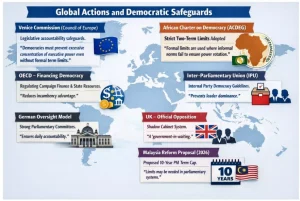
- Restoring Parliament as the Primary Check: The most immediate reform lies in reviving Parliament’s original role as a day-to-day accountability mechanism.
- The framers envisioned that the executive would survive only so long as it retained the confidence of the House.
- One practical step would be to exempt confidence and no-confidence motions from the anti-defection law (Tenth Schedule). This would allow MPs to vote freely on the survival of the government, without fear of disqualification.
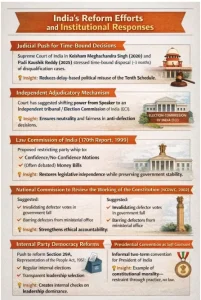 Such a reform would not dismantle party discipline entirely, but would carve out a constitutional space for genuine accountability, ensuring that executive legitimacy flows from actual legislative confidence, not merely numerical control enforced by party whips.
- Revisiting Term Limits- A Balanced Approach: Another reform option is the introduction of limits on consecutive terms, rather than an absolute cap. For instance, an individual could serve a fixed number of back-to-back terms as Prime Minister or Chief Minister, with the possibility of returning after a break.
- This approach strikes a balance between:
- Democratic choice (voters retain the right to re-elect), and
- Institutional balance (preventing prolonged concentration of power).
- It ensures leadership rotation without permanently excluding experienced leaders.
- Strengthening Intra-Party Democracy: A deeper and more sustainable solution lies within political parties themselves. The absence of internal elections, leadership review, and participatory decision-making has led to increasingly centralized, leader-driven structures.
- Reforms should focus on:
- Regular internal party elections
- Transparent leadership selection processes
- Greater member participation in decision-making
- If parties become more democratic, leaders will remain accountable internally, reducing the need for external constitutional constraints.
- Extending the Debate to the States: The issue of prolonged executive tenure is not confined to the Union. Several States have witnessed long-serving Chief Ministers, raising similar concerns about power concentration and weakened checks.
- Therefore, reforms must address both Prime Ministers and Chief Ministers, ensuring uniform democratic standards across the federal structure.
- Implications for Federal Balance: Prolonged tenure at the Union level can also affect federal dynamics. When the same party dominates both the Union and several States, federal checks may weaken in practice. It means, there is a risk of:
- Centralization of authority within party structures
- Reduced autonomy of State leadership
- Weakening of States as counterbalances to Union power
- This can dilute the federal principle, where States are meant to act as institutional checks on central authority.
- Legal Backing for Party Democracy: Strengthening intra-party democracy may require statutory backing, particularly through reforms to the Representation of the People Act, 1951 (Section 29A).
- Institutions like the Law Commission of India and the National Commission to Review the Working of the Constitution have emphasized the need to ensure that political parties themselves function democratically, rather than as centralized command structures.
- Key Committee Recommendations: Several expert bodies have already outlined actionable reforms:
- 170th Report of the Law Commission of India (1999): Recommended that the whip be restricted only to critical votes (e.g., confidence motions), allowing greater legislative independence otherwise.
- Dinesh Goswami Committee: Suggested transferring disqualification powers from the Speaker to the President/Governor acting on the advice of the Election Commission, to ensure neutrality.
- National Commission to Review the Working of the Constitution (2002): Emphasized the need for mandatory internal party democracy, including regular leadership elections.
Conclusion
India dispensed with term limits trusting Parliament, parties, and accountability mechanisms to check executive power. As these have weakened, prolonged tenure risks concentration and imbalance. The real task is to restore institutional checks or design new safeguards, ensuring power remains answerable, limited, and contestable.


 6 Apr 2026




.png)






 Current Affairs




 GS Foundation
 Optional Course
 Combo Courses
 Degree Program