Recently, the Maharashtra Freedom of Religion Bill, 2026, was passed by both Houses of the Maharashtra Legislature.
- Chhattisgarh enacted a new “Freedom of Religion” law to regulate religious conversions, targeting conversions through force, fraud, or inducement with stricter procedures and penalties.
- This reflects a growing trend of states adopting anti-conversion laws, expanding the regulatory framework on religious conversion.
Enroll now for UPSC Online Course
About the Maharashtra Freedom of Religion Bill, 2026
- It is a Bill that aims to protect the right to freedom of religion and prevent illegal religious conversions, along with related matters.
- Key Features:
- Objective: To prohibit conversions carried out through allurement, misrepresentation, force, undue influence, coercion, or any other fraudulent means.
- Declaration of Intent: It lays down an elaborate procedure for conversion, including a declaration of intent with 60-days’ prior notice.
- A post-conversion declaration is also required.
- Complaint Mechanism: It is mandatory for the police officer to register a complaint even if the relatives of the converted person approach them.
- The complainant may be the converted person, or their parents, siblings, or any other person related by blood, marriage, or adoption.
- Rights of Child: Any marriage solemnised solely for unlawful conversion shall be declared null and void by the court, on a petition filed by either party.
- Any child born out of such a marriage or relationship belongs to the religion of the mother before such a marriage or relationship.
- The child will have succession rights to the property of both parents as per the prevailing laws.
- Maintenance will have to be given, and custody will remain with the mother unless decided otherwise by a court.
- Punishment: Punishments for violation include imprisonment of up to 10 years and a fine of up to ₹7 lakh. Offences under the Bill will be cognisable and non-bailable.
- The offence of unlawful conversion is punishable with up to seven years’ imprisonment and a fine of ₹1 lakh.
- If the person converted is a minor, a woman, a person of unsound mind, or belongs to the Scheduled Castes or the Scheduled Tribes, the punishment increases to seven years’ imprisonment and a fine of ₹5 lakh.
- Institutional Fines: Institutions found guilty of forced conversions may face cancellation of registration and withdrawal of government aid or grants.
- Office-bearers may also face imprisonment of up to seven years and a fine of ₹5 lakh. Victims will be entitled to rehabilitation, maintenance, and custody of children.
Key Provisions of Chhattisgarh Regulation
- Prior Declaration and Administrative Scrutiny: Individuals must provide advance declaration to district authorities, enabling state scrutiny before conversion takes place.
- Broad Definition of Unlawful Conversion: The law expansively covers conversions by force, undue influence, coercion, allurement, or fraudulent means, rendering such conversions void.
- Inclusion of Religious Gatherings under Regulatory Scope: Even community or mass religious events can attract legal provisions if suspected of facilitating unlawful conversions.
- Exemption for Reconversion to Ancestral Religion: The law provides a specific exemption for reconversion, distinguishing it from other forms of religious conversion.
- Severe Penal Framework Including Life Imprisonment: The legislation prescribes stringent punishments, including life imprisonment in cases of mass conversions, along with making offences cognisable and non-bailable.
|
About Religious Conversions
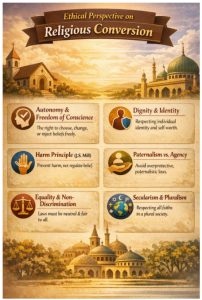
- About: Religious conversion refers to a voluntary or involuntary change in an individual’s faith, involving the adoption of a new system of beliefs and identity. In a plural and secular society like India, it raises critical questions concerning individual autonomy, dignity, and freedom of conscience, alongside concerns of state regulation and social harmony.
- Constitutional & Legal Dimension: The issue of religious conversion is closely linked with Fundamental Rights:
- Article 25 guarantees freedom of conscience and the right to freely profess, practice, and propagate religion, which includes the right to voluntarily change one’s religion.
- However, Article 25 is subject to reasonable restrictions on grounds of public order, morality, and health, allowing the state to regulate forcible or fraudulent conversions.
- Article 21 protects personal liberty and decisional autonomy, including choices related to faith and identity.
- Article 14 ensures equality before law, requiring that any regulation on conversion must be non-arbitrary and non-discriminatory.
- Judicial Position: The Supreme Court of India has maintained a balanced approach:
- It has upheld restrictions on conversions through force, fraud, or inducement.
- At the same time, it has consistently recognised that voluntary conversion is an intrinsic part of freedom of conscience and individual autonomy.
Core Constitutional Dilemmas in Religious Conversion Laws
- Autonomy vs State Regulation: The core tension lies in balancing freedom of conscience with the state’s power to regulate religion in the interest of public order.
- While voluntary conversion is constitutionally protected under Articles 25 and 21, excessive procedural controls (prior permission, scrutiny) risk undermining personal liberty and decisional autonomy.
- Propagation vs Conversion Distinction: Article 25 guarantees the right to propagate religion, but in Rev. Stainislaus v. State of Madhya Pradesh (1977), the Supreme Court clarified that this does not include the right to convert others through force, fraud, or inducement.
- However, voluntary self-conversion remains constitutionally protected, making the distinction crucial yet often blurred in practice.
- Privacy vs Prior Permission: Procedural requirements such as mandatory prior notice, public disclosure, and administrative approval intrude into the private domain of belief.
- As recognised in Justice K.S. Puttaswamy v. Union of India (2017), faith and belief fall within the ambit of informational and decisional privacy, and such measures may create a chilling effect on religious choice.
- Minority Rights vs Public Order: While the state can regulate religion to maintain public order, anti-conversion laws must ensure they do not lead to selective enforcement or disproportionate targeting of minority communities, thereby undermining secularism and equality (Article 14).
- Protection vs Paternalism: Enhanced safeguards for women, minors, and SC/ST communities aim to prevent exploitation. However, overbroad provisions may become paternalistic, presuming lack of agency and thereby diluting individual autonomy and dignity.
Check Out UPSC CSE Books From PW Store
Forced Religious Conversions vs Right to Marry
| Dimension |
Forced Religious Conversions |
Right to Marry |
| Definition |
Conversion through coercion, fraud, inducement, or undue influence |
Freedom of individuals to choose their life partner, irrespective of religion/caste |
| Constitutional Basis |
Article 25 of Indian Constitution (subject to public order, morality, health) |
Article 21 of Indian Constitution (includes right to marry a person of choice) |
| Nature of Right |
Not absolute; regulated by state laws to prevent abuse |
Fundamental and intrinsic right; part of personal liberty |
| State Intervention |
States can enact laws to prohibit forced conversions |
State interference is limited; cannot restrict consenting adults’ marriage |
| Key Laws |
State Anti-Conversion Laws (e.g., UP, MP, Gujarat laws) |
Special Marriage Act 1954 |
| Grounds of Regulation |
Fraud, coercion, misrepresentation, allurement |
Only valid restrictions: age, consent, prohibited degrees of relationship |
| Judicial Stand |
Courts uphold laws preventing forced conversions |
Courts strongly protect interfaith/inter-caste marriages |
| Important Judgements |
Rev. Stanislaus case (1977): Right to propagate ≠ right to convert |
Shafin Jahan vs Asokan K.M.; Lata Singh vs State of UP |
| Public Order Aspect |
Linked with maintaining law & order and social harmony |
Honour killings & harassment seen as violation of law and liberty |
| Misuse Concerns |
Laws may be misused to target voluntary conversions/interfaith couples |
Social pressure, honour crimes, and misuse of laws to harass couples |
Factors Responsible for Religious Conversion in India
Religious conversion in India is thus a multi-dimensional phenomenon, shaped by the interplay of autonomy, social structures, economic conditions, and regulatory frameworks, rather than a purely coercive or voluntary act.
- Individual (Autonomy-Driven) Factors: Religious conversion is often rooted in personal belief, spiritual quest, and individual autonomy, reflecting an exercise of freedom of conscience.
- Courts have consistently upheld voluntary conversion as part of personal liberty under Article 21 and religious freedom under Article 25.
- Social (Relational) Factors: Conversions may be influenced by marriage, family expectations, and community acceptance, particularly in inter-faith contexts where conversion is sometimes seen as facilitating social integration and familial harmony.
- Structural (Socio-Economic Inequality) Factors: In many cases, conversion is linked to escape from caste-based discrimination, exclusion, and marginalisation.
- Issues such as the loss of Scheduled Caste status upon conversion highlight how institutional and structural constraints shape religious choices.
- Economic (Incentive-Based) Factors: Economic vulnerabilities may play a role, where individuals are influenced by perceived or actual access to better livelihood opportunities, welfare benefits, or material support.
- Allegations of inducement in economically weaker sections continue to inform policy debates.
- Coercive (Illicit) Factors: Instances of force, fraud, undue influence, or misrepresentation remain a key concern for the state.
- Allegations of organised or mass conversions in certain regions have been cited to justify regulatory frameworks.
- Marriage–Conversion Interface: The intersection of marriage and conversion reflects tensions between individual choice and state suspicion of coercion, especially in the context of interfaith unions.
- Judicial Position: The Supreme Court of India in cases such as Shafin Jahan v. Asokan K.M. (Hadiya case, 2018) and Lata Singh v. State of Uttar Pradesh (2006) has affirmed that the choice of partner and religion lies within the core zone of personal liberty under Article 21, and cannot be curtailed by the state.
Anti-Conversion Laws in India
- Deals with: Anti-Conversion laws are legislative measures aimed at preventing or prohibiting religious conversions.
- Background & Status of Anti-Conversion Laws in India:
- Pre-Independence Era: Before Independence, several Hindu princely states such as Raigarh, Bikaner, Kota, Jodhpur, Surguja, Patna, Udaipur, and Kalahandi implemented anti-conversion laws to curb missionary activities aimed at spreading Christianity.
- Post-Independence Period: In 1954 and 1960, Parliament took up the Indian Conversion (Regulation and Registration) Bill and the Backward Communities (Religious Protection) Bill for Considerations.
- Both aimed to halt conversions but were eventually abandoned due to lack of support.
- No Central Law: Currently there is no specific law framed by the central government specific to religious conversion.
- Indian Penal Code, 1860: While there is no specific central law governing religious conversion, provisions such as Sections 295A and 298 of the Indian Penal Code address offences related to hurting religious sentiments, but do not directly regulate religious conversions.
- While there is no specific central law on religious conversion, the Bharatiya Nyaya Sanhita, 2023 contains provisions (e.g., Sections 299 and 302) that address offences relating to outraging religious sentiments, but do not directly regulate or prohibit religious conversions.
- Legislative and Federal Dimensions:
- State Jurisdiction: Public order and police fall under the State List (Seventh Schedule), explaining why anti-conversion laws are primarily state legislations.
- Lack of Uniformity: There is wide variation across states in definitions (allurement/inducement), procedural requirements, burden of proof, and penalties, leading to legal inconsistency.
Freedom of Religion in the Constitution of India
- Article 25: It deals with freedom of conscience and free profession, practice and propagation of religion.
- Article 25 guarantees freedom of religion but is subject to reasonable restrictions on grounds of public order, morality, and health, allowing the state to regulate secular aspects of religious practices.
- Article 26: It deals with freedom to manage religious affairs.
- Article 27: It deals with freedom as to payment of taxes for promotion of any particular religion.
- Article 28: It deals with freedom as to attendance at religious instruction or religious worship in certain educational institutions.
- Minority Rights and Secularism:
- Indian Secularism: The State must maintain principled neutrality among religions, ensuring laws do not become tools of majoritarian control.
- Protection of Vulnerable Groups: While preventing exploitation, laws must preserve agency of marginalized communities in matters of faith.
Anti-Conversion Laws in Various States
- Over the years, several states have enacted ‘Freedom of Religion’ legislation to restrict religious conversions carried out by force, fraud, or inducements.
- Anti-conversion laws are currently in force in several states (10+), including Odisha, Madhya Pradesh, Chhattisgarh, Gujarat, Himachal Pradesh, Jharkhand, Uttarakhand, Uttar Pradesh, Karnataka, and Haryana.
- Odisha (The Orissa Freedom Of Religion Act, 1967 ) was the first to introduce such legislation in 1967, followed by Madhya Pradesh in 1968.
- Chhattisgarh Religion Freedom (Amendment) Act, 2006
- Jharkhand Freedom of Religion Act, 2017
- Uttar Pradesh Prohibition of Unlawful Conversion of Religion Ordinance, 2020
- Karnataka Protection of Right to Freedom of Religion Act, 2022
- Haryana Prevention of Unlawful Conversion of Religion Act, 2022, etc.
|
Need for an Anti-Conversion Law in India
- Maintenance of Public Order and Social Harmony: Anti-conversion laws are justified to prevent communal tensions and disturbances to public order, especially in cases where religious conversions become contentious and lead to local conflicts or societal unrest.
 Prevention of Coercion, Fraud, and Undue Influence: These laws seek to prohibit conversions carried out through force, misrepresentation, inducement, or exploitation, thereby ensuring that any change of faith is based on free will and informed consent.
- Protection of Vulnerable Sections: Special safeguards are intended to protect women, minors, and socio-economically disadvantaged groups, who may be more vulnerable to coercion or inducement due to their social and economic conditions.
- Regulation of Marriage-Related Conversions: The laws address concerns related to interfaith marriages involving alleged concealment of identity or coercion, aiming to prevent misuse of marriage as a means to compel religious conversion.
- Ensuring Transparency and Accountability: Procedural mechanisms such as prior intimation and administrative verification are intended to introduce transparency in conversion processes, particularly in cases of organised or mass conversions.
- Deterrence Against Organised or Mass Conversions: The legal framework acts as a deterrent against large-scale or organised conversion activities, especially those suspected to involve coercive or inducement-based practices.
- Addressing Legal and Federal Gaps: In the absence of a uniform central legislation, state laws attempt to fill the regulatory vacuum while maintaining constitutional order and secular balance, as recognised by the Supreme Court of India.
Enroll now for UPSC Online Classes
Concerns Associated with Anti-Conversion Laws in India
- Violation of Fundamental Rights: The Indian Constitution upholds freedom as a fundamental right, including freedom of religion. However, anti-conversion laws can pose a threat to this foundational principle.
- Such laws not only violate religious freedom but also infringe upon other constitutional rights, such as the Right to Life and Personal Liberty (Article 21) and the Right to Equality (Article 14).
- Threat of Discrimination: These anti-conversion laws can be misused to discriminate against certain religious groups, particularly minority religions.
- In a secular nation like India, protecting the rights of vulnerable and marginalized communities should take precedence over imposing restrictions on religious conversion.
- Risk of selective enforcement and potential targeting of minority communities, raising concerns about equality under Article 14.
- Social Circumstances and Wellbeing: Individuals sometimes change their religion due to social pressures or for their own wellbeing. Anti-conversion laws could disproportionately affect these individuals and their freedom to make personal choices.
- Vague Terminology: Anti-Conversion laws in India contain certain vague terminology like misrepresentation, force, fraud that can be misused.
- Procedural and Rights-Based Concerns:
- Prior Restraint on Freedom: Requirements like prior permission and state scrutiny act as pre-emptive restrictions on freedom of conscience.
- Chilling Effect: Public disclosure of conversion intent may expose individuals to social pressure, harassment, or violence, discouraging genuine conversion.
- Due Process Issues: Reverse burden of proof and police intervention raise concerns regarding fair trial and misuse of law.
- Implementation Challenges:
- Risk of Misuse: Laws may lead to selective enforcement and targeting of specific communities.
- Low Conviction, High Litigation: A gap between registered cases and convictions suggests potential misuse and inefficiency.
Supreme Court Judgements Regarding Anti-Conversion Laws
- Hadiya vs. Ashokan K.M Case: The Supreme Court affirmed an adult’s right to marry and convert to another religion freely, asserting that the state cannot interfere with this choice.
- Lata Singh vs. State of Uttar Pradesh Case: The Supreme Court emphasized an individual’s right to marry irrespective of religion, caste, or social status, declaring any interference with this right a violation of freedom of choice.
- K.S. Puttaswamy or ‘Privacy’ Judgment: The Supreme Court underscored individual autonomy in making decisions concerning vital aspects of life.
- Sarla Mudgal vs. Union of India Case: The Supreme Court upheld the right to convert for marriage purposes but cautioned against using conversion to evade legal obligations or responsibilities.
- S. Pushpa Bai vs. C.T. Selvaraj Case: The Supreme Court affirmed the right to voluntary religious conversion, condemning coercion or misrepresentation in such processes as violations of freedom of religion.
- Rev Stanislaus vs. Madhya Pradesh Case: The Supreme Court held that the right to propagate religion does not include the right to convert another person by force or inducement.
- Recently, the Bench Of Justices MR Shah and Hima Kohli has said forced religious conversion is a very serious issue which can affect national safety, freedom of religion & freedom of conscience.
|
Way Forward
- Align with Constitutional and International Standards: India’s approach should be guided by Article 25 (freedom of conscience) and global norms such as Article 18 of the Universal Declaration of Human Rights, which recognise the right to freely adopt and change one’s religion, ensuring that laws remain rights-oriented.
- Develop a Harmonised Model Legal Framework: While “public order” falls under the State List, the Union can formulate a model law on religious conversion to promote uniformity, clarity, and constitutional consistency across states, reducing legal fragmentation.
- Ensure Precise and Narrowly Tailored Definitions: Key terms such as force, fraud, inducement, and allurement must be clearly and narrowly defined to prevent arbitrary interpretation and misuse, thereby strengthening the rule of law.
- Distinguish Clearly Between Voluntary and Coercive Conversion: The legal framework must explicitly protect voluntary conversions while penalising only those involving coercion or deception, ensuring that freedom of conscience is not diluted.
- Reform Procedural Requirements to Protect Privacy: Replace intrusive mechanisms like prior permission and public disclosure with post-facto intimation and privacy safeguards, in line with the right to dignity and autonomy.
- Strengthen Safeguards Against Misuse: Introduce judicial oversight, penalties for false or motivated complaints, and accountability mechanisms to prevent harassment and selective enforcement.
- Build Institutional Capacity and Public Awareness: Train police and administrative authorities for rights-based, non-discriminatory enforcement, while promoting public awareness to reduce misinformation and social tensions around religious conversion.
Conclusion
Religious conversion laws must balance individual freedom and state regulation. While preventing coercion and fraud is essential, excessive restrictions may violate Articles 14, 21, and 25. A clear, non-discriminatory framework is needed to protect voluntary choice and uphold constitutional values.


 31 Mar 2026





.png)






 Current Affairs




 GS Foundation
 Optional Course
 Combo Courses
 Degree Program