Reusable Launch Vehicle (RLV) Technology

21 Jan 2026

Reusable Launch Vehicle (RLV) Technology

Rapid advances in reusable launch vehicle technology have transformed the global space sector into a fast-growing commercial industry, projected to exceed $1 trillion by 2030.

  • It is driven by cost reduction and higher launch frequency.

About Reusable Launch Vehicles (RLVs)

  • Reusable Launch Vehicles are space transportation systems designed to recover and reuse rocket stages or spacecraft.
  • Components: 
    • Recoverable first-stage boosters or spaceplanes
    • Restartable engines
    • Advanced guidance and control systems, 
    • Thermal protection for atmospheric re-entry,
    • Landing mechanisms such as retro-propulsion, grid fins, and autonomous navigation software.
  • Working Mechanism
    • Rockets overcome gravity by ejecting exhaust backward at supersonic speeds.
    • Staging: Separation of lower propulsion module (first stage) from upper payload stage, with intent to recover the first stage.
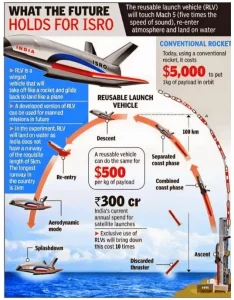
    • Recovery: Spent stages return using propulsive deceleration + aerodynamic braking, enabling refurbishment and reuse.

Space Agencies Currently Using or Developing RLVs

Space Agency   Vehicle Name Current Status (2026) Reusability Type
NASA (USA) Space Shuttle (Legacy), Starship (Partner) Using commercial partners; co-developing Starship for Artemis Partial (Legacy) / Full (Starship)
ISRO (India) Pushpak (RLV-TD),

Next Generation Launch Vehicle

( NGLV Soorya)

Testing winged RLV-TD orbital return in 2026;

Developing NGLV

Partial (First Stage)
CNSA (China) Long March 8, CZ-10 Operating LM-8; testing CZ-10 for crewed lunar programs Partial
ESA (Europe) Themis First test flights of Themis reusable demonstrator in early 2026 Vertical Take-off & Landing (VTVL)
JAXA (Japan) CALLISTO, RV-X Ongoing R&D and collaborative testing for reusable systems VTVL Demonstrators
SpaceX  Falcon 9, Falcon Heavy, Starship Fully operational (Falcon); ongoing Starship flight tests Partial / Full
Blue Origin  New Shepard, New Glenn New Shepard operational (suborbital); (Fully Reusable)

New Glenn VTVL landing demonstrated.(Partially Reusable )

Fully reusable

Check Out UPSC CSE Books

Visit PW Store

online store 1

India’s Status in Reusable Space Technology

  • ISRO’s Efforts: ISRO is pursuing multiple reusability pathways, including a winged Reusable Launch Vehicle capable of autonomous hypersonic re-entry and horizontal runway landing, validated under the RLV-TD programme.
    • RLV LEX-03 for the Pushpak vehicle is the successful third and final test of its RLV, “Pushpak” , demonstrating landing from 4.5 km altitude
    • ISRO is also developing vertical stage recovery concepts using aerodynamic drag and retro-propulsion, similar to global best practices, to reduce dependence on expendable launch vehicles like PSLV and LVM-3.
  • Private Participation: Space sector reforms and IN-SPACe facilitation have enabled Indian private startups to enter launch vehicle development, strengthening commercialisation of space and indigenous innovation.

Reusable Launch Vehicle

Rationale Behind Reusable Launch Vehicles

  • Cost and Mission Complexity: Human space missions are 3–5 times costlier than satellite launches due to life-support, safety, redundancy, and mission planning needs, making cost reduction through reusability essential.
    • Reusability lowers launch costs by 5–20 times by recovering high-value hardware, making frequent missions and human spaceflight economically viable.
  • Rocket Mass and Fuel Constraints: The Tsiolkovsky rocket equation shows that over 90% of a rocket’s mass is propellant, creating inefficiency that staging and reusable recovery help mitigate.
  • Sustainability : Reusable launch vehicles transform rockets from one-time-use systems into transport assets, reducing waste, lowering launch costs, and enabling frequent human access to space.
    • Stage recovery reduces ocean debris and manufacturing waste, promoting sustainable space access amid rising launch demand.
  • Strategic Competitiveness: Reusable systems increase launch cadence, enhance payload flexibility in the evolving global space transportation market.

Reusable Launch Vehicles mark a paradigm shift from disposable rockets to transportation systems, combining engineering innovation with economic and strategic imperatives for future space exploration.

Need help preparing for UPSC or State PSCs?

Connect with our experts to get free counselling & start preparing

Aiming for UPSC?

Download Our App

      
Quick Revise Now !
AVAILABLE FOR DOWNLOAD SOON
UDAAN PRELIMS WALLAH
Comprehensive coverage with a concise format
Integration of PYQ within the booklet
Designed as per recent trends of Prelims questions
हिंदी में भी उपलब्ध
Quick Revise Now !
UDAAN PRELIMS WALLAH
Comprehensive coverage with a concise format
Integration of PYQ within the booklet
Designed as per recent trends of Prelims questions
हिंदी में भी उपलब्ध

<div class="new-fform">


    </div>

    Subscribe our Newsletter
    Sign up now for our exclusive newsletter and be the first to know about our latest Initiatives, Quality Content, and much more.
    *Promise! We won't spam you.
    Yes! I want to Subscribe.