Recently, the Centre denied altering the Aravalli Hills definition, citing a Supreme Court–mandated freeze on new mining leases and a court-approved framework ensuring stronger ecological protection until a comprehensive management plan is finalised.
About Supreme Court–Mandated Freeze and Regulatory Framework
In a decisive move to curb the ecological degradation of India’s oldest mountain range, the Supreme Court of India, in its 20 November 2025 judgment, instituted a stringent regulatory framework, prioritising environmental conservation over resource extraction.
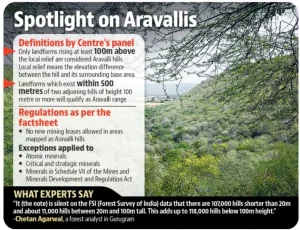
- Freeze on Mining Leases: The Supreme Court imposed a complete freeze on the grant and renewal of new mining leases across all Aravalli states until a scientific framework is finalised.
- Status of Existing Operations: Pre-existing valid leases may continue, subject to Environmental Clearances, forest laws, and pollution norms. Non-compliant units face immediate closure.
- Uniform ‘100-Metre’ Definition: An Aravalli hill is defined as a landform with minimum 100-metre elevation above local relief. An Aravalli range comprises two or more such hills within 500 metres.
- Management Plan for Sustainable Mining (MPSM): The MoEFCC, through ICFRE, must prepare the MPSM, involving scientific zonation, identification of inviolate areas, cumulative impact assessment, and carrying capacity analysis. No new approvals are permitted until notification.
Historical Evolution and Judicial Interventions
- Early and Modern Exploitation: Mining activities date back to the Khetri copper mines (5th century BCE).
- However, large-scale degradation accelerated during the 1960s–80s NCR urban expansion, driven by construction demand.
- Judicial Timeline: In 1992, the Ministry of Environment, Forest and Climate Change (MoEFCC) restricted mining in Alwar and Gurgaon, leaving Faridabad vulnerable..
- During the 1990s, monetisation of “hill homes” intensified pressure.
- In 2009, the Supreme Court imposed a blanket mining ban in Faridabad, Gurugram, and Mewat, asserting “Save the hill, ignore the definition.”
- Despite this, a 2018 assessment reported the disappearance of 31 hills in Rajasthan due to illegal mining.
About Aravalli Hills
The Aravalli Range is among the oldest geological formations on Earth, formed during the Proterozoic era, long before the Himalayas, and forms the ecological backbone of northwest India.
- Geological and Human Evolution: Formed nearly 3.2 billion years ago, the Aravallis evolved from a pristine ecological barrier to a fragmented landscape due to sustained human intervention.
- A relic of ancient fold mountains, representing one of the earliest stable landmasses of the Indian subcontinent.
- Extent & Orientation: Stretches about 670 km in a northeast–southwest direction.
- Geographical Spread: Originates near Himmatnagar (Gujarat), passes through Rajasthan and Haryana, and ends at the Delhi Ridge.
- Topography:
- Southern Aravallis: Steep, rugged, and relatively forested, including Mount Abu.
- Northern Aravallis: Low, rocky ridges with sparse scrub vegetation.
- Highest Peak: Guru Shikhar (1,722 m), located on Mount Abu, Rajasthan.
- Hydrology: Source of important rivers such as the Banas, Luni, Sakhi, and Sabarmati.
- Ecological & Cultural Significance: Hosts key conservation and heritage sites including Sariska Tiger Reserve, Kumbhalgarh Wildlife Sanctuary, and the Delhi Ridge, where ancient geology intersects with urban landscapes.
Significance of the Aravalli Hills- The Ecological “Kavach” of North India
The Aravalli Range functions as a multi-functional ecological “Kavach” (shield), providing critical environmental services essential for the survival and sustainability of northern India.
- Barrier Against Desertification & Pollution: The Aravallis act as a natural wall against the eastward expansion of the Thar Desert by influencing wind patterns and preventing sand and dust intrusion into the Indo-Gangetic plains.
- The Aravalli hills influence monsoon patterns and groundwater recharge, contributing around 2 million litres per hectare. Without them, much of the Arabian Sea rainfall would bypass Rajasthan, flowing into Pakistan instead.
- Forest Survey of India (FSI) studies show that gaps in the range allow dust storms, causing PM2.5 and PM10 levels in Delhi-NCR to rise 4–6 times, highlighting their role in air-quality regulation.
- Hydrological Lifeline: The range underpins regional water security through its unique geology, where fractured Alwar Quartzite and marble formations enable high rainwater infiltration.
- Central Ground Water Board (CGWB) data indicates that the Aravallis recharge nearly 20–30% of groundwater in the water-stressed National Capital Region (NCR) and act as the source region for major rivers such as the Luni, Sabarmati, Banas, and Chambal.
- Biodiversity Reservoir & Wildlife Corridors: The Aravallis host 22 wildlife sanctuaries and 4 tiger reserves and function as critical ecological corridors for species like the Indian Leopard and Striped Hyena, ensuring habitat connectivity between landscapes such as Sariska and Ranthambore.
- Climate Regulation Function: Acting as a vast green lung, the range moderates regional temperatures, traps dust, and functions as an important carbon sink, contributing directly to India’s climate-change mitigation and Paris Agreement commitments.
Concerns & Challenges Facing the Aravalli Hills
Despite their age and importance, the Aravallis are currently facing an existential crisis due to human intervention and regulatory shifts.
- Political & Governance Dimension: Critics argue that reliance on a uniform height-based definition masks deeper governance failures rather than strengthening conservation.
- The recent judicial and policy shifts aim to curb “definition shopping” by States. In December 2025, the Union Environment Minister asserted that around 90% of the Aravallis remain protected, countering fears of dilution.
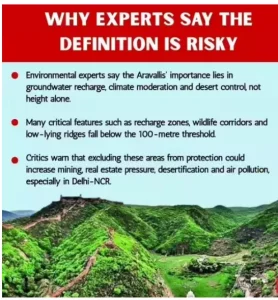
- The ‘100-Metre’ Definition Controversy (“Broken Shield” Argument): Environmental groups warn this could exclude nearly 90% of hillocks (about 1.6 lakh hills in Rajasthan), creating ecological gaps.
 The Forest Survey of India (FSI) has instead advocated a slope-based criterion (>3°), arguing that height alone is ecologically arbitrary.
- Such gaps weaken the natural barrier, allowing desert dust intrusion and causing PM2.5 and PM10 levels in Delhi-NCR to spike 4–6 times.
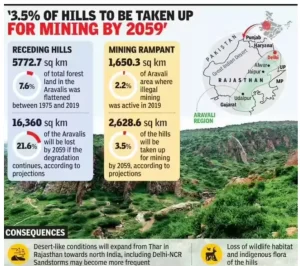
- Economic Dimension & Mining Pressures: Legal mining occupies only 0.19% of the total Aravalli area, indicating that degradation stems from weak enforcement and regulatory capture, not development necessity.
- A 2018 report highlighted that 31 hills have already vanished in Rajasthan due to sustained quarrying of sandstone, marble, granite, and silica.
- Mining contributes 2–3% to Rajasthan’s GSDP, while illegal mining in Haryana exceeds ₹1,000 crore annually.
- Threat to “Gair Mumkin Pahar”: Lands historically classified as “Gair Mumkin Pahar” (uncultivable hilly land)—traditionally protected—risk reclassification under the height-based criterion.
- This opens them to real estate development and urban encroachment, accelerating groundwater depletion and landscape fragmentation.
- Biodiversity & Landscape Fragmentation: Lower ridges and hillocks, though below 100 metres, function as critical wildlife corridors, especially between Sariska and Ranthambore.
- Their loss disrupts connectivity, pushing leopards and other fauna into urban areas like Gurugram, intensifying human–wildlife conflict.
- Social & Human Impact: Environmental degradation has imposed severe human costs. Unregulated mining and stone crushing have caused widespread silicosis among informal workers, while displacement of Bhil, Meena, and Meo Muslim communities raises serious concerns under Article 21 (Right to Life).
Initiatives by India to Protect and Restore the Aravalli Range
| The Precautionary Principle is a risk-averse strategy requiring preventive action against activities that may harm the environment or health, even without scientific certainty, shifting the burden of proof to the actor to prevent irreversible damage. |
- Judicial Interventions & Legal Moratoriums: The Supreme Court of India, applying the Precautionary Principle, froze all mining leases in Rajasthan, Haryana, Gujarat, and Delhi in 2025, mandated a uniform Aravalli definition (≥100 m; clusters within 500 m), and reinforced earlier bans protecting NCR groundwater recharge zones.
- #SaveAravallis Movement: Emerging in late 2025 after the Supreme Court’s uniform Aravalli definition and mining freeze, the movement raises public concern that the 100‑metre criterion could weaken long-term ecological protection of the range.
- Policy & Planning Frameworks: Under judicial direction, the Ministry of Environment, Forest and Climate Change (MoEFCC), through the Indian Council of Forestry Research and Education (ICFRE), is preparing a Management Plan for Sustainable Mining (MPSM).
- The plan demarcates “Inviolate Zones”—covering core forests, water bodies, and tiger corridors—where mining is permanently banned, and assesses the ecological carrying capacity to ensure activities remain within regenerative limits.
- Oversight is provided by the Central Empowered Committee (CEC), which recommends scientific mapping and macro-level Environmental Impact Assessments (EIA).
- Ecological Restoration – Aravalli Green Wall Project: Launched in June 2025 in alignment with World Environment Day, the Aravalli Green Wall Project is among India’s most ambitious restoration initiatives.
- Inspired by Africa’s Great Green Wall, it aims to create a 5 km-wide green buffer across a 1,400 km corridor from Gujarat to Delhi.
- Technological & Innovative Solutions: India is deploying “Space-to-Land” technologies to protect the range.
- ISRO’s Bhuvan satellite platform enables real-time monitoring of illegal mining and forest-cover change, while drones with night-vision and AI-based change detection help identify illegal hill-cutting promptly.
- Additionally, Aravalli Biodiversity Parks in Delhi and Gurugram demonstrate successful ecological revival by converting abandoned mining pits into native grassland and scrub forest ecosystems.
- Alternatives & Economic Transition: To reduce reliance on Aravalli stone and sand, the government is promoting manufactured sand (M-Sand) from granite and basalt through policy incentives, lowering pressure on fragile quartzite formations.
- Geopolymer concrete, using industrial by-products like fly ash, is being encouraged as a sustainable construction alternative.
| Manufactured Sand (M-Sand) is a crushed, engineered fine aggregate produced by crushing hard rock (granite/basalt) using advanced crushers and screening systems as a substitute for river sand in construction. |
- International Compliance & Climate Commitments: The range serves as a key landscape for India’s Bonn Challenge and UNCCD land-restoration targets, while its conservation is vital for achieving Nationally Determined Contributions (NDCs) under the Paris Agreement, particularly in carbon sequestration and climate resilience.
Way Forward
To secure the future of the Aravalli Range, India must move from reactionary litigation to proactive, science-based ecological governance, integrating legal reform, restoration ecology, livelihood security, and advanced technology.
- Strengthening the Legal & Technical Shield: While the 100-metre height criterion offers administrative clarity, it must be supplemented with slope-based (e.g., >3°), vegetation, and landscape-continuity criteria using GIS and satellite mapping, ensuring that ecologically vital lower hillocks are not lost to real estate.
- The Management Plan for Sustainable Mining (MPSM) should be notified urgently, with strict “No-Go” zones defined by ecological carrying capacity, ensuring mineral extraction never exceeds environmental regeneration.
- All 22 wildlife sanctuaries and 4 tiger reserves must be geo-referenced with a mandatory 1-km inviolate buffer, irrespective of Eco-Sensitive Zone notification status.
- Ecological Restoration & the Green Wall: The Aravalli Green Wall Project must shift from plantation-centric approaches to rewilding, prioritising native species such as Dhau, Khejri, and Babool over invasive monocultures like Prosopis juliflora, restoring the natural desert-shield function.
- Wildlife corridor connectivity, especially between Sariska and Ranthambore, should be rebuilt through overpasses and underpasses at highway crossings to reduce roadkill and human–wildlife conflict.
- The Gurugram Biodiversity Park model should be scaled across NCR cities, converting abandoned mining pits into wetlands and native forests to recharge aquifers and mitigate urban heat islands.
- Water Security & Hydrological Management: Fractured quartzite zones must be declared Critical Groundwater Recharge Zones, prohibiting construction and surface sealing.
- A network of decentralised check dams and traditional Johads should be implemented to maximise monsoon rain infiltration, reviving the Aravallis’ ancient hydrological sponge function.
- Economic & Industrial Transition: Dependence on Aravalli stone must be reduced through rapid scaling of Manufactured Sand (M-Sand) from non-Aravalli sources and mandatory use of Recycled Construction & Demolition (C&D) waste in NCR infrastructure.
- A carbon-credit and ecosystem-services economy should be institutionalised, enabling states and local communities to earn revenue from carbon sequestration, groundwater recharge, and biodiversity conservation, making preservation more profitable than mining.
- Low-impact eco-tourism in areas like Jhalana, Mount Abu, and Kumbhalgarh can convert the two-billion-year-old geological heritage into a sustainable livelihood source.
- Technology-Enabled Governance: Real-time monitoring must be institutionalised by fully integrating the ISRO Bhuvan portal with state forest department response units, where any satellite-detected topographical change triggers immediate drone verification.
- To prevent inter-state regulatory arbitrage, a statutory Inter-State Aravalli Conservation Authority involving Delhi, Haryana, Rajasthan, and Gujarat should be established with powers for regulation, monitoring, enforcement, and Centre–State coordination.
- Community-Centred Restoration & Social Justice: Conservation must be aligned with people’s livelihoods through payment for ecosystem services, afforestation-linked employment, and public-health safeguards for mining-affected workers, ensuring ecological protection advances Article 21-based rights to life, health, and dignity.
- Overall Vision: Re-imagine the Aravallis not as isolated hillocks open to extraction, but as a continuous ecological system and climate asset, anchoring air quality, water security, biodiversity, and climate resilience for northern India.
Conclusion
The Aravallis are North India’s ecological insurance policy. By freezing new mining and standardising definitions, the Supreme Court has attempted a balance between environmental protection and regulated development. The final Management Plan for Sustainable Mining must, however, prioritise the Precautionary Principle over short-term economic gains to ensure that this ancient ecological “Kavach” remains intact for future generations.


 22 Dec 2025





.png)






 Current Affairs




 GS Foundation
 Optional Course
 Combo Courses
 Degree Program