Recently, the Supreme Court said parental income alone cannot be used to determine whether a candidate from the Other Backward Classes (OBC) falls within the “creamy layer” and is therefore ineligible for reservation benefits.
Background of the Case
- UPSC Candidates Challenge Exclusion: The case arose from disputes involving Union Public Service Commission (UPSC) aspirants who had cleared the Civil Services Examination but were classified as “Creamy Layer” during document verification.
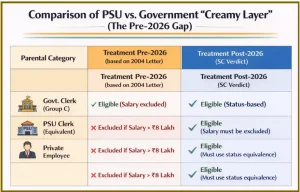 Government’s Stand Overruled: The Union Government had argued that in the absence of a formal “equivalence” between Public Sector Undertaking (PSU) posts and government ranks, the total salary income should be the deciding factor.
-
- A PSU refers to a government-owned corporate entity where the majority stake is held by the Union or State Government. These enterprises operate in commercial, industrial, or service sectors while pursuing both economic and strategic objectives of the state.
- Upholding High Court Judgments: The Supreme Court dismissed the government’s appeals, upholding previous pro-candidate rulings from the Madras High Court, Kerala High Court, and Delhi High Court.
Key Highlights of the Judgment
- Primacy of Status over Salary: The Court noted that creamy layer exclusion is “status-based rather than purely income-based,” reflecting the constitutional understanding that advancement in the service hierarchy denotes social progression.
- Exclusion of Salary from Wealth Test: The Bench clarified that the framework for exclusion explicitly mandates that parental income from salaries and agricultural land must be kept out while applying the income/wealth test.
- Unconstitutionality of Unequal Treatment: The judgment stated that any interpretation resulting in unequal treatment of similarly placed candidates (Government vs. PSU) is “constitutionally impermissible.”
Judicial Logic- The “Doctrine of Hostile Discrimination”
- Arbitrary Classification: The Supreme Court (SC) invalidated the 2004 Clarificatory Letter, ruling that it created an “Unintelligible Differentia.”
- By imposing an income-based filter on PSU/Private sector employees while exempting status-equivalent government employees, the State engaged in “Hostile Discrimination,” violating the Right to Equality (Article 14).
- Primacy of Occupational Status: The Bench reaffirmed that the “Income/Wealth Test” (the ₹8 lakh threshold) is merely a subsidiary criterion.
- It cannot supersede the “Status-Based Test.” If a parent’s professional position is not categorized as Group A or B, their salary is legally immaterial and cannot be mechanically aggregated to deny benefits.
- Conceptual Divergence (OBC vs. EWS): The Court reprimanded the executive for conflating Social Backwardness with Economic Deprivation.
- Unlike the EWS quota, which is a poverty-alleviation tool, OBC reservation is a mechanism for Social Justice and Representation. Therefore, applying a “Total Income” logic to OBCs is constitutionally flawed.
The DoPT OM of 1993 vs. 2004 Clarification
- The Foundational 1993 Office Memorandum (OM): This charter established a structured mechanism based on social status, occupation, and income, specifically excluding salary from the wealth test calculation.
- The Deviant 2004 Clarificatory Letter: In 2004, the Department of Personnel and Training (DoPT) issued a letter directing that the salary income of parents in PSUs and the private sector should be included, leading to the current legal conflict.
- Judicial Restoration of Original Intent: The Court ruled that the 2004 letter incorrectly changed the interpretation and “defeats the constitutional objective” laid down by the Mandal Verdict.
Impact of the DoPT Clarification
- Hostile Discrimination Created: The 2004 interpretation led to “Hostile Discrimination” where a government clerk’s child was eligible for reservation, but a PSU clerk’s child earning the same salary was not.
- Mechanical Aggregation Rejected: The Court held that salary income cannot be mechanically aggregated to determine backwardness, as a high salary does not always equate to high social status in the private or PSU sectors.
- Exclusion of Deserving Candidates: For over a decade, this clarification resulted in the rejection of meritous candidates who had otherwise qualified for India’s premier civil services.
|
About Reservation
- Reservation is a policy for ensuring Equality and Social Justice which aims to enable special provisions for the advancement of socially and educationally backward classes or OBC, Scheduled Castes (SC) and Scheduled Tribes (ST) in education and government jobs.
Constitutional Basis for Reservations in India
- Articles 15(4) and 16(4): They guarantee equality to all citizens in any policy of the government and public employment respectively.
- Reservations for SC and ST are fixed at 15% and 7.5% respectively, in jobs, educational institutions and public sector undertakings (PSU) at the central level
- OBC Reservation: It was introduced in 1990, by the then V. P. Singh government based on Mandal Commission (1980) recommendations.
- A 27% reservation for OBC was implemented in central government employment
- 2005: Reservation was enabled for OBC, SC and ST in educational institutions including private institutions.
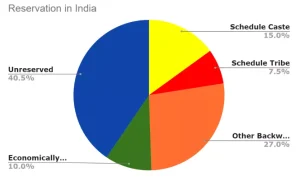 103rd Constitution Amendment Act 2019: 10% reservation was enabled for the Economically Weaker Sections (EWS) among the General category.
- Constitutionalization of NCBC (102nd Amendment, 2018): This landmark amendment inserted Article 338B, elevating the National Commission for Backward Classes (NCBC) to a constitutional body. It also introduced Article 342A, centralizing the power to notify Socially and Educationally Backward Classes (SEBCs).
- Restoration of Federal Balance (127th Amendment, 2021): In response to the Maratha Reservation (Jaishri Laxmanrao Patil) verdict, Parliament enacted this amendment to insert Article 342A(3). This explicitly restored the plenary power of States and Union Territories to identify and maintain their own State OBC Lists, preserving the federal spirit of the Constitution.
- Procedural Safeguards (Article 340): The Justice Rohini Commission was constituted under this Article to examine the Sub-categorization of OBCs, ensuring that the 27% reservation is not monopolized by dominant castes but filtered down to the most marginalized layers.
Federal Structure of OBC Lists:
- In India, separate lists of OBCs are maintained by the Union Government and the State Governments.
- Central OBC List: Maintained by the Union Government for the purpose of reservations in central government jobs and institutions.
- State OBC Lists: Maintained independently by individual states for reservation in state government employment and educational institutions.
|
Other Backward Class and The Creamy Layer Concept
- About Other Backward Class: OBC is a collective term used to denote castes that are educationally or socially backward.
- Occupational basis of Identification: The OBCs are generally identified on the basis of their occupation,
- Example: Cultivation of own land, tenant farming, pottery, agriculture labour, cultivation and selling of vegetables, fruits and flowers, oilseeds crushing, cattle-rearing, washing clothes, carpentry, blacksmith, stone-cutting, etc.
- Population Share: The Mandal Commission report of 1980 estimated OBCs population, including both Hindus and non-Hindus, at around 52 per cent of the total population and identified 3,743 castes and communities as OBCs.
- As per the National Sample Survey Organisation, the OBC population was at 41 per cent in 2006.
- Constitutional Safeguards:
- Article 15(4): It says nothing in this article shall prevent the State from making any special provision for the advancement of any socially and educationally backward classes of citizens.
- Article 16(4): It allows the state to make any provision for the reservation of appointments or posts in favour of any backward class of citizens which, in the opinion of the State, is not adequately represented in the services under the State.
- Article 340: It provides for the appointment of a National Commission for Backward Classes to investigate the conditions of and the difficulties faced by the socially and educationally backward classes and to make appropriate recommendations.
- OBC Reservation: It was introduced in 1990 by the then V. P. Singh government based on Second Backward Classes Commission (Mandal Commission) recommendations.
- A 27% reservation for OBC was implemented in central government employment
- Indra Sawhney case (1992): The 27% reservation for OBC was upheld by the Supreme Court with the opinion that ‘caste is a determinant of class in the Indian context’, but it was conditional and subject to the exclusion of the creamy layer.
- A 50% cap was also fixed for reservation unless there are exceptional circumstances to uphold the basic structure of equality.
Creamy Layer Concept
- The Department of Personnel and Training (DoPT) has listed various categories of people of certain rank/status/income whose children cannot avail the benefit of OBC reservation.
- Recommendation: The Justice Ram Nandan Prasad Committee (1993) recommendation was taken into consideration for identifying a person as part of the creamy layer.
- Criterion:
- Parental Income: It is determined by the position/income of an applicant’s parents alone.
- Non-Governmental: For those not in government, the current threshold is an income of Rs 8 lakh per year (excluding income from salary and agricultural income) in the last three consecutive financial years.
- Group A/B Government Service:
- Either of the parents entered government service (centre or State) as Group A/Class I officer
- Both the parents entered as Group B/Class II officers
- Father, who was recruited in Group B/Class II post and promoted to Group A/Class I before 40 years of age.
- Either of the parents is employed in a managerial position in PSUs
- Either of the parents holding constitutional posts.
- Children of a Colonel or higher-ranked officer in the Army, and children of officers of similar ranks in the Navy and Air Force.
| Reservation categories in India |
| Feature |
OBC: Non-Creamy Layer |
OBC: Creamy Layer |
EWS |
| Core Objective |
- Social Representation & Vertical Mobility.
|
- Prevention of Cornering of benefits by the “advanced.”
|
- Economic Support for the General Category.
|
| Parental Status |
- Parents are Group C or D (or Group B promoted after age 40).
|
- Either parent is Group A; both are Group B; or Constitutional Posts.
|
- No specific “Status” test; purely Asset & Income based.
|
| Income Limit |
- < ₹8 Lakh (excluding Salary & Agriculture).
|
- > ₹8 Lakh (excluding Salary & Agriculture).
|
- < ₹8 Lakh (Including Salary & Agriculture).
|
| The “Salary” Rule |
- Salary is NEVER added to the income test.
|
- Salary is NEVER added to the income test.
|
- Salary is the PRIMARY component of income.
|
| Asset Criteria |
- None.
- (Focus is on social/occupational rank).
|
- None.
- (Focus is on social/occupational rank).
|
- Includes Residential Flat/Plot size & Agricultural Land limits.
|
| Nature of Quota |
- Vertical Reservation (27%).
|
- Zero Reservation (treated as General).
|
- Vertical Reservation (10%).
|
Significance of the SC Ruling
- Strengthening Equality Jurisprudence: The decision reinforces the Constitutional Doctrine of Equality by preventing the Executive from using “clarificatory letters” to override fundamental policies.
- Clarification of Eligibility: It provides absolute clarity that occupational status (Group A, B, C, D) is the primary indicator of social progression, not the paycheck.
- Relief for Past Candidates: The ruling restores the rights of candidates from the 2016-2025 batches who were unfairly denied their service allocations.
Significance of the Creamy Layer principle in Indian Reservation Policy
- Realizing “Substantive Equality”: The primary significance is moving from formal equality to substantive equality.
- By excluding those who have already “arrived” socially and economically, the state ensures that the 27% OBC quota is not a hollow promise but a practical tool that reaches the genuinely backward who still face systemic hurdles.
- Preventing “Elite Capture”: Without the Creamy Layer filter, there is a high risk of monopolization.
- Socially advanced families within a backward class—who have better access to quality coaching, nutrition, and social capital—would naturally corner all the seats.
- The filter forces the benefits to “percolate down” to the most marginalized layers of the community.
- Upholding the “Social Backwardness” Test: Reservation in India is intended to remedy Social Stigma, not just poverty.
- The Creamy Layer significance lies in recognizing that once a family achieves a certain Status (like a Group A officer), they are deemed to have crossed the threshold of social backwardness.
- At this point, they are “as forward as any forward class member,” making their continued reservation constitutionally unjust.
- Maintaining Administrative Efficiency (Article 335): The Supreme Court has noted that the Creamy Layer helps balance Social Justice with Administrative Efficiency.
- By ensuring that those who have reached a high level of advancement compete in the General Category, the state maintains a standard of merit while simultaneously providing a protective umbrella to the truly disadvantaged.
- Preserving the “Reasonableness” of Classification: Under Article 14, any classification by the state must be reasonable and have a rational nexus with the objective.
- The Creamy Layer provides this rationality. It prevents the reservation policy from becoming an “infinite privilege,” ensuring it remains a temporary and targeted measure as envisioned by the Constitution’s makers.
- Curbing “Hostile Discrimination”: The 2026 verdict added a new layer of significance- Horizontal Equity.
- It ensures that two people in the same social strata (e.g., a government clerk and a PSU clerk) are treated equally. By striking down the “Salary-only” test for PSU wards, the Court ensured the law does not discriminate between different sectors of employment.
- Preventing the Dilution of the “Backward” Label: If the “Creamy” sections are allowed to stay in the quota, the entire category of “Other Backward Classes” loses its descriptive integrity.
- The filter keeps the category homogenous in its need for state support, ensuring that the term “backward” remains a true reflection of the candidates’ lived reality.
Challenges that need to be Tackled
- Determining Post Equivalence: A major administrative challenge remains the Equivalence of Posts, as the government has struggled to match PSU job categories with their Central Government counterparts.
- The Data Gap: There is an urgent need for an updated Caste Census or Socio-Economic data to accurately identify which sections of the Other Backward Classes have truly advanced.
- Administrative Burden: Integrating previously rejected candidates into the current civil service hierarchy without disrupting existing seniority lists will be a complex task for the MoPT.
- The Equivalence Vacuum: A primary catalyst for this litigation was the Executive’s Inertia in notifying the Equivalence of Posts. Despite recommendations from the Justice B.P. Jeevan Reddy Committee, the failure to map PSU/Banking roles to Civil Service Grades (Group A to D) led to interpretative chaos.
- Inflation-Adjusted Exclusion: The Creamy Layer ceiling is mandated for revision every three years. However, the threshold has remained stagnant at ₹8 lakh since 2017. This failure to account for Real Income vs. Nominal Income has resulted in “Exclusionary Drift,” where deserving candidates are disqualified due to inflationary pressures rather than social progression.
Way Forward
- Expediting Equivalence Mapping: The Union Government must immediately approve the Draft Cabinet Note to formally map PSU and private sector roles to government grades (Group A to D).
- Creation of Supernumerary Posts: Authorities have been directed to create Supernumerary (Extra) Posts to accommodate candidates who were wrongly classified as Creamy Layer.
- Time-Bound Reconsideration: The Supreme Court has mandated that the claims of all affected candidates must be reconsidered and processed within a six-month period.
- Institutionalizing Post-Equivalence: The Union Government must fast-track a Comprehensive Mapping Matrix to align all Autonomous Bodies, PSUs, and Private Sector hierarchies with the Standardized Service Grades of the Central Government.
- Dynamic Income Indexing: To prevent procedural unfairness, the Department of Personnel and Training (DoPT) should implement an Automated Indexing Mechanism for the income limit, ensuring it stays consistent with Consumer Price Index (CPI) fluctuations.
Conclusion
The Supreme Court has re-affirmed that Social Justice in India is a matter of status and dignity, rather than a simple financial calculation. By striking down the discriminatory 2004 interpretation, the Court has ensured that the OBC reservation system remains a fair and rational tool for uplifting the Socially and Educationally Backward Classes, as envisioned by the Mandal Commission and the Constitution of India.


 13 Mar 2026








.png)






 Current Affairs




 GS Foundation
 Optional Course
 Combo Courses
 Degree Program