Scheme to Promote Manufacturing of Sintered Rare Earth Permanent Magnets (REPM)

29 Dec 2025

Scheme to Promote Manufacturing of Sintered Rare Earth Permanent Magnets (REPM)

The Government of India has approved the ‘Scheme to Promote Manufacturing of Sintered Rare Earth Permanent Magnets’ (REPM). 
About the REPM Scheme

Rare Earth Permanent Magnets

  • Launch and Nodal Ministry: By the Ministry of Heavy Industries in December 2025. 
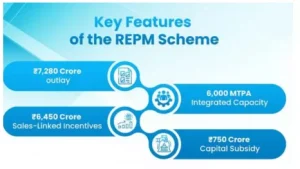
  • Financial Outlay: Total ₹7,280 crore.
  • Objective: To establish an integrated domestic manufacturing ecosystem for sintered Rare Earth Permanent Magnets (primarily NdFeB type), 
    • Reducing import dependence (currently nearly 100%, largely from China) and 
    • Enhancing self-reliance (Atmanirbhar Bharat).
  • Target Capacity: 6,000 Metric Tons per Annum (MTPA) of integrated REPM production.
  • Duration: 7 years per beneficiary (2-year gestation period for setup and  5 years for incentives).
  • Demand Context: India’s REPM consumption expected to double by 2030 (from 2025 levels) due to growth in EVs, renewables, and electronics. 
    • Current annual demand ~4,000–5,000 tonnes, fully imported.

India’s Rare Earth Mineral Resource Base

  • India possesses a substantial reserve of rare-earth minerals, found in various regions:
  • Primary Locations: Coastal Beach Sands & Red Sands: Andhra Pradesh, Odisha, Tamil Nadu, Kerala, Gujarat, Maharashtra.
  • Inland Alluvium: West Bengal, Jharkhand.

About Rare-Earth Permanent Magnets

  • Rare-earth permanent magnets are the strongest type of permanent magnets commercially available. 
  • They are made from alloys of rare-earth elements (a group of 17 metals on the periodic table) combined with other elements like iron and boron.
  • Sintered Rare Earth Permanent Magnets: Sintered REPMs are a subcategory of REPMs.
    • Sintered REPMs are made using the sintering process, where fine rare-earth alloy powders are pressed and heated below melting point to form a solid, dense magnet.
    • They provide the highest magnetic strength among all permanent magnets.

Most Common Types of Sintered REPM

  1. Neodymium (NdFeB) Magnets: Made from Neodymium, Iron, and Boron. The most powerful and widely used type. (This is the primary focus of India’s REPM scheme).
  2. Samarium Cobalt (SmCo) Magnets: Made from Samarium and Cobalt. Slightly less powerful than NdFeB but perform better at high temperatures and are highly corrosion-resistant.

Key Properties of REPM

  • Extremely High Magnetic Strength: They produce the strongest magnetic field for their size. A small rare-earth magnet can lift hundreds of times its own weight.
  • High Energy Product: They store a large amount of magnetic energy. This is the most important metric for their performance.
  • Compactness & Efficiency: Their strength allows for the miniaturization of devices (e.g., smaller, more powerful motors in headphones or EVs).

Key Applications of REPM

  • REPMs are critical in modern technology, especially for miniaturization, efficiency, and green energy:
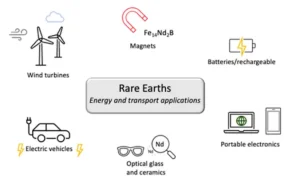
    • Electric Vehicles (EVs): Used in traction motors for efficient power conversion.
    • Wind Turbines: In direct-drive generators for renewable energy.
    • Consumer Electronics: Hard drives, speakers, headphones, smartphones.
    • Other: MRI machines, aerospace, defense, high-efficiency motors, and sensors.

Check Out UPSC CSE Books

Visit PW Store

online store 1

The Global Supply Chain Challenge

  • Dominant Producer: China currently controls ~90% of the global supply chain—from mining and processing to magnet manufacturing.
  • Strategic Vulnerability: This concentration creates a major supply chain risk for other nations, especially for critical sectors like defense and green energy. This is the core issue India’s REPM scheme aims to address.

Rare Earth Minerals

Rare Earth Permanent Magnets

  • Definition: Rare earth minerals are a group of 17 chemically similar elements used in high-technology, clean energy, and strategic industries.
  • Constituents: They include 15 Lanthanides (La–Lu) plus Scandium (Sc) and Yttrium (Y).
  • Key Properties: Possess unique magnetic, luminescent, and electrochemical properties, making them irreplaceable in advanced technologies.
  • Major Minerals: Monazite, Bastnäsite, Xenotime are the principal rare earth–bearing minerals.

Why Are They “Rare Earth”?

  • Many of these elements are actually relatively abundant in the Earth’s crust, but they are rarely found in concentrated, economically mineable deposits.
  • Historically, they were discovered in oxide forms, which were called “earths.”

Need help preparing for UPSC or State PSCs?

Connect with our experts to get free counselling & start preparing

Aiming for UPSC?

Download Our App

      
Quick Revise Now !
AVAILABLE FOR DOWNLOAD SOON
UDAAN PRELIMS WALLAH
Comprehensive coverage with a concise format
Integration of PYQ within the booklet
Designed as per recent trends of Prelims questions
हिंदी में भी उपलब्ध
Quick Revise Now !
UDAAN PRELIMS WALLAH
Comprehensive coverage with a concise format
Integration of PYQ within the booklet
Designed as per recent trends of Prelims questions
हिंदी में भी उपलब्ध

<div class="new-fform">


    </div>

    Subscribe our Newsletter
    Sign up now for our exclusive newsletter and be the first to know about our latest Initiatives, Quality Content, and much more.
    *Promise! We won't spam you.
    Yes! I want to Subscribe.