Sodium-ion Batteries: India’s Strategic Alternative to Lithium-ion Technology

7 Feb 2026

Sodium-ion Batteries: India’s Strategic Alternative to Lithium-ion Technology

Amid concerns over lithium import dependence and supply-chain risks, India is rethinking its battery strategy, with sodium-ion batteries emerging as a safer, strategic alternative.

Why India needs Sodium-ion Batteries

Sodium-ion Batteries

  • Reduces dependence on imported critical minerals like lithium, cobalt and nickel.
  • Enhances energy security through use of abundant, geographically diversified sodium.
  • Supports cost-effective grid-scale storage and domestic manufacturing.

About Sodium-ion Batteries

  • Sodium-ion batteries (SiBs) are rechargeable batteries that use sodium ions (Na⁺) as charge carriers instead of lithium ions.
  • They belong to the same “rocking-chair” battery family as lithium-ion cells but rely on more abundant raw materials.
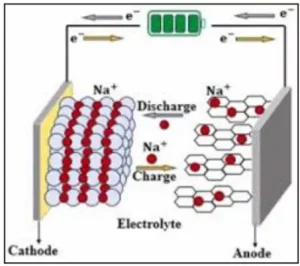
    • A “rocking-chair” battery is a rechargeable system where ions (Li / Na ion ) “rock” or shuttle back and forth between the cathode and anode through an electrolyte during charging and discharging cycles.
  • Working of Sodium-ion Batteries
    • Charging: Sodium ions move from cathode to anode through the electrolyte; electrons flow via the external circuit.
    • Discharging: Sodium ions migrate back to the cathode, releasing electrical energy.
    • Key design feature: Aluminium is used as the current collector on both electrodes, unlike lithium-ion batteries which require copper on the anode side.
  • Applications
    • Grid-scale energy storage for renewable energy integration.
    • Two and three wheeler EVs where ultra-high energy density is not critical.
    • Stationary storage for households, telecom towers, and industrial backup.
    • Energy storage systems (ESS) for load balancing and peak shaving.
  • Limitations
    • Lower energy density compared to lithium-ion batteries, limiting long-range EV use.
    • Volumetric energy density still trails advanced lithium chemistries.
    • Ecosystem and commercial deployment are at an early stage.

Lithium ion vs Sodium ion Batteries

Aspect Lithium-ion Battery Sodium-ion Battery
Charge carrier Lithium ions (Li⁺) Sodium ions (Na⁺)
Raw material availability Scarce, geographically concentrated Abundant, widely available
Current collector Copper (anode), aluminium (cathode) Aluminium on both electrodes
Energy density Higher (suitable for long-range EVs) Lower (better for stationary use)
Safety & transport Higher thermal runaway risk

State of charge (SOC)  limits

Safer; can be stored at 0% SOC

Check Out UPSC CSE Books

Visit PW Store

online store 1

Conclusion

By combining safety, material abundance, manufacturing compatibility and strategic resilience, sodium-ion batteries can complement lithium-ion systems and strengthen India’s long-term energy and industrial security.

Follow Us

Enroll in SRIJAN Prelims Crash Course

Need help preparing for UPSC or State PSCs?

Connect with our experts to get free counselling & start preparing

Aiming for UPSC?

Download Our App

      
Quick Revise Now !
AVAILABLE FOR DOWNLOAD SOON
UDAAN PRELIMS WALLAH
Comprehensive coverage with a concise format
Integration of PYQ within the booklet
Designed as per recent trends of Prelims questions
हिंदी में भी उपलब्ध
Quick Revise Now !
UDAAN PRELIMS WALLAH
Comprehensive coverage with a concise format
Integration of PYQ within the booklet
Designed as per recent trends of Prelims questions
हिंदी में भी उपलब्ध

<div class="new-fform">


    </div>

    Subscribe our Newsletter
    Sign up now for our exclusive newsletter and be the first to know about our latest Initiatives, Quality Content, and much more.
    *Promise! We won't spam you.
    Yes! I want to Subscribe.