The rapid rise of private space actors like SpaceX has led to orbital congestion, while weak governance, lack of monitoring, and reliance on pre-launch commitments under frameworks like the Outer Space Treaty expose gaps in space sustainability and accountability.
About Space Governance
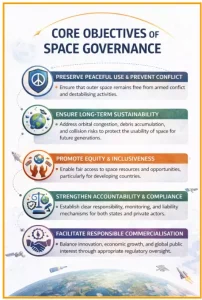
- Concept: Space governance refers to the comprehensive framework of international treaties, customary norms, institutional mechanisms, and domestic regulations that guide and regulate human activities in outer space.
- It seeks to ensure that space is used for peaceful purposes, collective benefit, and long-term sustainability, while assigning responsibility and liability to states for both governmental and private actors, as codified in the Outer Space Treaty.
- Scope: The scope of space governance has expanded from a state-centric exploration regime to a multi-actor, multi-dimensional domain, covering:
- Commercial and private participation: Rapid growth of satellite constellations, launch services, and space-based industries led by firms like SpaceX.
- Strategic and security dimensions: Increasing use of space for military, surveillance, and dual-use purposes, raising concerns over weaponisation.
- Environmental sustainability: Management of space debris, orbital congestion, and collision risks, treating orbital space as a finite ecological resource.
- Resource utilisation and emerging frontiers: Governance of asteroid mining, lunar exploration, and extraterrestrial resource extraction.
- Communication and data governance: Regulation of orbital slots, radio spectrum, and satellite-based global services.
- Thus, space governance spans legal, technological, economic, environmental, and geopolitical dimensions.
- Key Features:
- Global Commons Orientation: Outer space is recognised as a non-sovereign domain, not subject to national appropriation, ensuring shared access.
- State Responsibility and Authorization: States are internationally accountable for all national space activities, including those conducted by private entities under their jurisdiction.
- Liability and Risk Allocation Framework: Mechanisms exist for compensation in case of damage caused by space objects, as elaborated in the Liability Convention.
- Transparency through Registration: Space objects must be registered and notified internationally under the Registration Convention to enhance traceability.
- Predominance of Soft Law: Much of contemporary governance—especially on space debris mitigation and sustainability—relies on non-binding guidelines and voluntary compliance.
- Fragmented and Decentralised Structure: Governance is dispersed across multiple bodies such as the United Nations Committee on the Peaceful Uses of Outer Space, with no centralised enforcement authority, leading to regulatory gaps.
UPSC Online Coaching
Framework of Space Governance
The framework of space governance comprises a multi-layered architecture of legal norms, institutional mechanisms, regulatory systems, and emerging governance tools, evolving from a state-centric treaty regime to a fragmented, multi-actor system.
- Legal Foundations (Treaty-Based Framework): The legal core of space governance is based on UN-led treaties, which establish foundational principles governing outer space activities:
- The Outer Space Treaty (1967) defines outer space as a non-appropriable global commons, mandating peaceful use, freedom of exploration, and state responsibility for both governmental and non-governmental activities.
- Liability Convention (1972) establishes a dual liability regime, ensuring accountability for damage caused by space objects.
- Registration Convention ensures transparency and traceability through mandatory registration of space objects.
- However, these treaties remain broad, state-centric, and weakly enforceable, limiting their effectiveness in a rapidly evolving space ecosystem.
- Legal Status of Outer Space: Outer space is recognised as a global commons under international law, characterised by:
- Non-appropriation principle (no sovereignty claims)
- Use for the benefit of all humankind
- Freedom of exploration and access
- This normative foundation ensures equity but faces challenges from commercialisation and strategic competition.
- Institutional and Multilateral Architecture: Space governance is facilitated through international organisations and coordination mechanisms:
 The United Nations Committee on the Peaceful Uses of Outer Space serves as the primary norm-setting body, developing consensus-based guidelines such as the LTS framework.
- The United Nations Office for Outer Space Affairs supports treaty implementation, capacity building, and international cooperation.
- The International Telecommunication Union regulates radio spectrum and orbital slot allocation, critical for satellite operations.
- The architecture remains fragmented and consensus-driven, with no central enforcement authority.
- Soft Law and Norm-Based Governance: A significant portion of space governance operates through non-binding instruments and voluntary guidelines:
- Instruments such as the UN Space Debris Mitigation Guidelines and Long-term Sustainability Guidelines provide operational best practices.
- These include norms on debris mitigation, collision avoidance, and data sharing.
- Their voluntary nature leads to uneven compliance, creating gaps in accountability and enforcement.
- National Regulatory and Licensing Frameworks: States operationalise international obligations through domestic legal regimes, which:
- Authorise and supervise launches and satellite operations
- Impose technical, safety, and end-of-life disposal norms
- Regulate private sector participation under national jurisdiction
- Divergence in national regulations leads to regulatory fragmentation and forum shopping, weakening global coherence.
- Transition to a Multi-Actor Governance System: Space governance has evolved into a multi-stakeholder domain, involving:
- Private corporations
- Commercial launch providers
- Emerging spacefaring nations
- This shift increases complexity, regulatory gaps, and the need for coordinated governance mechanisms.
- Emerging Governance Mechanisms: New governance tools are evolving to address contemporary challenges:
- Space Traffic Management (STM): Development of systems for real-time coordination and collision avoidance in congested orbits.
- Space Situational Awareness (SSA): Enhancing tracking, monitoring, and data sharing for orbital objects.
- Environmental and Ethical Frameworks: Incorporating principles of sustainability, precaution, and intergenerational equity into governance norms.
Need for Governing Space
- Orbital Debris Crisis and Collision Risks: As per the European Space Agency (ESA) Space Environment Report 2025, over 40,000 objects are actively tracked, while an estimated 130 million debris fragments exist in orbit—many too small to track but capable of catastrophic damage.
- The cascading collision effect (Kessler Syndrome) could make vital orbits unusable.
- Environmental Sustainability and Emerging Externalities: The surge in satellite constellations has created light pollution affecting up to 40–96% of telescope observations, alongside concerns of atmospheric pollution from re-entry and rocket emissions, as highlighted in recent NASA-led studies.
- This necessitates treating space as a finite ecological resource.
- Rising Congestion and Space Traffic Management (STM) Needs: With record launch rates (e.g., launches occurring every ~2 days in 2025, largely driven by private players), orbital regions—especially Low Earth Orbit (LEO)—are becoming increasingly crowded.
- This requires robust Space Traffic Management (STM) and Space Situational Awareness (SSA) frameworks.
- Security, Militarisation, and Strategic Stability: The proliferation of dual-use technologies and Anti-Satellite (ASAT) tests (e.g., Russia’s Nudol test) increases debris and undermines strategic trust, raising risks of conflict spillover into outer space.
- Equitable Access and Global Commons Concerns: Limited orbital slots and radio spectrum, coordinated by the International Telecommunication Union, risk being dominated by a few advanced nations and corporations, potentially marginalising Global South and late entrants.
- Accountability, Liability, and Governance Deficit: Existing frameworks lack post-launch monitoring and verification mechanisms, with regulators often relying on self-declared compliance by operators, leading to gaps in liability attribution and enforcement.
- Managing Rapid Commercialisation of Space: The expansion of private actors such as SpaceX and mega-constellations has transformed space into a high-value economic domain, necessitating governance to balance innovation, competition, and long-term sustainability.
India’s Initiatives and Actions in Space Governance
- Institutional Mechanisms:
- Shift from Mission-Oriented to Governance Approach: India has gradually transitioned from a purely scientific and mission-oriented space programme to a more governance-driven approach centred on Space Situational Awareness (SSA), reflecting the need for continuous monitoring of orbital activities.
- IS4OM as the Nodal SSA Centre: In this direction, IS4OM (ISRO System for Safe and Sustainable Space Operations Management), established in 2022, functions as the nodal centre for tracking orbital debris, conducting Collision Avoidance Analysis (COLA), and coordinating with global agencies to protect Indian space assets.
- Project NETRA for Indigenous Tracking Capability: Complementing this, Project NETRA (Network for Space Object Tracking and Analysis) is being developed as an indigenous early-warning system using radars and telescopes, reducing dependence on foreign systems such as United States Space Command.
- Policy and Regulatory Initiatives:
- Alignment with Global Norms and Strategic Autonomy: India is aligning its domestic framework with emerging global standards while maintaining strategic and regulatory autonomy, signalling a proactive governance approach.
- Debris Free Space Mission (DFSM) 2030: The Debris Free Space Mission (DFSM) 2030 reflects India’s commitment to achieving zero-debris generation in all future public and private missions.
- Guidelines and Regulatory Oversight via IN-SPACe: The National Space Debris Mitigation Guidelines, based on standards of United Nations Committee on the Peaceful Uses of Outer Space and Inter-Agency Space Debris Coordination Committee, incorporate Post-Mission Disposal (PMD) norms.
- Additionally, IN-SPACe (Indian National Space Promotion and Authorization Centre) acts as a single-window regulator, integrating licensing, sustainability, and compliance requirements.
- Technological Innovations for Debris Mitigation and Sustainable Operations:
- Shift Towards Active Debris Mitigation Technologies: India is moving beyond passive monitoring towards active technological solutions for ensuring long-term orbital sustainability.
- SpaDeX and Future Active Debris Removal (ADR): The SpaDeX (Space Docking Experiment) demonstrates autonomous rendezvous and docking capabilities, forming the technological foundation for Active Debris Removal (ADR) and on-orbit servicing.
- PS4 Orbital Experimental Module (POEM) Innovation: The PS4 Orbital Experimental Module (POEM) showcases an innovative approach by repurposing the spent PSLV stage into a functional orbital platform, thereby reducing debris and enhancing resource efficiency.
- Capacity Building and Indigenous Capability Development:
- Strengthening Indigenous SSA Capabilities: India is investing in domestic tracking infrastructure, SSA systems, and real-time orbital analytics, strengthening its independent monitoring capacity.
- Balancing Private Participation with Regulation: Simultaneously, India is encouraging private-sector participation under regulatory oversight, ensuring that commercial expansion aligns with safety, accountability, and sustainability norms.
- Global Leadership and Norm Entrepreneurship:
- Active Role in Multilateral Governance Platforms: India is emerging as a norm entrepreneur, actively participating in platforms such as the United Nations Committee on the Peaceful Uses of Outer Space and contributing to frameworks like the Long-Term Sustainability (LTS) Guidelines.
- Shaping Inclusive and Forward-Looking Norms: Its approach seeks not just compliance but also to shape global norms in a manner that is balanced, inclusive, and future-oriented.
- Global South Perspective and Equity-Based Advocacy:
-
- Advocating Equity in Space Governance: India consistently emphasises equitable and inclusive governance, especially for developing and emerging spacefaring nations.
- Common but Differentiated Responsibilities (CBDR) Approach: It argues that historically dominant space powers should bear greater responsibility for debris mitigation, reflecting principles of fairness and justice.
- Promoting Access, Capacity Building, and Technology Sharing: India advocates for fair access to orbital resources, capacity-building support, and technology-sharing mechanisms, ensuring that the benefits of space are widely distributed.
|
Click to Know UPSC OnlyIAS Coaching Centres
Challenges that Need to be Tackled
- Weak Enforcement and Verification Deficit: There is no central global authority to conduct on-orbit audits or ensure compliance, leading to reliance on self-certification by satellite operators.
- Existing frameworks like the Outer Space Treaty lack binding enforcement and monitoring mechanisms, creating a significant governance gap.
- Orbital Congestion, Space Debris, and Orbital Differentiation: The surge in satellite launches—especially mega-constellations—has intensified collision risks and debris accumulation.
- The cascading collision effect, known as the Kessler Syndrome, threatens orbital sustainability. Challenges differ across orbits—Low Earth Orbit (LEO) faces severe congestion (e.g., Starlink constellation), while Geostationary Orbit (GEO) is constrained by limited orbital slots and spectrum scarcity.
- Absence of Global Space Traffic Management (STM) and Data Asymmetry: There is no universally accepted Space Traffic Management (STM) framework for real-time coordination and collision avoidance.
- Further, access to Space Situational Awareness (SSA) data is often restricted due to commercial confidentiality and national security concerns, leading to information asymmetry and higher risks.
- Fragmented Regulations and Regulatory Arbitrage: Divergent national licensing regimes allow operators to engage in “forum shopping”, registering in jurisdictions with lenient regulatory standards to bypass stringent sustainability norms, thereby weakening global governance coherence.
- Liability, Accountability, and Attribution Challenges: It remains difficult to identify the origin of debris and establish fault, particularly for small or untracked fragments, limiting the effectiveness of liability frameworks such as the Liability Convention.
- Militarisation and Unregulated Commercialisation: The rise of dual-use technologies and Anti-Satellite (ASAT) tests (e.g., Russia’s 2021 Nudol test) increases debris and strategic tensions. Simultaneously, rapid expansion of private actors such as SpaceX has led to orbital crowding, market concentration, and sustainability concerns without adequate global oversight.
Way Forward
- Establish a Binding Global Governance Framework: Move beyond voluntary norms to develop legally binding international rules under platforms like the United Nations Committee on the Peaceful Uses of Outer Space, including standardised debris mitigation thresholds, compliance obligations, and sanctions for violations.
- Create a Global Verification and Monitoring Mechanism: Set up an independent international system for on-orbit audits and compliance verification, leveraging Space Situational Awareness (SSA) networks to track adherence to commitments such as end-of-life disposal and collision avoidance.
- Develop a Comprehensive Space Traffic Management (STM) Regime: Establish a globally coordinated Space Traffic Management (STM) framework with real-time data sharing, collision avoidance protocols, and mandatory coordination mechanisms to manage increasing orbital congestion.
- Harmonise National Regulations and Prevent Regulatory Arbitrage: Standardise licensing norms, liability provisions, and sustainability requirements across countries to prevent forum shopping and ensure a level playing field for all operators.
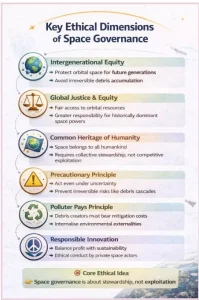
- Strengthen Liability and Accountability Mechanisms: Update existing frameworks like the Liability Convention to address cumulative harm, small debris attribution, and shared responsibility, possibly through insurance models and “polluter pays” principles.
- Promote Transparency and Open Data Sharing: Encourage mandatory sharing of SSA data among states and private actors, while balancing security concerns, to reduce information asymmetry and enhance collision avoidance capabilities.
- Integrate Environmental and Ethical Principles: Embed principles such as precaution, sustainability, and intergenerational equity into space governance, treating orbital space as a finite ecological resource requiring stewardship.
- Regulate Commercial Expansion and Mega-Constellations: Introduce caps, zoning mechanisms, and stricter approval criteria for large satellite constellations by companies like SpaceX to prevent overcrowding and ensure equitable access.
- Strengthen India’s Leadership Role: As India expands its space capabilities, it should develop robust domestic legislation, promote responsible licensing practices, and lead Global South advocacy for equitable and sustainable space governance.
Conclusion
The increasing congestion of Earth’s orbits is a direct consequence of the mismatch between rapid technological advancement and slow institutional adaptation. A paradigm shift toward anticipatory and enforceable governance is essential. The sustainability of space depends on the ability of the international community to move from rhetorical commitments to concrete, accountable action that preserves the orbital environment for future generations.


 2 Apr 2026





.png)






 Current Affairs




 GS Foundation
 Optional Course
 Combo Courses
 Degree Program