Sponge-Associated Microbes in Tackling Metal Pollution

22 Dec 2025

Sponge-Associated Microbes in Tackling Metal Pollution

A recent study by scientists from the Bose Institute (an autonomous institute of the Department of Science and Technology)  found that freshwater sponges from the Sundarban delta can act as effective bioindicators of toxic metal pollution.
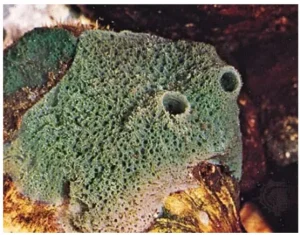
What Are Freshwater Sponges?

Sponge-Associated Microbes

  • Freshwater sponges are simple, multicellular animals (Phylum Porifera) that live attached to solid surfaces in lakes, slow-moving rivers, streams, and canals. 
  • They are filter feeders, meaning they pump large volumes of water through their bodies to capture tiny food particles like bacteria, protozoa, and organic debris.
  • Their ability to host diverse microbial communities makes them ecologically significant.

Key Characteristics & Biology of Sponges

  • No True Tissues or Organs: Their bodies are organized as a colony of specialized cells working together.
  • Porous Body: The name “Porifera” means “pore-bearer.” Their body is a network of channels and chambers.
  • Skeleton Made of Spicules: Unlike sea sponges, which often have fibrous spongin, freshwater sponges have a supporting skeleton made of microscopic, needle-like structures called spicules. 
    • These are typically made of silica or a protein called spongin, and their shape is key to identifying species.

How They Feed & Function

  • Water Pumping: They draw water in through many small pores (ostia) using flagellated cells called choanocytes.
  • Filtering: The choanocytes trap food particles from the water current.
  • Water Exit: Filtered water is expelled through one or more larger openings called oscula.
  • An individual sponge can filter liters of water per day, significantly clarifying their aquatic environment.

Sponge-associated Microbes

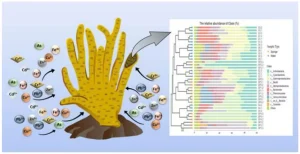
  • Sponge-associated microbes are the diverse and abundant community of bacteria, archaea, fungi, and other microorganisms that live in a very close, symbiotic relationship inside the tissues of a sponge.
  • They are not just passive passengers; they form an integral, functional part of the sponge’s biology.
  • They are often referred to as the sponge holobiont (the host organism plus all its symbiotic microbes).

Check Out UPSC CSE Books

Visit PW Store

online store 1

A Symbiotic Relationship between Sponges and Microbes

Sponge-Associated Microbes

  • Sponges and Microbes have a mutualistic symbiosis:
    • The sponge provides: A protected, stable environment (home and steady flow of nutrient-rich water).
  • The microbes provide: A vast array of biochemical services that enhance the sponge’s survival, nutrition, and defense.

Key Findings of the Study

  • Bioindicator Potential: Freshwater sponges accumulate significantly higher levels of arsenic, lead, and cadmium than surrounding water.
    • This makes them effective bioindicators of toxic metal pollution.
  • Strong Bioaccumulation Ability: Sponges act as natural absorbents, concentrating toxic metals within their tissues.
    • Particularly relevant for the Gangetic plain, where heavy metal pollution is widespread.
  • Role of Sponge-Associated Microbes: Microbial communities in sponges are distinct from surrounding water bacteria.
    • Shaped by sponge species and habitat, not random colonisation.
  • Functional Microbial Adaptations: Sponge-associated bacteria are enriched with genes related to:
    • Metal ion transport
    • Heavy-metal resistance
    • Antimicrobial resistance
  • These microbes do not just survive pollution, they actively detoxify contaminated environments.

Need help preparing for UPSC or State PSCs?

Connect with our experts to get free counselling & start preparing

Aiming for UPSC?

Download Our App

      
Quick Revise Now !
AVAILABLE FOR DOWNLOAD SOON
UDAAN PRELIMS WALLAH
Comprehensive coverage with a concise format
Integration of PYQ within the booklet
Designed as per recent trends of Prelims questions
हिंदी में भी उपलब्ध
Quick Revise Now !
UDAAN PRELIMS WALLAH
Comprehensive coverage with a concise format
Integration of PYQ within the booklet
Designed as per recent trends of Prelims questions
हिंदी में भी उपलब्ध

<div class="new-fform">


    </div>

    Subscribe our Newsletter
    Sign up now for our exclusive newsletter and be the first to know about our latest Initiatives, Quality Content, and much more.
    *Promise! We won't spam you.
    Yes! I want to Subscribe.