Recently, Iran’s Islamic Revolutionary Guard Corps began a new round of military exercises in the Strait of Hormuz, according to state media.
- The drills, launched on the eve of talks with the United States, were aimed at preparing for “potential security and military threats” in the strait of Hormuz.
- In particular for India, any instability in this narrow corridor has direct consequences for energy security, inflation, and overall economic stability.
Past Flashpoints in Strait of Hormuz
- 2019: At just about 21 miles across, the Strait of Hormuz is extremely susceptible to disruption. Events such as the 2019 tanker attacks and rising tensions between the United States and Iran highlight how rapidly regional conflicts can drive up global oil prices.
- 1980: During the Iran-Iraq war of the 1980, both countries targeted oil tankers and commercial vessels in what came to be known as the “tanker war”.
- Naval mines were deployed and shipping lanes were temporarily disrupted.
|
About Strait of Hormuz
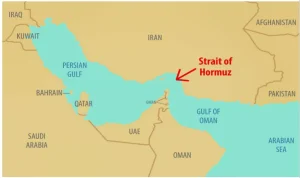
- Geographical Extent: It lies between Oman and the UAE on one side and Iran on the other.
- It links the Persian Gulf in the north with the Gulf of Oman to the south, and the Arabian Sea beyond.
- Buffer Zone: At its narrowest, it is just 33 km wide. The designated shipping lanes within it are only about 3km in each direction separated by a buffer zone.
- Legal Status and Maritime Regulation: Under international maritime law framed by the United Nations, coastal states exercise sovereignty up to 12 nautical miles (about 22 km) from their shores.
- At its narrowest point, the Strait of Hormuz lies within the territorial waters of Iran and Oman.
Significance
- Key Energy Corridor: Strait of Hormuz is a key energy corridor and one of the world’s most critical energy chokepoints.
- For Example: According to the U.S. Energy Information Administration (EIA), roughly 17–20 million barrels of oil and petroleum liquids transit the strait daily, which is close to 20% of global petroleum consumption.
- Major Economies at Risk: Large oil-importing nations such as India, Japan, China would be significantly affected, as they depend heavily on crude oil passing through the Strait of Hormuz.
- Critical Global Sea Route: Members of OPEC (Organization of the Petroleum Exporting Countries), which are Saudi Arabia, Iran, the UAE, Kuwait and Iraq, export most of their crude via the strait, mainly to Asia.
- For example: Qatar, one of the world’s largest LNG exporters, also sends most of its gas exports through this route.
- Strategic Leverage of Iran: The Strait of Hormuz has long been a geopolitical flashpoint due to its critical location.
- Iran’s coastline spreads the entire northern edge of the strait, and the narrow shipping lanes force vessels to pass close to Iranian waters, giving Tehran significant strategic leverage.
- Limited Alternatives: The Strait of Hormuz has few viable alternatives.
- For Example: Some Gulf nations have built bypass routes such as Saudi Arabia’s East–West pipeline to the Red Sea and United Arab Emirates’ pipeline to Fujairah but these lack the capacity to fully offset daily transit volumes.
- Access to Indian Ocean: The strait is the only sea passage that allows the Persian Gulf waters to reach open waters (Indian Ocean).
Potential Impact of Strait of Hormuz Disruptions on India
- Energy Prices: For India, which is a net importer of crude oil, more than 40% of its oil supplies come from Gulf countries that use the Strait of Hormuz for these oil exports.
- Any minor disruption in this region would likely increase global crude prices, in turn leading to an increase in the prices of domestic petrol, diesel and LPG.
- Currency Pressure: Rising import bills would widen the current account deficit and weaken the rupee.
- Sectoral Impact: Aviation, logistics, tyres, and manufacturing sectors could face cost surges.


 21 Feb 2026






.png)






 Current Affairs




 GS Foundation
 Optional Course
 Combo Courses
 Degree Program