Recently, the Supreme Court of India has directed the Union and States to frame a practical, time-sensitive Standard Operating Procedure (SOP) to deal with human trafficking cases, emphasizing immediate action in missing person complaints.
Judicial Approach to Child Trafficking
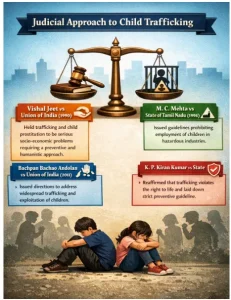
- Vishal Jeet vs Union of India (1990): The Supreme Court recognised trafficking and child prostitution as grave socio-economic problems and emphasised a preventive, rehabilitative, and humanistic approach rather than a purely punitive framework.
- M. C. Mehta vs State of Tamil Nadu (1996): The Court highlighted the linkage between child labour and exploitation, issuing directions to prohibit employment of children in hazardous industries and ensure their welfare.
- Bachpan Bachao Andolan vs Union of India: The Court mandated compulsory registration of FIRs in missing children cases and stressed that such cases should be treated with urgency, often presuming trafficking linkages.
- Continuity in Judicial Approach: The present Supreme Court directive on SOP reflects a shift toward operational accountability, time-bound action, and ground-level enforcement, strengthening earlier jurisprudence.
- The recent directives stem from G. Ganesh v. State of Tamil Nadu (2025/26), where the Court transitioned from mere monitoring to “Judicial Realism,” demanding a concrete, enforceable SOP.
Enroll now for UPSC Online Course
Key Observations by the Court
- Time is of the Greatest Importance: The Court emphasised that time is the most critical factor from the moment a missing complaint is received, as delays drastically reduce the likelihood of tracing victims.
- Gap Between Law and Enforcement: It noted that while laws exist, inefficiencies in procedural implementation and delayed response mechanisms undermine their effectiveness in tackling trafficking networks.
- Need for Ground-Level Operational Clarity: The Court stressed that the absence of a clear, actionable procedural framework at the police station level leads to ad hoc responses and weak investigation outcomes.
- Inadequacy of Paper-Based Compliance: The Court criticised the tendency to keep cases alive only on paper, stressing that investigations must involve continuous, real-time field action until the victim is located.
Key Directives from the Supreme Court
- Formulation of a Practical SOP: The Court directed the Union, States, and Union Territories to frame a practical, implementable SOP, explicitly rejecting theoretical or academic approaches and emphasising usability at the local police station level.
- Immediate Initiation of Investigation: It mandated that investigation must begin without delay upon receiving a missing person complaint, recognising the high probability of trafficking linkages.
- Continuous Ground-Level Pursuit: The Court directed that cases must be actively pursued on the ground until resolution, ensuring sustained investigation rather than procedural formality.
- Multi-Level Institutional Coordination: The Union Home Secretary, State Home Secretaries, and Directors General of Police (DGPs) have been instructed to coordinate and consult with relevant stakeholders and specialised agencies to develop an effective SOP.
- Expert Committee Guidance: A committee comprising experts such as P. M. Nair, Veerendra Kumar Mishra, and S. D. Sanjay has been constituted to guide the SOP formulation process at every stage.
- Focus on Early-Stage Investigation Reforms: The Court emphasised that the SOP should prioritise prompt complaint registration, immediate investigation, and robust tracking systems, targeting the most critical early-stage failures.
- Judicial Oversight and Accountability: By scheduling further hearings, the Court signalled continuous judicial monitoring to ensure time-bound compliance, accountability, and effective implementation.
About Child Trafficking
- Global Definition: According to the United Nations Palermo Protocol, trafficking involves recruitment or movement of individuals through threat, force, or deception for exploitation.
- For children, exploitation alone, regardless of how recruitment occurs, is considered trafficking.
- National Definition: Under Section 370 of the Indian Penal Code (IPC), trafficking is defined as the recruitment, transportation, or harboring of persons for exploitation, including physical and sexual exploitation, slavery, and forced labor.
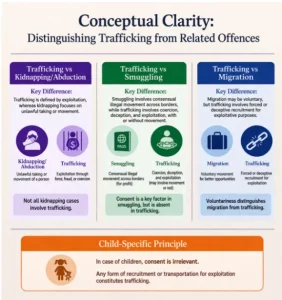 The definition was expanded in the Bharatiya Nyaya Sanhita (BNS) to include online trafficking and trafficking for forced marriages.
- Forms of Child Trafficking:
- Commercial Sexual Exploitation
- Forced Labour (domestic work, agriculture, construction, small industries)
- Bonded Labour and Begging Rackets
- Child Marriage and Forced Marriage Trafficking
- Illegal Adoption and Organ Trafficking
Concerning Statistics
India is a major source, transit, and destination for human trafficking, with commercial sexual exploitation and forced labor being the most prevalent forms.
- National Crime Records Bureau (NCRB) 2023: A total of 177,335 total crimes against children were registered, marking a 9.2% rise from 2022.
- Regional Hotspots (by volume): Madhya Pradesh (22,393 cases), Maharashtra (22,390 cases), and Uttar Pradesh (18,852 cases) reported the highest total volume of crimes against children.
- Highest Crime Rates: Assam reported the highest crime rate in the country (84.2 per lakh children), while Delhi topped the Union Territories with a staggering rate of 140.3.
- Underreporting and “Masking”: While human trafficking cases were officially recorded at 2,183, victim data highlights a severe gap. For instance, in 2022, child-specific trafficking victims were nearly 2,878.
- Kidnapping as a Proxy: Experts note that 45% of crimes against children (79,884 cases) are registered as Kidnapping and Abduction.
- Many of these, particularly in states like Bihar and Rajasthan, are suspected to be trafficking cases masked under simpler charges to avoid complex organized crime investigations.
- NCPCR Rescues (November 2025): The National Commission for Protection of Child Rights reported rescuing over 2,300 children in the latest cycle of interventions.
- 2024-2025 Trends: The Just Rights for Children network reported over 6,500 interventions in child sexual exploitation cases linked to trafficking since April 2025.
- Urban Destination Hubs: Delhi and Mumbai continue to see an alarming rise in child trafficking for domestic servitude and commercial sex, with Delhi witnessing a 68% increase in trafficking incidents from pre-to-post-Covid periods.
- Global Observations: The US Trafficking in Persons (TIP) Report 2024 maintains India on Tier 2, citing ongoing issues in government-funded shelters where frequent abuse cases have been noted, contributing to the cycle of re-trafficking.
Check Out UPSC CSE Books From PW Store
Root Causes of Child Trafficking
- Economic Deprivation and Distress Migration: Persistent poverty, agrarian distress, and lack of livelihood opportunities compel vulnerable families into unsafe migration and child labour.
- Trends from the National Crime Records Bureau (NCRB) show a high concentration of trafficked children from economically weaker rural backgrounds, further intensified by shocks such as COVID-19, climate change, and indebtedness.
- Organised Trafficking Networks and Systemic Deception: Well-structured criminal syndicates exploit information asymmetry through fake promises of jobs, education, and better opportunities.
- The use of local agents, placement agencies, and social media platforms, along with cyber-enabled grooming, reflects the emergence of networked and digitally facilitated trafficking systems (e.g., Jharkhand–Delhi domestic work chains).
- Social Marginalization and Intersectional Vulnerability: Children from Scheduled Castes (SCs), Scheduled Tribes (STs), minorities, migrant families, and girl children face disproportionate risks due to structural inequalities.
- Limited access to education, legal aid, and welfare schemes, combined with gender-based vulnerabilities (sexual exploitation, forced marriage), creates intersectional exposure to trafficking.
- Demand-Side Drivers and Informal Economy Pull Factors: Sustained demand for cheap, invisible labour and commercial sexual exploitation drives trafficking networks.
- Sectors: Domestic work, agriculture, construction, small industries
- Role of intermediaries (placement agencies, contractors)
- Expansion of online/digital demand platforms
- NCRB data indicates forced labour and sexual exploitation as dominant purposes, making trafficking a low-risk, high-profit activity.
- Governance Deficits and Weak Enforcement Mechanisms: Despite laws like the Immoral Traffic (Prevention) Act (ITPA), 1956 and Indian Penal Code (IPC) Sections 370/370A, implementation gaps persist.
- Delayed First Information Reports (FIRs), weak investigation, low conviction rates
- Under-resourced Anti-Human Trafficking Units (AHTUs)
- Poor inter-state coordination
- Judicial intervention in Bachpan Bachao Andolan v. Union of India mandated compulsory FIRs and presumption of trafficking in missing child cases, highlighting systemic gaps.
- Family Vulnerability and Breakdown of Social Protection Systems: Factors such as orphanhood, migration, domestic violence, and school dropouts weaken traditional protective structures.
- Post-COVID trends show a surge in child labour and trafficking, reflecting gaps in social security and child protection mechanisms.
- Emerging Risks- Technology, Disasters, and Climate Change: Trafficking is increasingly hybrid (physical and digital), with:
- Online grooming, cyber trafficking, and dark web networks
- Increased vulnerability during disasters and climate-induced displacement (e.g., flood-prone regions like Bihar and Assam)
- These evolving risks require adaptive and technology-driven responses.
Constitutional and Legislative Provisions in India
- Article 21 (Right to Life and Personal Liberty): The Supreme Court’s 2025 judgment anchors the fight against trafficking in Article 21, asserting that the Right to Life is inseparable from bodily integrity and human dignity.
- Trafficking is viewed as a fundamental violation that subjects children to “moral and material abandonment,” necessitating a judicial approach that protects the survivor’s mental and physical sanctity.
- Article 23 (Prohibition of Traffic in Human Beings): This is the primary constitutional shield that explicitly prohibits trafficking and forced labor (begar).
- It mandates the State to dismantle any system where human beings are treated as commodities, providing the legal basis for all anti-trafficking statutes.
- Immoral Traffic (Prevention) Act (ITPA), 1956: This is the premier legislation aimed at penalizing the commercial exploitation of children.
- It provides the framework for raiding brothels, rescuing victims, and prosecuting those who profit from commercial sexual exploitation.
- Protection of Children from Sexual Offences (POCSO) Act, 2012: This act provides a child-friendly legal framework designed to prevent secondary victimization.
- It ensures that the recording of evidence and court testimonies are conducted with sensitivity, shielding the minor from the trauma of facing their abuser.
- Criminal Law (Amendment) Act, 2013 & BNS: These laws revamped Section 370, broadening the definition of trafficking to include recruitment, transportation, and harboring.
- The Bharatiya Nyaya Sanhita (BNS) further modernizes this by introducing stricter penalties for organized crime networks, online grooming, and forced marriages.
- Supplementary Laws: A web of protective legislation, including the Prohibition of Child Marriage Act, the Bonded Labour System (Abolition) Act, and the Transplantation of Human Organs Act, works in tandem to address specific dimensions of economic and physical exploitation.
Alignment with Sustainable Development Goals (SDGs)
- SDG 5 (Gender Equality): Addressing child trafficking is vital for achieving Target 5.2, which calls for the elimination of all forms of violence against women and girls.
- Since girls are disproportionately targeted for sexual exploitation, effective prosecution directly advances gender-based justice.
- SDG 8.7 (Decent Work and Economic Growth): India’s commitment to ending modern slavery and human trafficking is a core component of this goal.
- Eradicating trafficking cartels is essential to meeting the global mandate to end the worst forms of child labor and forced employment by 2030.
- SDG 16 (Peace, Justice, and Strong Institutions): This goal focuses on ending abuse, exploitation, and trafficking of children (Target 16.2).
- By adopting “judicial realism” as suggested by the Supreme Court, India strengthens its institutional capacity to provide equitable justice to the most marginalized survivors.
|
Government Measures to Combat Trafficking
- Anti-Trafficking Nodal Cell: Established by the Ministry of Home Affairs (MHA) in 2006, this cell coordinates policy decisions and action against trafficking.
- Anti-Human Trafficking Units (AHTUs): Specialized AHTUs have been set up in 270 districts to strengthen law enforcement through training and capacity building.
- Mission Vatsalya: The Mission Vatsalya scheme, under the Ministry of Women and Child Development (MWCD), focuses on child protection, non-institutional care, and rehabilitation of trafficked children.
- It includes open shelters for vulnerable children and vulnerability mapping (e.g., Samvardhan program by NCPCR). This program subsumes the earlier Integrated Child Protection Scheme (ICPS) and is key to integrated services under the Mission Shakti Portal (2025 launch).
- Ujjawala Scheme: This scheme specifically focuses on rescue and rehabilitation for those trafficked for commercial sexual exploitation.
- Pending Anti-Trafficking Bill: Despite several attempts, the comprehensive Anti-Trafficking Bill remains stalled for years, limiting the effectiveness of current efforts (as per the US TIP Report 2024, it is the sixth consecutive year of stalling).
- Institutional Mechanisms for Child Protection:
- TrackChild Portal & Khoya-Paya Platform: Digital platforms for tracking missing and rescued children, enabling real-time coordination across states.
- Child Welfare Committees (CWCs): Statutory bodies under the Juvenile Justice Act responsible for care, protection, and rehabilitation decisions for rescued children.
- District Child Protection Units (DCPUs): Act as nodal agencies for implementation of child protection services at the district level.
- Childline Services (1098): Emergency outreach mechanism for rescue and reporting of children in distress.
- Juvenile Justice Framework: Provides a rights-based approach to care, protection, rehabilitation, and reintegration.
Role of Civil Society/NGOs:
- Key players in addressing trafficking include organizations like Bachpan Bachao Andolan (Kailash Satyarthi), Prajwala, and Vimukthi.
- These NGOs play critical roles in rescue, advocacy, and filling rehabilitation gaps, complementing government efforts and ensuring a multi-stakeholder approach.
|
Enroll now for UPSC Online Classes
Challenges in Tackling Child Trafficking
- Legislative Gaps and Legal Fragmentation: India lacks a single, comprehensive anti-trafficking law, as the Trafficking of Persons Bill (2018) lapsed, resulting in reliance on a fragmented legal framework comprising the Immoral Traffic (Prevention) Act (ITPA), Protection of Children from Sexual Offences (POCSO) Act, and Bharatiya Nyaya Sanhita (BNS).
- This creates jurisdictional ambiguity and weakens coordinated prosecution against organised trafficking networks.
- Complex Crime Networks and Weak Institutional Capacity: Trafficking operates through multi-layered organised crime syndicates involving recruitment, transit, and exploitation, making detection and disruption difficult.
- Anti-Human Trafficking Units (AHTUs) suffer from underfunding, staff shortages, lack of specialised training, and high personnel turnover, resulting in weak investigations and poor conviction rates.
- Governance Deficits and Federal Coordination Issues: Weak coordination between Central and State agencies hampers effective tracking of traffickers across jurisdictions.
- Poor inter-state intelligence sharing and administrative fragmentation allow traffickers to exploit federal gaps, especially in cross-border cases.
- Victim Trauma and Secondary Victimization: Victims often face re-traumatisation in hostile court environments, discouraging testimony and weakening prosecution.
- Issues such as witness intimidation, fear, and occasional corruption or complicity within enforcement agencies further undermine justice delivery.
- Crisis in Rehabilitation and Reintegration Systems: Post-rescue mechanisms remain inadequate, with limited long-term support, counselling, education, and livelihood opportunities.
- Reports of abuse and poor conditions in shelter homes increase the risk of re-trafficking, reflecting a serious gap in the rehabilitation ecosystem.
- Weak Investigation, Prosecution, and Low Conviction Rates: Challenges include poor evidence collection, lack of forensic support, delayed trials, and hostile witnesses, leading to low conviction rates.
- Additionally, there is a failure to effectively invoke organised crime provisions, limiting action against entire trafficking networks rather than individual offenders.
- Inter-State, Cross-Border, and Emerging Technological Threats: Trafficking follows a source–transit–destination pattern, linking vulnerable regions to urban centres, while porous borders with Nepal and Bangladesh facilitate cross-border movement.
- Simultaneously, digital trafficking through social media, encrypted platforms, and fake job portals has increased, posing challenges for traditional policing and requiring advanced cyber capabilities.
International Framework and India’s Commitments:
- United Nations Convention against Transnational Organized Crime (UNCTOC): India ratified this convention, aligning national laws with international protocols on trafficking.
- South Asian Association for Regional Cooperation (SAARC) Convention: India is a signatory to this convention on preventing trafficking in women and children.
- Bilateral Mechanisms: India and Bangladesh have a Task Force for cross-border victim repatriation and reintegration.
|
Way Forward
- Operationalising Time-Sensitive, Field-Oriented Protocols: The “paperwork phase” must be replaced with a Golden Hour Protocol, ensuring immediate First Information Report (FIR) registration, rapid response, and real-time tracking as soon as a child is reported missing.
 These protocols should be integrated with the Crime and Criminal Tracking Network System (CCTNS) and Inter-operable Criminal Justice System (ICJS) for seamless nationwide coordination.
- Strengthening Law Enforcement and Institutional Capacity: Anti-Human Trafficking Units (AHTUs) must be transformed into specialised, well-resourced units with trained personnel, forensic tools, and fixed accountability mechanisms for delays.
- Further, inter-state coordination should be enhanced through joint task forces and centralised intelligence databases to effectively dismantle organised trafficking networks.
- Enacting a Comprehensive Legal Framework: India must fast-track a holistic Trafficking in Persons law to address the current legal fragmentation across multiple statutes.
- The law should explicitly cover organised crime syndicates, cyber trafficking (online grooming), and victim/witness protection mechanisms, thereby improving prosecution and conviction rates.
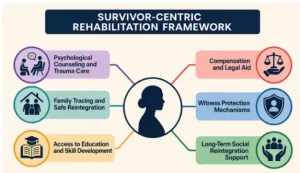
- Adopting a Survivor-Centric Rehabilitation Approach: The focus must shift from rescue-centric interventions to long-term reintegration under schemes like Mission Vatsalya.
- This includes psychological counselling, education, skill development, and livelihood support, along with strict safety audits and monitoring of shelter homes to prevent re-trafficking.
- Addressing Structural Root Causes and Vulnerabilities: Targeted interventions must focus on high-risk districts and vulnerable groups, including Scheduled Castes (SCs), Scheduled Tribes (STs), and migrant populations, through Direct Benefit Transfers (DBT), education retention programmes, and livelihood generation initiatives. Strengthening safe migration systems is also essential.
- Leveraging Technology and Data-Driven Policing: Law enforcement agencies should utilize Artificial Intelligence (AI)-based facial recognition, predictive analytics, and digital surveillance to track trafficking networks across both physical and online domains.
- Creation of real-time dashboards and integrated databases will enhance tracking of missing and rescued children.
- Strengthening Community Participation and Global Convergence: Grassroots institutions such as Panchayats, schools, and Anganwadi networks must be empowered for early detection of vulnerable children and unsafe migration patterns.
- Simultaneously, India should align efforts with Sustainable Development Goal (SDG) 8.7 and strengthen cross-border cooperation mechanisms (e.g., India–Bangladesh frameworks) to combat transnational trafficking.
Conclusion
The Supreme Court of India push for a time-sensitive SOP signals a shift to real-time enforcement and accountability. Combating trafficking demands swift action, coordinated governance, and a rights-based approach, recognising trafficked children as rights-bearing individuals entitled to dignity, protection, and rehabilitation.


 1 Apr 2026




.png)






 Current Affairs




 GS Foundation
 Optional Course
 Combo Courses
 Degree Program