The National Council of Educational Research and Training (NCERT) is redesigning school textbooks to align with the National Education Policy 2020 (NEP 2020). Recently, the Supreme Court of India intervened over sensitive content in a Class 8 textbook, sparking debate on academic freedom vs dignity of constitutional institutions.
About the Recent Issue
- The Supreme Court’s Action (Suo Motu): The Supreme Court initiated suo motu proceedings after senior advocates highlighted that a specific textbook was unfairly attacking the legal system.
- In a decisive move, the Court imposed a “complete blanket ban” on the publication, specifically objecting to sections alleging “corruption in the judiciary.”
- The “Bleeding” Metaphor & Judicial Intent: Chief Justice Surya Kant expressed the gravity of the situation using powerful imagery, stating: “They fired a gunshot; the judiciary is bleeding today.”
- The Court interpreted the chapter as a “calculated conspiracy” (a pre-planned move) intended to systematically erode the trust and respect students, teachers, and parents hold for the Indian courts.
- Mandate for Accountability: To ensure high standards in educational materials, the Court has taken the following steps:
- Credential Audit: Demanded a detailed list of the names and credentials of the textbook development team to verify their expertise in handling sensitive topics.
- Legal Consequences: Issued a Show Cause Notice for Contempt of Court to top education officials, who may now face punishment for allowing content that lowers the dignity of the Judiciary.
- Enforcement and Government Response:
- Total Recall: The Court ordered the immediate seizure and removal of all physical and digital copies across all state governments.
- Official Inquiry: The Union Education Minister confirmed the Centre is treating the matter “seriously,” launching a formal investigation into how such content cleared the approval process.
- Institutional Deference: A defining moment in the proceedings was the Solicitor General’s unconditional and unqualified apology on behalf of the Ministry of Education.
The Court’s Argument- Why It Intervened?
The Court highlighted several critical flaws in the textbook’s pedagogical approach:
- Unfair Targeting & Bias: The book focused exclusively on corruption within the Judiciary, while omitting similar issues within the Executive (Government) or the Police, creating a biased worldview for students.
- “Wiping Away History”: By focusing solely on negatives, the Court noted the text ignored 75 years of judicial success in protecting Fundamental Rights and upholding the Constitution.
- Developmental Appropriateness: The Court argued that 13-year-olds (Class 8) lack the maturity to distinguish between individual misconduct and systemic failure. Teaching only negatives could lead to a total loss of faith in the law.
|
Constitutional and Legal Dimensions of the Court Action
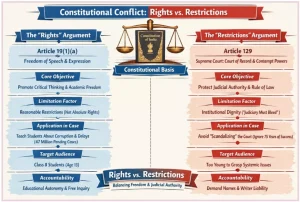
- Institutional Dignity: Under Article 129, the Supreme Court is a “Court of Record” with the power to punish for its contempt.
- The Court argues that “scandalizing” the judiciary can undermine the Rule of Law.
- Reasonable Restrictions: While Article 19(1)(a) grants Freedom of Speech, it is not absolute.
- Restrictions must be traceable to Article 19(2), including contempt of court.
- The Court maintains that textbooks must not present information that is factually “distorted” or damaging to the public’s faith in constitutional pillars.
| Important Judicial Precedents on Free Speech:
Two landmark judgments of the Supreme Court of India reinforce the importance of protecting freedom of expression:
- Shreya Singhal v. Union of India (2015): The Court struck down Section 66A of the IT Act, holding that vague restrictions on online speech violate Article 19(1)(a) and that any limitation on free expression must fall strictly within the grounds listed in Article 19(2).
- S. Rangarajan v. P. Jagjivan Ram (1989): The Court ruled that freedom of expression cannot be suppressed merely because a section of society finds it uncomfortable, emphasizing that open criticism and debate are essential to a democratic society.
|
- The Veeraswami Precedent (1991): The Court’s intervention aligns with the Veeraswami case (1991), which established that no FIR can be registered against a superior court judge without the Chief Justice of India’s prior sanction.
- This creates a high threshold for “scandalizing” the court, as judicial conduct is shielded from standard criminal investigation to preserve independence.
- The “Basic Structure” Doctrine: The judiciary views these textbook allegations not merely as criticism, but as an assault on the Basic Structure of the Constitution.
- Since Judicial Independence was declared an unalterable feature in the Kesavananda Bharati (1973) case, any “calculated move” to delegitimize the courts is seen as a threat to the constitutional order itself.
- Administrative Superintendence (Art. 227 & 235): Beyond the power of contempt, the High Courts exercise administrative superintendence over the lower judiciary.
- This power justifies the 2025 disciplinary sweep, where 12 officers were removed, proving that the system relies on internal “supervision” rather than external “exposure” in school books.
- Individual Accountability: By seeking the credentials of individual writers, the Court is establishing a precedent that academic writers can be held personally accountable for the content they produce.
Criticisms of the SC’s Approach
While the Supreme Court’s intervention was framed as a defense of institutional integrity, it has faced significant scrutiny from legal scholars, educators, and civil rights advocates. The criticisms center on the balance between judicial dignity and democratic transparency.
- Overreach and “Judicial Censorship”: Critics argue that by ordering a “complete blanket ban” and the physical seizure of textbooks, the Court exercised an extreme form of prior restraint. Also, this violates the Doctrine of Proportionality.
| The Doctrine of Proportionality is a critical principle in constitutional law used to determine whether a government or judicial action that restricts a Fundamental Right is justified or excessive. |
-
- Silencing Discourse: There is concern that the Court is using its contempt powers to suppress uncomfortable truths about systemic issues that are already in the public domain (such as those mentioned in Law Commission reports).
- Setting a Dangerous Precedent: If the judiciary can vet its own portrayal in school books, other constitutional bodies (like the Election Commission or Parliament) might demand similar “editing” rights, leading to a sanitized and unbalanced curriculum.
- Impact on Academic Autonomy: The demand for the names and credentials of the textbook development team is seen by many as an intimidating move.
- The “Chilling Effect”: This approach may deter top academics from participating in academic projects for fear of personal liability or legal harassment.
- Erosion of Independence: Academic bodies are supposed to be autonomous. By treating a textbook chapter as a “calculated conspiracy,” the Court shifts the nature of educational drafting from an academic exercise to a potential criminal act.
- The “Infantilization” of Students: The Court’s argument that 13-year-olds (Class 8) are too young to understand judicial corruption has been contested by pedagogues.
- Critical Thinking: Education experts argue that middle-school students are at the ideal age to learn about checks and balances, including where systems fail.
- Cynicism vs. Awareness: Critics suggest that hiding systemic flaws creates a “false consciousness” that backfires when students encounter real-world legal delays or corruption later in life, leading to deeper disillusionment.
- Selective Protection of Dignity: Some observers point out an inconsistency in how the Court views Article 19 (Freedom of Speech).
- Public Interest vs. Institutional Pride: While the Court protects its own “dignity,” critics argue it has been less aggressive in protecting the speech rights of journalists or activists who highlight similar issues.
- Transparency as Dignity: A counter-argument suggests that the judiciary’s dignity is better served by openly addressing corruption rather than banning the mention of it in schools.
About the Official Setup for Writing New School Books
The current process is governed by the National Curriculum Framework for School Education (NCF-SE) 2023. It relies on a high-level, multi-layered committee structure to ensure that all educational material is modern and accurate.
- National Syllabus and Teaching Learning Material Committee (NSTC): This is the top-tier 19-member body led by M.C. Pant.
- It is responsible for the overall vision of the Syllabus and includes a diverse mix of experts, such as mathematicians, artists, and policy advisors, to ensure a well-rounded approach to learning.
- Curricular Area Groups (CAGs): These are specialized teams of experts for different subjects.
- For instance, a 35-member Social Science CAG provides the academic framework and detailed guidelines that writers must follow for history, geography, and political science.
- Textbook Development Team: This group consists of the actual authors, including university professors and school teachers, who write the chapters.
- National Curriculum Frameworks Oversight Committee (NOC): This body acts as a final “compliance checker.”
- Its main task is to ensure that every single textbook is in Full Alignment with the goals and values set by the National Education Policy (NEP).
|
About Judicial Corruption
- Core Definition and Scope: Judicial corruption involves the use of bribery, nepotism, or political pressure to compromise the independence and integrity of the legal system. It primarily manifests in two ways:
- Adjudicatory Corruption: When case outcomes are dictated by external factors or bribes rather than the law.
- System Manipulation (Bench Hunting): In late 2025, a major “Bench Hunting” scam was uncovered in a North Indian High Court.
- Lawyers and court staff were caught working together to send specific cases to “friendly” judges to get the desired result.
- Administrative Corruption: The manipulation of court processes, such as tampering with records or selective scheduling by court staff.
- The Statutory Gap: While the Judges (Inquiry) Act, 1968 provides a roadmap for investigating “proven misbehavior,” it is often criticized for being too cumbersome.
- This creates a “legal vacuum” between minor internal warnings and the extreme, rarely successful process of Parliamentary Impeachment, allowing “petty corruption” to occasionally go unaddressed.
- Structural and Systemic Vulnerabilities: The internal operations of the Indian Judiciary face specific criticisms regarding transparency:
- The Collegium System: A lack of objective criteria in appointments is often cited as a breeding ground for favoritism and quid-pro-quo arrangements.
- Post-Retirement Benefits: Judges accepting lucrative placements in tribunals or commissions immediately after retirement raises concerns about pre-retirement judgments delivered to secure future employment.
- “Uncle Judge Syndrome”: As highlighted by the Law Commission’s 230th Report (2009), conflicts of interest arise when relatives of a judge practice in the same court, creating networks of mutual favoritism.
- External Pressures and Influence:
- Executive Interference: Judges may face pressure from political actors, often enforced through the threat of punitive transfers or the denial of promotions for unfavorable verdicts.
- Political Pressure: High-profile cases are particularly susceptible to influence, testing the independence of the bench against the interests of the ruling administration.
- Accountability and Oversight Gaps: Mechanisms intended to curb misconduct are often criticized for being internal and opaque:
- Ineffective Disciplinary Mechanisms: The current “In-House Mechanism” lacks external oversight. Between 2017 and 2021, over 1,600 complaints were filed, yet very few resulted in visible disciplinary action.
- Ground-Level Bribery: A 2025 Transparency International survey found that 1 in 4 people dealing with local (District) courts reported paying a bribe or using a “connection” just to get basic paperwork processed.
- Rise in Complaints: The 2025 Central Vigilance Commission (CVC) report saw a 15% jump in complaints against court staff (clerks and registry officials). Most complaints were about “illegal gratification” (taking extra money) to number cases or file documents.
- Whistleblower Protection: There is no formal mechanism to protect judges or officials who expose internal corruption, leaving them vulnerable to professional retaliation.
- Confidentiality: The extreme secrecy surrounding disciplinary proceedings diminishes public accountability and shields the higher judiciary from scrutiny.
Institutional Framework & Accountability Mechanisms in Judiciary
- Internal Governance & Appointment Systems: The judiciary primarily regulates itself through internal mechanisms designed to maintain Judicial Independence.
-
- The Collegium System: A non-constitutional body for appointments and transfers.
- SC Collegium: Comprises the CJI and the 4 senior-most judges.
- HC Collegium: Comprises the Chief Justice of the High Court and the 2 senior-most judges.
- National Judicial Appointments Commission (NJAC): A 2015 attempt to replace the Collegium with a more transparent, diverse body; however, it was struck down by the Supreme Court to prevent Executive interference.
- In-House Mechanism (1997): A system where the CJI or High Court Chief Justices review complaints against judges. It focuses on remedial action for violations of judicial standards.
- Legal Protections & Ethical Codes: To ensure judges can deliver verdicts without fear or favor, specific protections and codes are in place:
- Judges (Protection) Act, 1985: Grants civil and criminal immunity to judges for any acts performed in the discharge of their official judicial duties.
- Restatement of Values of Judicial Life (1997): An adopted Code of Conduct outlining ethical standards. While authoritative, it is often criticized for lacking legal enforceability.
- Contempt of Courts Act, 1971: Provides the power to punish for “Criminal Contempt” if an individual’s actions scandalize the court or lower its authority.
- Oversight and Removal (External Checks): The Executive and Legislature have limited but significant roles in high-level accountability:
- Impeachment (Articles 124 & 217): The only way to remove a judge of the Higher Judiciary. It requires a Special Majority in Parliament on grounds of “proven misbehavior or incapacity.”
- Lokpal and Lokayuktas Act, 2013: While targeting corruption in government, SC and HC judges are excluded from its purview to maintain the separation of powers.
- Executive Role: The Executive conducts Intelligence Bureau (IB) inquiries on appointees but cannot legally influence judicial outcomes.
- Global Ranking: In the 2025 Rule of Law Index (by the World Justice Project), India ranks 86th out of 143 countries.
- Specifically, India scores poorly in the “Absence of Corruption” category, showing that the world perceives our courts as still struggling with integrity issues.
- Proposed Reforms & Digital Transparency: Modern initiatives aim to shift the judiciary toward greater transparency and efficiency:
- Law Commission Reports: 230th Report (2009): Recommended transferring judges from their parent High Courts to eliminate favoritism (“Uncle Judge Syndrome”).
- 214th Report (2008): Called for urgent Collegium reforms.
- Technological Monitoring: LIMBS (Legal Information Management & Briefing System): A web-based tool used to monitor cases where the Central Government is a party.
- Accountability Reports: Inspired by the Orissa High Court, there is a growing demand for all courts to publish Annual Functioning Reports to foster public trust.
Legal and Institutional Framework to Combat Corruption in India
- Constitutional Provisions:
- Article 124(4) & 218: Impeachment of SC/HC judges for “proven misbehavior or incapacity.”
- Article 311: Dismissal of corrupt public servants (excluding judges).
- Key Legislations:
- Prevention of Corruption Act (PCA), 1988: Criminalizes bribery, undue influence, and illicit enrichment by public servants.
- 2018 Amendment: Criminalizes bribe-giving, mandates speedy trials.
- Lokpal and Lokayuktas Act, 2013: Establishes Lokpal (center) and Lokayuktas (states) to probe corruption against PM, ministers, MPs, and bureaucrats.
- Exclusion: Judges (SC stayed Lokpal’s jurisdiction over HC judges in 2024).
- Benami Transactions Act, 1988: Targets undisclosed assets; Enforcement Directorate (ED) investigates.
- Prevention of Money Laundering Act (PMLA), 2002: ED prosecutes money laundering linked to corruption.
- Central Vigilance Commission (CVC), 2003: To oversee vigilance administration and prevent corruption in public administration.
- CVC monitors corruption cases and supervises the functioning of the Central Bureau of Investigation (CBI).
|
Risks and Consequences of Judicial Corruption
- Erosion of Public Trust and the Rule of Law: Corruption acts as a slow poison to democratic legitimacy. When the judiciary—the “last resort” for justice—is perceived as compromised, citizens lose faith in the Rule of Law.
- This leads to a selective application of justice, where influential parties are favored, and wrongdoers operate with impunity.
- Ultimately, this encourages lawlessness and weakens the very foundations of the state.
- Socio-Economic Marginalization: Judicial corruption disproportionately affects those without the resources to “buy” justice.
- It creates a system where the wealthy and influential can manipulate outcomes, while marginalized communities are denied fair hearings.
- Economically, this lack of legal reliability discourages Foreign Direct Investment (FDI), as investors fear unfair commercial litigation, thereby hindering national growth.
- Systemic Inefficiency and Backlog: Corrupt practices are often at the heart of judicial delays.
- Intentional file tampering, the favoring of specific cases, and deliberate procedural stalls exacerbate the judicial backlog.
- These prolonged delays deprive ordinary citizens of timely justice, turning “justice delayed” into “justice denied.”
- As of March 2026, the National Judicial Data Grid (NJDG) shows over 5.2 crore pending cases.
- The “Chilling Effect” on Academic Autonomy: A major secondary risk involves the education system.
- If every textbook chapter must be vetted to avoid offending constitutional bodies, it may lead to self-censorship by writers.
- This compromises academic autonomy and makes it difficult to teach students to be critically aware citizens without making them cynical about their country’s foundations.
- Threat to Checks and Balances: When judges are susceptible to political or executive pressure, the separation of powers is compromised.
- Corruption gives political actors leverage over judicial decisions, effectively removing the judiciary’s ability to act as a check on the other branches of government.
High-Profile Cases Involving Judicial Misconduct
- Justice V Ramaswami (Supreme Court): Misused public funds for renovating his official residence as Punjab & Haryana HC Chief Justice.
- First impeachment motion (1993) failed in Lok Sabha despite the committee finding him guilty.
- Justice PD Dinakaran (Chief Justice, Sikkim HC; formerly Karnataka HC): Owned disproportionate assets.
- Resigned (2011) after Rajya Sabha passed impeachment motion.
- Justice Soumitra Sen (Calcutta High Court): Misappropriated large sums of money as court-appointed receiver.
- Resigned (2011) before Lok Sabha could vote on impeachment.
- Justice SN Shukla (Allahabad High Court): Took bribes to influence medical college case (2017).
- Judicial work withdrawn, but remained judge till retirement (2020). CBI later charged him.
- Justice IM Quddusi (Odisha High Court): Middleman in medical college bribery scam involving SC judges (2017).
- Action: Arrested by CBI, got bail. Case pending.
|
The Imperative for Judicial Accountability
- Upholding Constitutional Integrity: Accountability mechanisms are not meant to weaken the courts but to ensure they function strictly within the Constitutional Framework.
- It ensures that Judicial Independence is used to protect Fundamental Rights rather than as a shield for personal misconduct or nepotism.
- Maintaining Impartiality and Fairness: Transparency in judicial processes enhances public confidence.
- When a clear Code of Conduct is enforceable, citizens perceive the judiciary as truly fair and impartial. Strong accountability acts as a deterrent against bribery and “quid-pro-quo” arrangements.
- Addressing the Accountability Deficit: Despite numerous allegations over the decades, the fact that no High Court or Supreme Court judge has ever been convicted highlights a significant accountability deficit.
- Establishing effective disciplinary mechanisms ensures that instances of misconduct are addressed promptly and visibly, rather than being hidden behind a veil of confidentiality.
- Preventing Abuse of Power: Proper accountability ensures that the judiciary does not exceed its mandate or misuse contempt powers to stifle legitimate, constructive criticism.
- It balances the court’s need for respect with the public’s right to demand an efficient, honest, and transparent legal system.
International Practices to Address Judicial Corruption
- United States: Judicial Conduct and Discipline Framework
- Judicial Conduct System: Judges are subject to investigation by Judicial Councils in their respective circuits.
- The presence of external review bodies ensures impartial investigations and oversight.
- United Kingdom: Judicial Appointments Commission (JAC)
- Merit-Based Appointments: Judicial Appointments Commission (JAC) appoints judges based on merit, transparency, and diversity. The selection process is independent of political influence.
- Australia: Judicial Commission of New South Wales
- Independent Oversight Body: The Judicial Commission of New South Wales (JCNSW) investigates complaints against judges and ensures judicial accountability.
- Periodic monitoring and continuous training promote a culture of integrity.
- Singapore: Integrity and Strict Disciplinary Measures
- Judicial Integrity Standards: Judges follow strict codes of conduct and financial disclosure norms to maintain integrity.
- A proactive approach ensures swift action and discourages corruption.
- International Standards: Bangalore Principles of Judicial Conduct (2002)
- Key Principles: Adopted in 2002, the principles (Independence, Impartiality, Integrity, Propriety, Equality, Competence) set a global standard for judicial conduct.
- Encourages adherence to ethical standards and international guidelines.
Way Forward
- Structural Reform of Appointments and Transfers: The current system requires a shift from complete internal control to a balanced, transparent framework:
- Reforming the Collegium: There is a growing call to revive a modified version of the National Judicial Appointments Commission (NJAC).
- A hybrid model could maintain judicial primacy while incorporating external oversight to ensure independence is not used as a shield for favoritism.
- Implementation of AIJS: The All India Judicial Services (AIJS) should be implemented to standardize recruitment across the country, significantly reducing the risk of nepotism at the subordinate judiciary level.
- Cooling-Off Periods: To prevent quid-pro-quo arrangements, a mandatory two-year cooling-off period should be introduced before retired judges can accept government-appointed positions or benefits.
- Legislative Fill: To bridge the gap between voluntary codes and impeachment, there is an urgent need to revive and pass the Judicial Standards and Accountability Bill.
- It would provide a statutory framework for citizens to lodge complaints, replacing the current “opaque” in-house mechanism with a transparent, legally-backed process.
- Transition to AI-Driven Listings: To combat the “Registry-Lawyer” nexus, the Phase III of the e-Courts Project must fully automate case assignments.
- By removing the “human interface” from the case-numbering and bench-allocation process, the system can systematically eliminate the incentives for “speed money.”
- Strengthening Oversight and Disciplinary Action: Accountability must move from opaque “in-house” discussions to enforceable legal standards:
- Judicial Ethics Commission: An independent body should be empowered to investigate complaints, making the inquiry process transparent and time-bound.
- Mandatory Asset Declaration: Annual filing of assets by judges should be mandatory and published on official websites for independent verification.
- Expansion of Lokpal: Amending the Lokpal and Lokayuktas Act, 2013 to include the Higher Judiciary (with necessary safeguards) would ensure no branch of government is above corruption oversight.
- Recent Enforcement: As seen in 2025, the judiciary has begun “cleaning the system” from within, with 12 lower-court judges fired or forced into retirement for possessing disproportionate assets or issuing questionable bail orders.
- Technological and Legislative Modernization: Modernizing the “machinery of justice” reduces the human element prone to corruption:
- Digitization and AI: Scaling the e-Courts Mission Mode Project and integrating AI-based case management can identify procedural bottlenecks and prevent the manual tampering of court records.
- Contempt Law Reform: The Contempt of Courts Act, 1971 requires amendments to clearly define “contempt,” ensuring the power is used to protect the court’s dignity rather than to stifle legitimate, constructive criticism.
- Guidelines for Educational and Academic Accuracy: To resolve the specific issue of “distorted” narratives in textbooks, a new standard for academic content is required:
- Technical Vetting: Curricular Area Groups (CAGs) should include legal experts or retired judges when writing about the judiciary to ensure technical and constitutional accuracy.
- Fact-Based Critique: Any discussion of judicial flaws must be rooted in official documents (such as Law Commission Reports) rather than generalized or biased statements.
- The “Constitutional Morality” Framework: Textbooks should adopt a balanced narrative—emphasizing the vital role of courts in protecting rights while acknowledging the ongoing reforms needed to improve the system.
Conclusion
Education is meant to foster Critical Thinking, and textbooks must reflect the complexities of a functioning democracy. However, this must be balanced with Constitutional Morality. The NCERT must ensure that while students are taught to be aware of systemic issues, they are also taught to respect the Integrity of Institutions that hold the nation together.


 5 Mar 2026








.png)






 Current Affairs




 GS Foundation
 Optional Course
 Combo Courses
 Degree Program