Recently, a petition was filed in the Supreme Court of India challenging the constitutional validity of regulation 3(c) of the newly notified University Grants Commission (UGC) (Promotion of Equity in Higher Education Institutions) Regulations, 2026.
The petitioner alleges that the regulation is discriminatory as it excludes “general category” students from the protective ambit of caste-based discrimination, potentially violating Article 14 (Equality before law).
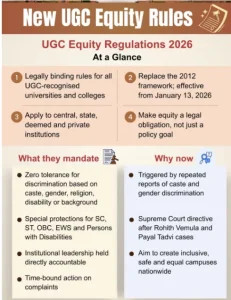
- The UGC (Promotion of Equity in Higher Education Institutions) Regulations, 2026, notified on January 13, 2026, replace the largely advisory 2012 framework with a more enforceable regime.
- Expansion: For the first time, Other Backward Classes (OBCs) have been explicitly included in the definition of protected groups under caste-based discrimination.
About the UGC Equity Regulations, 2026
- Background and Rationale: Caste-based discrimination continues to be a deep-rooted problem in Indian higher education.
- Institutional failures highlighted by the deaths of Rohith Vemula (2016) and Dr. Payal Tadvi (2019), followed by Supreme Court intervention, exposed the inadequacy of advisory mechanisms and created the need for a stronger, enforceable equity framework.
- Framework Shift from 2012 Regulations: The 2026 Regulations replace the largely advisory 2012 anti-discrimination framework, marking a transition from discretionary moral guidance to binding regulatory obligations linked directly to UGC compliance.
- Alignment with NEP 2020: The Regulations operationalise the inclusive and equitable vision of the National Education Policy (NEP) 2020, embedding equity as a core institutional responsibility rather than a peripheral welfare measure.
- Expanded Scope of Equity : Moving beyond admission-stage safeguards, the framework addresses everyday campus discrimination—in classrooms, hostels, laboratories, evaluation systems, and informal academic spaces—to curb institutional hostility that can result in dropouts and mental health distress.
- Protected Groups and Inclusion Mandate: The Regulations explicitly extend protection to Scheduled Castes (SCs), Scheduled Tribes (STs), Other Backward Classes (OBCs), women, and Persons with Disabilities (PwDs), ensuring representation, support, and effective grievance redressal.
- Equity as an Enforceable Institutional Duty: Equity is treated as a statutory responsibility of higher education institutions, with prevention, monitoring, and redressal mechanisms integrated into the regulatory oversight of the UGC.
About University Grants Commission (UGC)
- Historical Evolution:
- Originated from the 1944 Sargent Report, recommending a University Grants Committee.
- Formed in 1945, initially supervised Aligarh, Banaras, and Delhi universities, expanding to all universities by 1947.
- Restructured on the advice of the 1948 University Education Commission (Dr. S. Radhakrishnan), inspired by the UK model.
- It became a statutory body in 1956, after formal inauguration by Maulana Abul Kalam Azad in 1953.
- Organisational Structure: Headquartered in New Delhi, led by a Chairman, Vice-Chairman, and ten members appointed by the Central Government.
- Key Functions:
- Funding and Grants: Allocates financial support to central, state, and private universities for infrastructure, research, and faculty development.
- Policy and Advisory Role: Provides recommendations on higher education reforms and expansion to the government.
- Quality Assurance: Promotes academic excellence by maintaining standards of teaching, examination, and research across universities.
- Accreditation and Monitoring: Works alongside agencies like National Assessment and Accreditation Council (NAAC) and National Institutional Ranking Framework (NIRF) to ensure quality assessment and institutional ranking.
- Significance and Contemporary Relevance:
- Acts as the apex regulatory authority for Indian higher education.
- Ensures equity, accountability, and quality, supporting initiatives like the National Education Policy 2020 and recent UGC Equity Regulations 2026.
|
Key Provisions of the UGC Equity Regulations, 2026
- Mandatory Institutional Architecture: All Higher Education Institutions (HEIs) must establish a multi-tier system including Equal Opportunity Centres (EOCs), Equity Committees, and mobile Equity Squads to monitor vulnerable campus spaces like hostels and labs.
- Leadership Accountability: In a significant shift toward administrative liability, Vice-Chancellors and Heads of Institutions are now held directly responsible for any lapses in the implementation of equity measures, fixing accountability at the highest level.
- Strict Adjudication Timelines: The regulations mandate that an Equity Committee must meet within 24 hours of a complaint and submit its report within 15 days, ensuring that grievances are not buried under bureaucratic delays.
- Regulatory Penalties: The UGC is empowered to take “coercive actions” against defaulting institutions, which include withdrawing eligibility for central grants, debarring them from UGC schemes, and restricting their right to offer online or distance learning programs.
| From Guidelines to Enforcement: A Comparison of UGC Equity Regulations (2012 & 2026) |
| Feature |
2012 Regulations (Old) |
2026 Regulations (New) |
| Legal Nature |
- Primarily advisory and directory; lacked “teeth” for enforcement.
|
- Mandatory and statutory; non-compliance leads to financial and regulatory sanctions.
|
| Definition of Caste |
- Focused on SC and ST groups; OBCs were often addressed via separate guidelines.
|
- Explicitly includes OBCs in the definition of caste-based discrimination (Regulation 3(c)).
|
| Accountability |
- Vague institutional responsibility; no specific individual was held liable.
|
- Direct liability of Vice-Chancellors and Heads of Institutions for implementation lapses.
|
| Response Time |
- No fixed timelines for grievance redressal, leading to “justice delayed.”
|
- Strict 24-hour meeting mandate for committees; 15-day window for inquiry reports.
|
| Monitoring |
- Episodic and based on voluntary reporting by universities.
|
- Continuous surveillance via Equity Squads, 24/7 Helplines, and National Monitoring.
|
Significance of the UGC Equity Regulations, 2026
- Shift to Substantive Equality: The UGC Equity Regulations 2026 represent a transformation from mere access and allocation of seats to active intervention in campus life, ensuring that discrimination in classrooms, hostels, and assessment systems is systematically addressed.
- Response to Rising Complaints: Official data submitted to the Supreme Court shows reported complaints of caste-based discrimination in universities and colleges rose by about 118% between 2019–20 and 2023–24 (from 173 to 378 cases), with a total of over 1,160 complaints from 704 universities and 1,553 colleges in that period, highlighting persistent exclusionary experiences.
- From Moral Duty to Regulatory Obligation: By linking compliance to funding, recognition, and accreditation, the UGC has made equity a statutory governance requirement — a notable shift from the advisory nature of the 2012 framework.
- This structural shift is meant to make institutions legally accountable for discrimination redressal.
- Broader Inclusion and Representation: The mandatory inclusion of SC, ST, OBC, women, and PwD members in Equity Committees and Equal Opportunity Centres embeds the perspectives of historically marginalised groups in grievance mechanisms, a significant step toward representative campus governance.
- Catalysts from Tragedy and Judiciary: The impetus for enforceable protections traces back to Supreme Court-linked proceedings following student deaths like Rohith Vemula (2016) and Dr. Payal Tadvi (2019), which underscored institutional inaction on caste harassment.
Concerns Arising with the UGC Equity Regulations, 2026
- Perceived Exclusion of General Category: Critics (including protesters and student groups) argue that the regulations effectively allow only SC/ST/OBC categories to be recognised as victims of caste discrimination, excluding general category students from comparable protective mechanisms.
- This perceived one-sided design has prompted protests, especially in cities like Lucknow and other parts of Uttar Pradesh, where students voiced fears of bias and campus tension.
- Article 14 and Hierarchy of Victimhood: Legal critics argue that defining caste-based discrimination as applying only to certain caste groups may lack the intelligible differentia and rational nexus required under Article 14 of the Constitution, potentially creating a “hierarchy of victimhood.”
- Ambiguity and Misuse Fears: Concerns have been raised about vague definitions of discrimination and the absence of clear safeguards against malicious or false complaints in the final notified text, a provision reportedly removed from the draft, fueling fears of procedural misuse and allegations without adequate checks.
- Administrative Strain on Institutions: Smaller colleges and state universities, already stretched for faculty and budgets, may find it challenging to maintain 24/7 helplines, Equity Squads, and multiple oversight bodies without additional support.
- Political and Social Backlash: The regulations have sparked political controversy, with reports of local leaders and office-bearers resigning in protest in some regions, as well as broad public debate and mobilisation around the rules.
PWOnlyIAS Extra Edge:
Impacts of Caste Discrimination on Educational Access
Caste-based exclusion functions as a structural glass ceiling that transforms the Right to Education (RTE) into a mere “Right to Enroll,” failing the test of Substantive Equality.
- Threat to Constitutional Values: Discrimination directly undermines the trinity of Equality, Dignity, and Fraternity.
- It erodes Public Faith in democratic institutions and contradicts India’s commitment to Inclusive and Equitable Development.
- The “Ghettoization” of Elite Spaces: As highlighted by the Thorat Committee (2007), marginalized students often experience “social ghettos” within campuses—segregation in Hostels, Dining Halls, and Sporting Arenas.
- This isolation denies them the Social Capital necessary for professional growth.
- The Psychological “Glass Ceiling”: Stigma attached to the “Reserved Category” identity fosters Stereotype Threat, leading to chronic Anxiety, Low Self-Esteem, and diminished academic performance.
- Restricted Entry and Occupational Traps: Caste bias reduces the representation of Scheduled Castes (SC), Scheduled Tribes (ST), and Other Backward Classes (OBC) in Premier Institutions.
- This restricts upward mobility and traps communities in Low-Income Occupations, weakening education’s role as a Social Equalizer.
- Efficacy Deficit in Redressal: Most SC/ST Cells in universities remain “Paper Tigers.”
- They are often dysfunctional, lack “Legal Teeth,” and prioritize Institutional Reputation over delivering justice to victims of harassment.
Initiatives taken by India to Address Caste Discrimination in Education
- Constitutional and Legislative Actions:
- Article 15 (93rd Amendment): Enables the State to make “Special Provisions” (Reservations) for SC/STs in admissions, extending to Private Unaided Institutions.
- Article 46: A Directive Principle of State Policy (DPSP) that serves as the “Bedrock of Social Justice,” mandating the State to protect marginalized groups from “Social Injustice and all forms of Exploitation.”
- Scheduled Castes and the Scheduled Tribes (Prevention of Atrocities) Act, 1989: A critical legal instrument that criminalizes the denial of entry into educational institutions and public insults against marginalized students.
- Financial and Academic Access Initiatives:
- SHRESHTA: Provides High-Quality Residential Education to meritorious SC Students in reputed private schools, breaking the Ghettoization of Government Schooling.
- National Fellowship for SC/ST: Supports scholars during M.Phil and Ph.D. programs, reducing dependence on faculty-controlled grants and fostering Academic Autonomy.
- Top Class Education Scheme: Removes Financial Barriers by fully funding SC/ST Students in premier institutes like IITs and IIMs.
- PM-AJAY (Pradhan Mantri Anusuchit Jaati Abhyuday Yojana): Focuses on infrastructure, particularly building Hostels, to ensure safety and reduce the Social Isolation of first-generation learners.
Landmark Supreme Court Judgments Shaping Educational Equity
- State of Madras v. Champakam Dorairajan (1951): The Supreme Court struck down caste-based reservations in medical and engineering colleges.
- Resulted in the 1st Constitutional Amendment, adding Article 15(4), empowering the State to make special provisions for SCs/STs.
- Indra Sawhney v. Union of India (1992): While primarily an employment case, it established the 50% cap on reservations.
- Introduced the “Creamy Layer” concept, later extended to education, ensuring benefits reach the truly needy.
- P.A. Inamdar v. State of Maharashtra (2005): Ruled that the State cannot impose reservation policies on unaided private colleges.
- Led to the 93rd Constitutional Amendment, adding Article 15(5) to bring private institutions under reservation mandates.
- Ashoka Kumar Thakur v. Union of India (2008): Upheld the 27% OBC reservation in central educational institutions.
- Validated the 93rd Amendment and reinforced the use of caste as a criterion for identifying backwardness.
- Janhit Abhiyan v. Union of India (2022): Upheld the 103rd Amendment (EWS reservation).
- Ruled that economic criteria alone for reservation does not violate the Basic Structure of the Constitution.
Actions Required to Counter Institutional Casteism
- Mandatory Social Audits: The National Commission for Scheduled Castes (NCSC) should conduct annual “Zero Discrimination” Audits in Central Universities, making institutional funding contingent on compliance.
- Curriculum of Inclusion: We must Decolonize the Curriculum to include Dalit History and Literature. Intellectual representation provides Validation for marginalized students in elite spaces.
- Systemic Faculty Diversification: The massive vacancy in Reserved Faculty Positions (often 30-40%) must be filled via Special Recruitment Drives (SRD).
- A diverse faculty body is the strongest deterrent against Institutional Bias.
- Faculty and Staff Sensitization: Institutionalizing mandatory “Unlearning Caste” Workshops to train professors to identify “Micro-aggressions” (e.g., public disclosure of ranks or exclusionary lab groupings).
- Institutionalized Mentorship: Scaling programs like the “Sathi” Initiative to bridge the “Cultural Capital Gap” for freshers, ensuring they can navigate complex academic environments with confidence.
|
Way Forward
- Clear Procedural Framework: The UGC needs to issue detailed Standard Operating Procedures that define investigative criteria, evidence standards, witness safeguards, and anti-retaliation mechanisms to reduce ambiguity and build trust in implementation.
- Inclusive Redressal Mechanisms: While prioritising historically disadvantaged students remains essential, there is a strong case for accessible grievance pathways for all students, to uphold universal non-discrimination principles and reduce feelings of alienation.
- Capacity Building Support: Rather than relying solely on punitive sanctions, the government should invest in administrative, financial, and training support for HEIs, especially resource-constrained state institutions to meet equity mandates effectively.
- Campus Culture and Sensitisation: Emphasising continuous sensitisation programmes and dialogue can help embed equity into institutional ethos rather than treating the regulations as a set of monitoring or policing tools.
Conclusion
The UGC Equity Regulations 2026 mark a landmark step to institutionalise equity in higher education, addressing caste discrimination and accountability. Their success depends on clear procedures, inclusive implementation, and fairness, balancing protective measures with constitutional equality, and advancing SDG 4 (Quality Education) and SDG 10 (Reduced Inequalities).


 28 Jan 2026








.png)






 Current Affairs




 GS Foundation
 Optional Course
 Combo Courses
 Degree Program