Urban Co-operative Banks (UCBs)

16 Jan 2026

Urban Co-operative Banks (UCBs)

The Reserve Bank of India (RBI) has proposed reopening the licensing window for new urban co-operative banks (UCBs).

Capital to Risk-Weighted Assets Ratio measures a bank’s capital adequacy by expressing its capital funds as a percentage of its risk-weighted assets.

  • RBI had stopped issuing new UCB licences around 2004 after finding that many newly licensed UCBs became financially unsound within a short period.

Key Proposals of RBI

  • Capital Adequacy: The capital to risk-weighted assets ratio (CRAR) must be at least 12%.
  • NPA Ratio: The net non-performing assets (NNPA) ratio should not exceed 3% at the time of applying for a license.
  • Urban Co-operative BanksEligibility: The RBI Proposal only for large co-operative credit societies with a minimum of 10 years of active operation and a good financial track record of at least 5 years.

About Urban Cooperative Banks (UCBs)

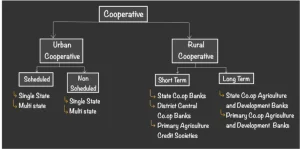
  • UCBs are cooperative societies registered under either the State Cooperative Societies Act or the Multi-State Cooperative Societies Act
  • They are granted a banking license under the Banking Regulation Act, 1949, and operate as primary cooperative banks.
  • Current Status of UCBs in India
    • As of March 31, 2025, there are 1,457 Urban Cooperative Banks (UCBs) in India.
    • Asset Quality:
      • Gross NPA ratio: 6.2%
      • Net NPA ratio: 0.7% 
      • Provisioning coverage ratio: 90.1%
    • Assets and Deposit Growth: 
      • Total assets of UCBs stood at Rs 7.38 lakh crore.
      • Total deposits were Rs 5.84 lakh crore, a significant increase from 2015.
  • Regulatory Framework and Dual Control
    • Reserve Bank of India (RBI) Regulation: Since 1966, the RBI has regulated UCBs, overseeing functions such as licensing, capital adequacy, loan policies, prudential norms, and ensuring financial stability.
    • Registrar of Cooperative Societies (RCS): The administrative and management aspects of UCBs are regulated by the Registrar of Cooperative Societies (RCS), under the supervision of either the state or central government.

Tiered Regulatory Structure

  • UCBs are classified into four tiers by the RBI based on their deposit size, allowing for proportionate regulation and supervision to ensure effective oversight.
    • Tier 1 UCBs: Deposit Size Up to ₹100 crore.
    • Tier 2 UCBs: More than ₹100 crore and up to ₹1,000 crore.
    • Tier 3 UCBs: More than ₹1,000 crore and up to ₹10,000 crore.
    • Tier 4 UCBs: More than ₹10,000 crore

Challenges in Granting UCB Licences

  • Governance Risks: Capital raising challenges and volatility in capital structure due to share characteristics.
  • Lack of Investment Incentives: The “one member, one vote” principle makes it difficult to attract growth capital.
  • Weak Governance in Small UCBs: Issues such as management fraud, poor governance, and lack of domain knowledge among board members.
  • Regulatory and Legal Barriers: Despite amendments to the Banking Regulation Act (1949), court interventions have slowed governance reforms.

Check Out UPSC CSE Books

Visit PW Store

online store 1

Difference Between UCBs and Commercial Banks

Aspect Urban Cooperative Banks (UCBs) Commercial Banks
Ownership UCBS are owned by their members, who are both depositors and borrowers under the cooperative principle. Commercial Banks are owned by shareholders, which may include the Government (in PSBs), institutions, or private investors.
Regulation They are subject to dual regulation, where the RBI regulates banking operations, while State Governments/Central Government regulate management and incorporation. They are regulated solely by the Reserve Bank of India (RBI) under the Banking Regulation Act, 1949.
Lending Focus They Primarily lend to small traders, salaried persons, self-employed individuals, and MSMEs in urban and semi-urban areas. They have a diversified lending portfolio, including large industries, infrastructure, MSMEs, agriculture, retail, and services sectors.
Voting Rights Follows the “one member, one vote” principle, irrespective of the number of shares held. Follow the “one share, one vote” principle, where voting rights are proportional to shareholding.

Need help preparing for UPSC or State PSCs?

Connect with our experts to get free counselling & start preparing

Aiming for UPSC?

Download Our App

      
Quick Revise Now !
AVAILABLE FOR DOWNLOAD SOON
UDAAN PRELIMS WALLAH
Comprehensive coverage with a concise format
Integration of PYQ within the booklet
Designed as per recent trends of Prelims questions
हिंदी में भी उपलब्ध
Quick Revise Now !
UDAAN PRELIMS WALLAH
Comprehensive coverage with a concise format
Integration of PYQ within the booklet
Designed as per recent trends of Prelims questions
हिंदी में भी उपलब्ध

<div class="new-fform">


    </div>

    Subscribe our Newsletter
    Sign up now for our exclusive newsletter and be the first to know about our latest Initiatives, Quality Content, and much more.
    *Promise! We won't spam you.
    Yes! I want to Subscribe.