At COP30 (Belem, 2025), waste and circularity were placed at the centre of climate negotiations, with emphasis on reducing methane through initiatives such as “No Organic Waste (NOW)”.
- COP30 called upon cities to accelerate circularity initiatives where waste is recognised as a resource.
- India’s Mission LiFE (Lifestyle for Environment), announced at COP26, promotes conscious consumption and sustainable lifestyles, and is strongly grounded in the philosophy of circular economy.
Urban Waste Challenge in India
- Rapid Urbanisation: India’s expanding cities face a stark choice between clean, liveable urban spaces and waste-ridden environments, with many cities failing to meet global environmental health standards.
- Rising Waste Volumes: Urban India is projected to generate 165 million tonnes of waste annually by 2030, increasing to 436 million tonnes by 2050 as the urban population reaches 814 million.
- Climate and Health Impact: Waste-related emissions could exceed 41 million tonnes of greenhouse gases, posing risks to public health, productivity, and climate targets.
- Methane Link: Decomposing organic waste in landfills releases methane, a greenhouse gas with higher global warming potential than CO₂, making waste management a key climate mitigation strategy.
What are Linear and Circular Economy Models ?
- Linear Economy Model
- Concept: The linear economy model follows a “take, make and dispose” approach, where resources are extracted, converted into products, and discarded after use.
- Resource Inefficiency: This model results in excessive resource extraction, large volumes of waste, and environmental degradation.
 Circular Economy Model
-
- Concept: The circular economy model treats waste as a resource and aims to keep materials in use for as long as possible.
- It focuses on minimising waste generation and maximising resource recovery through reuse, recycling and energy recovery.
- Sustainability Advantage: Circularity supports inclusive growth by creating green jobs, reducing emissions and improving urban environmental quality.
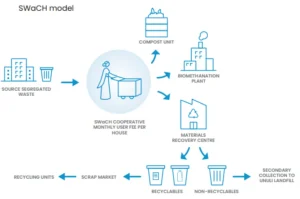
- Example: Pune’s SWaCH model integrates waste-pickers in a pro-poor partnership for door-to-door collection and recycling, showing how circularity can be socially inclusive
Trends and Status of Urban Waste in India
- Organic Waste Dominance: Over 50% of municipal waste is organic and can be managed through composting and bio-methanation.
- Green Energy Potential: Compressed Biogas (CBG) plants enable conversion of wet waste into green fuel, while complete combustion can also generate electricity.
- Example: Indore pursued 100% door-to-door collection and segregation and has implemented wet-waste processing systems, demonstrating how governance + infrastructure can drive circularity
- Dry Waste Challenge: Approximately one-third of urban waste is dry waste, including plastics, metals and paper, which requires efficient segregation and recycling systems.
- Construction and Demolition Waste: Around 12 million tonnes of waste are generated by Construction and demolition activities annually, contributing to dust pollution and land degradation.
- Example: Greater Chennai Corporation has moved toward strict enforcement by penalising and seizing vehicles dumping debris illegally, reflecting the need for deterrence
Regulatory Frameworks in India
- Swachh Bharat Mission (Urban): The Swachh Bharat Mission provides the overarching policy framework for urban sanitation, solid waste management and cleanliness.
- Solid Waste Management Rules, 2016: These rules mandate segregation at source, door-to-door collection, scientific processing and safe disposal of municipal waste.
- Example: Bidhannagar Municipal Corporation (Kolkata) implemented structured user fees and penalties linked to SWM Rules, reflecting a push toward compliance-based urban waste governance.
- C&D Waste Management Rules, 2016: The rules assign responsibility to bulk generators and require local bodies to establish recycling and processing facilities.
- Environment (C&D) Waste Rules, 2025: These rules, effective from April 1, 2026, aim to strengthen compliance and improve accountability in construction waste management.
- Extended Producer Responsibility: It seeks to make producers accountable for the collection, recycling and disposal of plastic and other dry waste.
- Wastewater Reuse Framework: Urban missions such as AMRUT and Swachh Bharat Mission promote wastewater recycling and reuse to enhance urban water security.
- Example: Surat Municipal Corporation established tertiary treatment capacity to convert wastewater into a reusable economic resource, supporting circular water governance
- Example: Nagpur’s reclaimed water reuse project supplies treated municipal wastewater for cooling at Koradi Thermal Power Plant and has been documented as an operational water circularity case in World Bank
Challenges in Achieving Circularity
- Source Segregation Deficit: Segregation of waste at source remains weak due to limited awareness and inconsistent citizen participation.
- Municipal Capacity Constraints: Urban local bodies face financial, technical and manpower shortages in implementing circular waste management systems.
- Infrastructure Gaps: Insufficient material recovery facilities, recycling plants and waste-to-energy infrastructure hinder effective waste processing.
- Market Viability Issues: Recycled products face quality concerns, limited consumer trust and weak market linkages.
- EPR Implementation Gaps: Extended Producer Responsibility has not been uniformly enforced across all categories of dry waste.
- C&D Waste Traceability: Construction and demolition waste management suffers from weak identification, tracking and integration with building regulations.
- Institutional Fragmentation: Poor coordination among municipal bodies, pollution control boards and urban planning authorities weakens policy implementation.
- Behavioural Barriers: Rising consumerism and rapid product obsolescence undermine the principles of reducing and reusing materials.
- Monitoring Deficiencies: Lack of robust testing, monitoring and data systems affects the credibility and scalability of circular economy initiatives.
Case Study: Solid and Liquid Resource Management in Ambikapur city, Chhattisgarh
- Ambikapur implemented an effective SLRM model with door-to-door waste collection and scientific disposal, led by women from Self Help Groups.
- The city converted a 16-acre dumpsite into a sanitation awareness park and became a bin-free city.
- The initiative created green jobs, cut land acquisition costs, and highlighted the importance of home and community composting.
|


 3 Jan 2026





.png)






 Current Affairs




 GS Foundation
 Optional Course
 Combo Courses
 Degree Program