US Attack on Iranian Frigate IRIS Dena Near Sri Lanka: Maritime Law and Indian Ocean Security

6 Mar 2026

US Attack on Iranian Frigate IRIS Dena Near Sri Lanka: Maritime Law and Indian Ocean Security

Recently, a U.S. submarine torpedoed the Iranian frigate IRIS Dena near Sri Lanka in international waters, raising legal and security concerns in the Indian Ocean region.

Also Read | IAS Final Result

PWOnlyIAS ExtraEdge

About Torpedo

  • A torpedo is a self-propelled, cigar-shaped underwater weapon launched from submarines, surface ships, or aircraft to destroy enemy vessels or submarines
  • It travels underwater and explodes upon contact or proximity to its target.

Applications

  • Anti-Submarine Warfare (ASW): Lightweight torpedoes are deployed by helicopters and ships to hunt submarines.
  • Anti-Surface Warfare (ASuW): Heavyweight torpedoes are used by submarines to destroy large ships.
  • Defensive Measures: Used to counter other torpedoes in modern naval engagements

About the U.S. Attack in the Indian Ocean Region

  • Incident near Sri Lanka: A U.S. submarine attacked the Iranian warship IRIS Dena about 40 nautical miles off Galle, causing heavy casualties and sinking the vessel.
  • Iranian Frigate IRIS DenaParticipation in Maritime Exercise: The Iranian frigate had earlier participated in the International Fleet Review 2026 and MILAN Naval Exercise hosted by Indian Navy at Visakhapatnam
  • Expansion of West Asian Conflict: The attack extended the ongoing US–Israel–Iran conflict beyond West Asia into the Indian Ocean Region.
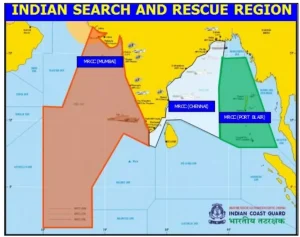
  • Search and Rescue Response: The Sri Lanka Navy conducted rescue operations under the International Convention on Maritime Search and Rescue, saving several sailors.
    • The Indian Coast Guard is responsible for executing /Coordinating Search and Rescue (SAR) missions in the Indian Maritime Search and Rescue Region (ISRR).

Convention on Maritime Search and Rescue (SAR), 1979

  • The International Convention on Maritime Search and Rescue (SAR), 1979, is a crucial international treaty developed by the International Maritime Organization (IMO)
  • Objective:  To ensure that no matter where an incident occurs, the rescue of persons in distress at sea is coordinated by a structured, international system.
  • It fills a critical gap in maritime law by organizing, rather than just requiring, the assistance of people in danger at sea

Key Concerns Regarding the Attack in the Indian Ocean

Iranian Frigate IRIS Dena

  • Escalation of Maritime Conflict: Military confrontation in international waters risks turning the Indian Ocean into an expanded theatre of global conflict.
  • Legal Ambiguity under Maritime Law: The United Nations Convention on the Law of the Sea (UNCLOS) mainly governs peacetime maritime activities and does not clearly regulate naval warfare.
  • Security Implications for India: The incident occurred near India’s maritime neighbourhood, raising concerns about naval security and sea lane safety.
  • Risks to Global Shipping: Escalation of conflict threatens vital international sea routes used for energy transport and trade.

PWOnlyIAS ExtraEdge

Key Areas Defined Under UNCLOS

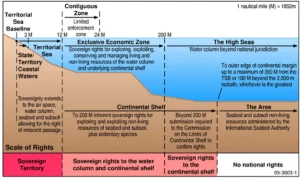
  • The UNCLOS (1982) establishes a legal framework governing maritime boundaries, navigation rights, and marine resource management.
  • Origin: UNCLOS replaced earlier 1958 Geneva Conventions and emerged from the Third UN Conference on the Law of the Sea (1973–1982) to create a comprehensive law of the seas.
  • Major Maritime Zones: Territorial Sea (Up to 12 nautical miles)
    • Coastal states exercise full sovereignty, though foreign ships enjoy the right of innocent passage.
  • Contiguous Zone (Up to 24 nautical miles): Coastal states can enforce laws related to customs, immigration, taxation, and pollution.
  • Exclusive Economic Zone – EEZ (Up to 200 nautical miles): Coastal states have exclusive rights to explore and exploit marine resources while allowing freedom of navigation.
  • Continental Shelf: Coastal states enjoy sovereign rights over seabed resources beyond territorial waters, potentially extending beyond 200 nautical miles.
  • High Seas / International Waters: Areas beyond national jurisdiction where all states enjoy freedom of navigation, overflight, and scientific research

Check Out UPSC CSE Books

Visit PW Store

online store 1

Way Forward

  • Strengthening Maritime Governance: Countries should adhere to international maritime laws and norms to maintain stability in global waters.
  • Diplomatic Conflict Resolution: International disputes should be resolved through dialogue and multilateral platforms rather than military escalation.
  • Enhancing Regional Maritime Security: India and regional powers should strengthen cooperation in the Indian Ocean Region to ensure secure sea lanes.
  • Clarifying Legal Framework for Naval Warfare: The global community should develop clearer legal guidelines on maritime warfare alongside UNCLOS provisions.

Need help preparing for UPSC or State PSCs?

Connect with our experts to get free counselling & start preparing

Aiming for UPSC?

Download Our App

      
Quick Revise Now !
AVAILABLE FOR DOWNLOAD SOON
UDAAN PRELIMS WALLAH
Comprehensive coverage with a concise format
Integration of PYQ within the booklet
Designed as per recent trends of Prelims questions
हिंदी में भी उपलब्ध
Quick Revise Now !
UDAAN PRELIMS WALLAH
Comprehensive coverage with a concise format
Integration of PYQ within the booklet
Designed as per recent trends of Prelims questions
हिंदी में भी उपलब्ध

<div class="new-fform">


    </div>

    Subscribe our Newsletter
    Sign up now for our exclusive newsletter and be the first to know about our latest Initiatives, Quality Content, and much more.
    *Promise! We won't spam you.
    Yes! I want to Subscribe.