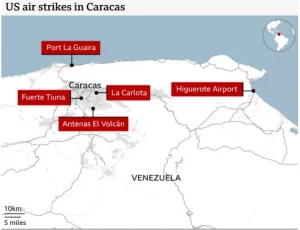
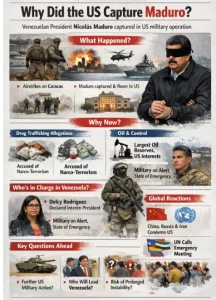
Recently, the United States carried out Operation Absolute Resolve, capturing and removing Venezuelan President Nicolás Maduro in Caracas, Venezuela.
- The move marked a shift from diplomatic pressure to direct military intervention, with the US announcing temporary control over Venezuela and plans to sell its oil, reshaping regional geopolitics.
Why Did the US Capture Nicolas Maduro?
About Venezuela and its Global Importance
- Venezuela, officially the Bolivarian Republic of Venezuela, is located on the northern coast of South America.
- Rich in natural resources and strategically located, it has historically played a critical role in global energy markets and geopolitics.
- In recent decades, the country has been at the center of regional instability and international diplomatic debates.
Key Highlights & Global Importance
- Energy Superpower: Holds the world’s largest proven oil reserves (~300 billion barrels) and significant gas reserves in the Orinoco Belt; a key OPEC member, influencing global oil prices and energy security.
- Geopolitical Significance: Strategically located in the Caribbean, near the U.S., serving as a geopolitical pivot; alliances with Russia, China, Turkey, and Iran challenge U.S. dominance in the region.
- Regional Influence & Stability: Active in Latin American politics through ALBA (Bolivarian Alliance for the Peoples of Our America), UNASUR (Union of South American Nations), and CELAC (Community of Latin American and Caribbean States); domestic crises lead to mass migration (~7 million), affecting neighboring countries, trade, and regional security.
- Economic and Humanitarian Challenges: Hyperinflation, political instability, and humanitarian crises impact global oil markets, investment flows, and humanitarian aid channels.
- Diplomatic Flashpoint: Venezuela’s political crisis tests international law, sovereignty norms, and multilateral diplomacy, drawing attention at forums like the UN.
- Global Impact: Changes in oil production, sanctions, or internal instability influence global energy prices, inflation, migration patterns, and geopolitical alignments.
|
- “Don-roe Doctrine” in Action: The 2026 intervention marked the operationalisation of Trump’s rebranded Monroe Doctrine, asserting US dominance in the Western Hemisphere through direct action rather than diplomacy.
- Narco-State Justification: The US Justice Department portrayed President Nicolás Maduro as the head of a narco-state, citing criminal indictments linking him to the Tren de Aragua network and alleged conspiracies to traffic cocaine and fentanyl into the United States.
- The US argues that under Maduro, organised drug trafficking became embedded within state structures, with illicit revenues sustaining regime survival and influencing state policy—a phenomenon commonly described as narco-terrorism.
- Narco-terrorism: It refers to a situation where organised drug trafficking networks systematically fund, influence, or become embedded within state institutions, blurring the line between criminal enterprise and political authority.
- Fentanyl: It is a synthetic opioid, 50–100 times more potent than morphine, legally used as a painkiller but increasingly trafficked illegally, contributing to a severe overdose crisis in the United States.
- Why Fentanyl Is a Public Concern in the US?
-
- The United States increasingly frames fentanyl trafficking as a national security threat, not merely a public health issue, due to its role in mass overdose deaths and financing organised crime networks.
Resource Curse Theory
- About Resource Curse Theory: The Resource Curse Theory argues that countries rich in natural resources (oil, gas, and minerals) often experience slower economic growth, weaker institutions, authoritarianism, corruption, and conflict, external intervention, instability, and regime change rather than broad-based development.
- Historical Examples: Iraq, Libya, Venezuela.
|
- Failure of Sanctions & Diplomacy: Years of economic sanctions, diplomatic isolation, and opposition backing failed to dislodge Maduro, prompting a shift to coercive regime change.
- Energy Imperialism & Oil Control: Venezuela’s 300+ billion barrels of proven oil reserves were central. The US openly signalled intent to temporarily govern Venezuela, rebuild its oil sector, and make supplies accessible to US energy companies.
- Venezuela possesses the world’s largest proven crude oil reserves, exceeding even Saudi Arabia, making control over its energy sector strategically significant for global oil markets and geopolitics.
- Countering Great Power Rivals: Removing Maduro was aimed at dismantling a strategic foothold for China and Russia, which had deepened military, economic, and technological ties with Caracas.
- Regional Stability Narrative: The move was framed as necessary to address state collapse, refugee flows, organised crime, and instability spilling across Latin America.
The Monroe Doctrine
- Origin and Core Principle (1823): Named after President James Monroe, the doctrine opposed new or expanding European colonisation in the Americas, presenting the Western Hemisphere as a distinct political sphere.
- Initially Symbolic in Nature: At inception, it was largely a declaratory policy with limited enforcement capacity, relying on British naval power and moral signalling rather than US military strength.
- Expansion into Hemispheric Dominance: Over time, the US reinterpreted the doctrine to treat Latin America as its strategic backyard, asserting exclusive influence over Central and South America.
- Institutionalisation of Interventionism: Through the Roosevelt Corollary (1904) and Cold War policies, the doctrine justified direct military and political interventions, often to counter perceived ideological threats.
- Extensive Historical Use: Between 1898 and 1994, the US intervened at least 41 times to change governments in Latin America, frequently citing national security and anti-communist rationales.
- Post–Cold War Dilution: Recent US administrations softened or avoided Monroe Doctrine rhetoric, acknowledging its association with neo-imperialism and regional distrust.
- Contemporary Revival (“Don-roe Doctrine”): Under Donald Trump, the doctrine has been revived in a coercive form, emphasising military action, resource control, and exclusion of rival powers, as seen in Venezuela.
Limits of the ‘Don-roe Doctrine’- Domestic Pushback
- Contradiction with MAGA Doctrine: Trump’s “Make America Great Again” platform was built on ending “forever wars” and avoiding overseas entanglements.
- His statement that the US would “run Venezuela” until a transition risks signalling open-ended involvement, unsettling his own political base.
- Emerging Intra-Party Dissent: Prominent MAGA-aligned figures publicly criticised the intervention, calling it a continuation of US’s military-industrial politics, funded by American taxpayers.
- Republican Ideological Split: Prominent figures also highlighted inconsistencies between the legal rationale (narco-terrorism indictments) and Trump’s political justification (oil recovery and fentanyl control), exposing strategic incoherence.
- Implications for Sustainability: Such domestic resistance could constrain the duration, funding, and legitimacy of US involvement, increasing the risk of a hasty or unstable exit.
|
Historical Context
- The 2024 Election Trigger: The crisis escalated after the disputed 2024 presidential elections, in which opposition leaders presented evidence of a landslide victory.
- President Nicolás Maduro’s refusal to step down led to the complete collapse of the Barbados Agreement, ending prospects for a negotiated democratic transition.
The Barbados Agreement
- About: It refers to a set of political and electoral understandings reached in October 2023 between the Venezuelan government and the opposition, mediated by Norway and supported by international stakeholders.
- Aim: The agreement aimed to ensure free, fair, and credible presidential elections, including commitments to lift bans on opposition candidates, allow international election observers, and create conditions for a peaceful democratic transition.
- Collapse of Agreement: However, the agreement collapsed after the Maduro government failed to implement key provisions, including restrictions on opposition leaders and disputed electoral processes, thereby undermining prospects for a negotiated political settlement.
|
- The 2025 Military Buildup: By mid-2025, the US significantly expanded its naval presence in the Caribbean, conducting pre-emptive actions against drug-smuggling networks and illicit oil shipments.
- These moves aimed to cripple the regime’s shadow economy and marked a shift from sanctions-led pressure to military coercion.
- Generational and Ideological Rivalry: The confrontation traces back to Hugo Chávez’s 1999 Bolivarian Revolution, which replaced a US-aligned liberal democratic model with an anti-imperialist socialist order.
- This ideological shift resulted in decades of sanctions, diplomatic estrangement, and strategic hostility between Washington and Caracas.
United States–Venezuela Relations- 26-Year Overview
- Chavez Era (1999–2013): Hugo Chavez launched the Bolivarian Revolution, nationalised the oil sector, and pursued an anti-United States, left-wing foreign policy, strengthening ties with Russia, China, and Iran.
- Relations deteriorated due to accusations of authoritarianism, expulsion of United States-backed Non-Governmental Organisations (NGOs), and the 2002 coup attempt, which Venezuela blamed on the United States.
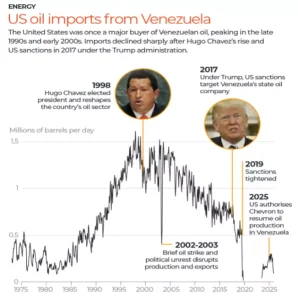 Maduro’s Rise and Early Tensions (2013–2019): Nicolas Maduro assumed power amid economic decline and corruption scandals.
- The United States imposed sanctions on officials and key sectors.
- Hyperinflation, food and medicine shortages, and mass migration escalated.
- Disputed elections in 2018 sparked political crises; opposition leader Juan Guaidó gained recognition from the United States and its allies.
- Escalation under Trump’s Second Term (2025):
- Military Build-up: The United States deployed the USS Gerald R Ford, other warships, troops, and F-35 Lightning II stealth jets near the Caribbean Sea.
- Designation of “Cartel de los Soles”: The United States labelled it a terrorist organisation, accusing Maduro of leading it.
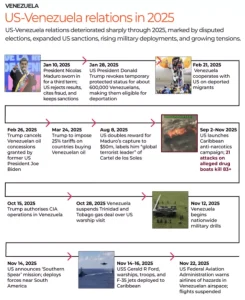 Central Intelligence Agency (CIA) Operations and Sanctions: Trump authorised covert CIA operations, increased oil sanctions, and issued Federal Aviation Administration (FAA) travel advisories.
- Venezuelan Response: Maduro denounced United States actions and conducted nationwide military drills, highlighting heightened tensions.
Current Dynamics & Key Flashpoints (2026)
- Leadership Standoff: Following Maduro’s removal, Venezuela’s Supreme Court appointed Vice-President Delcy Rodríguez as Interim Leader.
- She has adopted a defiant stance, declaring Maduro the “only legitimate president” and warning of a prolonged national resistance.
- Democratic Hopes vs External Control: Opposition leader María Corina Machado, operating from exile, has called for a civilian-led democratic transition.
- However, US statements downplaying her role suggest a potential clash between external military “management” and domestic democratic aspirations.
- Emerging Security Vacuum: The mobilisation of Colectivos (pro-government militias) and the possibility of Cuban security involvement raise fears of an asymmetric insurgency, risking Venezuela’s descent into a long-term low-intensity conflict.
| Comparison of Stances in the 2026 Crisis |
| Issue |
United States Position |
Venezuelan Regime Stance |
| Legal Basis |
- Enforcement of criminal indictments for narco-terrorism
|
- State terrorism through the illegal capture of a sitting Head of State
|
| International Law |
- Invocation of Responsibility to Protect (R2P) and transnational drug enforcement
|
- Violation of UN Charter Article 2(4) on sovereignty and use of force
|
| Oil Management |
- “Reconstruction” by deploying US energy firms to revive infrastructure
|
- “Theft” and plunder of sovereign national wealth
|
The Indian Perspective
- Principled Commitment to Sovereignty: India’s response reflects its long-standing support for state sovereignty, non-intervention, and international law, consistent with its strategic autonomy and United Nations-centric diplomacy.
- The principle of non-intervention, enshrined in Article 2(7) of the UN Charter, prohibits external interference in the internal affairs of sovereign states and remains a cornerstone of the post-colonial international order.
- India remains cautious of externally imposed regime change, given the risks of precedent and selective application.
- Measured Diplomatic Signalling: The Ministry of External Affairs (MEA) issued a carefully worded statement expressing “deep concern”, urging all parties to respect sovereignty and international law, while avoiding explicit condemnation of the United States.
- This calibrated silence also reflects the need to preserve India–US strategic convergence and ongoing bilateral trade negotiations.
- Energy and Economic Stakes: Venezuela remains significant for India’s energy security.
- Historically, India imported USD 6–7 billion worth of Venezuelan crude annually, though US sanctions had curtailed imports, prompting diversification towards Russia, the Gulf countries, the United States, Saudi Arabia, and Iraq.
- ONGC Videsh Limited (OVL) has substantial investments in Venezuelan oil fields, including the San Cristobal projects, which could be at risk in case of regime change or prolonged conflict.
- A sustained escalation in South American geopolitical tensions may trigger spikes in Brent crude prices, affecting India’s oil import bill; however, as long as prices remain near $60 per barrel, the fiscal impact is manageable due to diversified import sources.
- The US intervention also represents a historic geopolitical shift, expanding US’s strategic sphere of influence in Latin America and raising concerns about the safety of oil infrastructure, potential supply chain disruptions, and global oil market volatility.
- Global South Leadership: As a leading voice of the Global South, India is attentive to how unilateral interventions affect South–South solidarity and norms against coercive regime change, especially in resource-rich developing states.
- Multilateral Mediation Role: India may engage through BRICS or United Nations platforms to advocate a civilian-led, inclusive political transition, resisting outcomes that reduce Venezuela to a proxy or puppet state, while upholding the principle of non-intervention.
- Consular and Humanitarian Priorities: Ensuring the safety of Indian nationals and supporting humanitarian access remain immediate operational concerns.
| International Reactions |
| Region / Actor |
Reaction |
| Latin America |
- Mixed Responses: Colombia, Brazil, and Panama cautiously acknowledged US influence; Colombia, Cuba, Nicaragua, Bolivia, and Mexico condemned the intervention as illegal aggression.
- The Colombian government condemned Washington’s early Saturday morning attacks on Venezuela.
|
| Russia & China |
- Strong Condemnation: Labeled the act as US imperialism, warning against further military encroachment in the Western Hemisphere; pledged support to Venezuela.
|
| European Union |
- Called for restraint, dialogue, and adherence to international law; stopped short of explicitly condemning the US, reflecting energy and strategic ties.
|
| United Nations |
- The UN Secretary-General expressed concern over sovereignty violations; potential debates in the Security Council expected, with the US likely to use veto power.
|
| Global South |
- Largely critical, framing it as a precedent of coercive intervention threatening principles of non-interference.
|
Global Impact of the US Capture of Maduro
- Shift in Intervention Norms: The operation marks a significant departure from traditional diplomatic and economic pressure toward direct military intervention against a sitting head of state, raising concerns about the erosion of sovereignty norms under international law.
- Energy Market Volatility: Venezuela holds the world’s largest proven oil reserves (300+ billion barrels). US control and planned exploitation of these reserves could reshape global oil prices, affect OPEC dynamics, and impact energy security for developing nations.
- Great-Power Rivalry Intensification: The capture disrupts Russian and Chinese influence in Latin America, where both countries had established economic, military, and technological footholds. This may trigger countermeasures or heightened strategic posturing in the region.
- Global South and Multilateralism: Many Global South nations view the intervention as a violation of sovereignty, potentially weakening UN-based conflict resolution mechanisms and encouraging unilateral approaches by powerful states.
- Security and Migration Consequences: Political instability could exacerbate refugee flows, human trafficking, and narcotics smuggling, impacting regional and global security architectures.
- Taiwan and Strategic Signaling:
- Shift in Intervention Norms: The US operation in Venezuela demonstrates the willingness to act unilaterally, signaling that traditional deterrence and diplomatic pressure can be overridden by direct military action.
- Deterrence vs. Emboldenment: While some fear China could cite the Venezuela precedent to justify action against Taiwan, the display of US military capability may instead deter China from misadventures in the near term.
- Great-Power Rivalry Intensification: The operation underscores US resolve to counter Chinese influence globally, including in strategic regions such as the Indo-Pacific, reinforcing the stakes in Taiwan.
- Implications for Chinese Ambitions: Expansion of China’s Belt and Road Initiative and overseas influence faces limits, signaling that US action can disrupt China’s strategic calculations.
Challenges & Concerns Arising from the US Intervention in Venezuela
- Sovereignty and International Law: The capture of a sitting head of state by a foreign military represents an extraordinary escalation in international conduct, blurring the boundaries between law enforcement, regime change, and armed intervention.
- Violation of Sovereignty: The capture of a sitting head of state sets a precedent for extraterritorial military interventions, undermining Article 2(4) of the UN Charter.
- Erosion of International Norms: Raises fears that powerful states can bypass diplomacy or Security Council approval, weakening multilateral conflict-resolution mechanisms.
- Regional Stability Risks: Disruption of state control may enhance drug trafficking and organised crime, affecting regional security.
- Asymmetric Conflict: Mobilisation of Colectivos (pro-regime militias) and potential Cuban involvement increases the risk of a protracted insurgency.
- Refugee Flows: Political instability could trigger mass migration into neighbouring countries, straining resources and creating humanitarian crises.
- Energy and Economic Concerns: US control of Venezuela’s 300+ billion barrels of crude could distort prices and affect OPEC dynamics.
- Access for Developing Countries: Nations like India and China may face limited access to Venezuelan oil, affecting energy diversification strategies.
- Geopolitical Tensions: The intervention directly challenges Russian and Chinese influence in Latin America, increasing the likelihood of strategic escalation.
- Global South Distrust: Developing nations may perceive this as US imperialism, complicating future cooperation on multilateral platforms like BRICS or the UN.
- Democratic Legitimacy and Governance: US-led temporary administration risks marginalising Venezuelan democratic actors like María Corina Machado.
- Long-Term Governance Gap: Unclear timelines for restoring local control may result in political vacuum, weakening institutions and rule of law.
Way Forward
- Transition to Multilateral Oversight: The US must shift from directly “running” Venezuela to a United Nations–Organization of American States (UN–OAS) monitored framework, ensuring inclusive elections and restoring legitimacy to the political process.
- Multilateral supervision would help prevent perceptions of a proxy or puppet state and uphold international norms.
- Institutional Rebuilding: Restoration of the National Assembly’s authority is crucial to prevent a colonial-style occupation.
- Strengthening domestic institutions is key to ensuring rule of law and sustainable governance.
- Inclusive Dialogue and Reconciliation: Stability cannot be achieved if “Chavista” supporters are entirely sidelined.
- A Chavista refers to a supporter or adherent of Chavismo, the political ideology associated with Hugo Chávez, the former President of Venezuela.
- A South African–style Truth and Reconciliation approach may be necessary to heal societal divisions, prevent insurgency, and integrate former regime supporters into a peaceful political framework.
- Security and Humanitarian Measures: Immediate measures should protect civilians, refugees, and foreign nationals, while disarming and integrating armed militias (Colectivos).
- Humanitarian aid should be delivered via multilateral channels to avoid politicisation.
- Energy and Economic Stabilisation: Venezuela’s oil sector must be managed transparently, with equitable access for global markets to prevent monopolisation by any single power.
- Ensuring economic stability is essential to support political transition and regional security.
Conclusion
The 2026 capture of Nicolás Maduro sets a perilous precedent for unilateral intervention. For India, sovereignty, dialogue, and multilateralism are strategic imperatives, while inclusive transition and civilian protection remain key to restoring Venezuela’s legitimacy and stability.


 5 Jan 2026





.png)





 Current Affairs






 GS Foundation
 Optional Course
 Combo Courses
 Degree Program