Recently, the observance of World Water Day (22 March 2026) brought renewed global focus on the growing challenge of water security, particularly under the theme “Water and Gender”, which highlights inequities in access and burden-sharing.
- Freshwater Systems Under Unsustainable Stress: This comes amid rising global concern that freshwater systems are approaching unsustainable limits, with increasing evidence of groundwater depletion, river pollution, erratic rainfall, and climate-induced hydrological stress.
- India’s Intensifying Water Stress Scenario: Despite being home to a large share of the global population, India’s per capita water availability has steadily declined, placing it in the category of water-stressed countries.
- The discourse around water is thus shifting from a developmental concern to a strategic, ecological, and human security issue.
About World Water Day
- Observed on: 22 March every year, as declared by the United Nations in 1992 (Rio Earth Summit), first celebrated in 1993.
- Objective: To raise awareness on global water issues—including water scarcity, pollution, sanitation, and sustainable management—and to promote action for universal access to safe water.
- Theme-based Approach: Each year has a specific theme (e.g., glaciers, groundwater, wastewater), aligned with global priorities and linked to UN-Water initiatives.
- Link with SDGs: Closely connected with SDG 6 (Clean Water and Sanitation) under the Sustainable Development Goals, focusing on equitable and sustainable water access.
- Global Participation: Observed worldwide through campaigns, policy dialogues, community programs, and educational events, involving governments, NGOs, and civil society.
- India’s Context: Highlights critical challenges such as groundwater depletion, water stress, river pollution, and climate impacts, reinforcing initiatives like Jal Jeevan Mission and water conservation drives.
|
Enroll now for UPSC Online Course
About Water Security
- Concept and Definition: Water security refers to the ability of a society to ensure adequate, reliable, equitable, and sustainable access to water of acceptable quality, while simultaneously protecting ecosystems and managing risks such as droughts, floods, and contamination.
- It represents a holistic governance framework, integrating resource management, social justice, environmental sustainability, and disaster resilience, rather than being confined to mere physical availability of water.
- Shift from “Water Scarcity” to “Water Insecurity”: The contemporary discourse has evolved from a narrow focus on physical scarcity to a broader understanding of water insecurity, which includes:
- Quality degradation (pollution and contamination)
- Inequitable access across regions and communities
- Unreliable supply due to seasonal and climatic variability
- Institutional and governance failures.
- Thus, even water-abundant regions may experience seasonal shortages and unsafe water, indicating that water security is fundamentally a management challenge.
Core Pillars of Water Security
- Availability → Adequacy of Water Resources: Water security requires sufficient surface and groundwater resources to meet competing demands of agriculture, industry, domestic use, and ecosystems.
- In India, per capita water availability has declined sharply due to population growth and over-extraction.
- Excessive dependence on groundwater (over 60% irrigation) has led to aquifer depletion, especially in north-western India.
- Availability is increasingly constrained by climate variability, overuse, and unsustainable extraction patterns.
- Accessibility → Equity in Distribution: Accessibility emphasizes equitable and inclusive distribution of water, ensuring that all sections of society—irrespective of geography or socio-economic status—can access water.
- Despite expansion of rural tap water coverage under schemes like Jal Jeevan Mission, regional and social disparities persist.
- Women and marginalized communities often bear a disproportionate burden of water collection, reflecting gendered water inequality.
- Water insecurity is often a result of unequal access rather than absolute scarcity.
- Quality → Safety and Potability: Water security requires that water be safe for human consumption and ecological health, free from contaminants.
- India faces widespread issues of chemical contamination (arsenic, fluoride, nitrates) and biological pollution.
- According to the Central Pollution Control Board, only about 29% of urban wastewater is treated, leading to river and groundwater pollution.
- Poor water quality transforms a resource issue into a public health crisis, increasing disease burden and economic costs.
- Resilience and Sustainability → Long-Term Security: This pillar focuses on the capacity of water systems to withstand shocks and ensure long-term sustainability.
- Increasing frequency of floods, droughts, and extreme weather events reflects declining resilience.
- Reports like the NITI Aayog Composite Water Management Index highlight that hundreds of millions face high water stress.
- Sustainable water security requires ecosystem conservation, demand management, and climate-adaptive planning.
Case Study- Jal Saheli Movement:
- Context (Bundelkhand Water Stress): A drought-prone region in UP–MP where acute water scarcity forced women to spend hours fetching water, leading to time poverty, health risks, and gender inequality.
- Core Problem: Women bore a disproportionate burden of water collection, with limited role in decision-making, weak infrastructure, and rising agrarian distress & migration.
- Intervention (Jal Saheli Initiative): Formation of women-led collectives (~1500+ women, 300+ villages) focusing on community-based water governance, water budgeting, and local planning.
- Key Actions:
- Revival of traditional water bodies (ponds, wells, check dams)
- Rainwater harvesting & groundwater recharge
- Repair and maintenance of handpumps
- Awareness on water conservation practices
- Gender Impact:
- Reduced drudgery & time spent fetching water
- Enhanced women’s leadership and participation
- Shift from “water carriers” to “water managers”
- Water & Livelihood Outcomes:
- Improved local water availability & sustainability
- Better health, sanitation, and livelihoods
- Reduced distress migration and local conflicts
- Key Insight: Demonstrates that gender-inclusive, community-led water governance leads to more efficient, equitable, and sustainable water management, aligning with SDG 5 & SDG 6 and schemes like Atal Bhujal Yojana.
|
Drivers of Water Insecurity in India
- Declining Per Capita Availability and Rising Demand: India’s per capita water availability has declined to ~1486 m³ (2021, Central Water Commission) and is projected to fall further, approaching water-scarcity thresholds.
- This decline reflects the combined effects of population growth, urbanisation, and expanding industrial demand.
- Over-Extraction and Regional Groundwater Imbalances: India is the largest extractor of groundwater globally (~245.64 BCM, Central Ground Water Board 2024), with extraction heavily concentrated in northwestern states such as Punjab, Haryana, and Rajasthan.
- A significant proportion of administrative units are classified as “overexploited blocks”, where extraction exceeds recharge.
- For instance, Gurgaon records extraction levels of ~195%, indicating unsustainable use.
- This pattern is closely linked to cropping patterns and subsidised electricity, which incentivise excessive pumping, leading to aquifer depletion and long-term water insecurity.
- Inefficient Agricultural Practices and Policy Distortions: Agriculture consumes ~80–87% of groundwater, driven by water-intensive crops like rice and sugarcane cultivated even in water-scarce regions.
- Policy instruments such as Minimum Support Price (MSP) and free electricity for irrigation distort incentives, promoting unsustainable water use.
- Water Quality Degradation and Pollution: A large proportion of India’s water bodies are polluted due to untreated sewage, industrial discharge, and agricultural runoff.
- Contamination issues, such as uranium presence in Punjab groundwater, pose serious public health risks, indicating that quality is as critical as quantity.
- Climate Variability and Weak Recharge Systems: Climate change, as highlighted by the Intergovernmental Panel on Climate Change (IPCC), is increasing rainfall variability, drought frequency, and extreme events, while loss of wetlands and recharge zones reduces natural replenishment.
- Institutional Fragmentation and Behavioural Gaps: Water governance is characterised by fragmented institutional responsibilities, weak enforcement, and limited public awareness, reducing policy effectiveness.
Check Out UPSC CSE Books From PW Store
Why Are Concerns Around Water Security Intensifying?
- Shift from Scarcity to Multi-Dimensional Water Insecurity: The global discourse on water has evolved from a narrow focus on physical scarcity to a broader understanding of water insecurity, which includes concerns of quality, accessibility, affordability, and reliability.
- Even regions with adequate water resources are facing seasonal shortages, contamination, and unequal distribution, pointing to systemic failures in governance and infrastructure.
- This reflects a transition towards holistic water security, where equitable and sustainable access becomes as critical as availability.
- Structural and Demand-Side Pressures in India: India’s water stress is rooted in deep structural challenges, including overdependence on groundwater (as the world’s largest extractor), inefficient agricultural practices such as flood irrigation and cultivation of water-intensive crops, and rising demand from urbanisation and industrialisation.
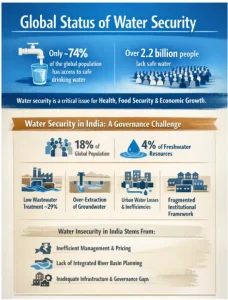 Declining per capita water availability, coupled with inter-state river disputes (e.g., Cauvery, Yamuna), further exacerbates tensions.
- The crisis is less about absolute shortage and more about unsustainable usage patterns, policy distortions, and institutional fragmentation.
- Urban Water Crisis and Growing Inequality: Urban centres are increasingly witnessing a chronic water crisis, characterised by “day-zero” risks, over-reliance on private tankers and groundwater extraction, and aging, inefficient distribution networks with high leakage losses.
- Vulnerable populations in informal settlements face disproportionate access constraints, reinforcing socio-economic inequities.
- This underscores a failure of integrated urban planning, inclusive infrastructure, and sustainable resource governance.
- Climate Change as a Hydrological Disruptor: Climate change is acting as a powerful threat multiplier, intensifying the hydrological cycle through erratic rainfall patterns, frequent floods and prolonged droughts, and glacial retreat in the Himalayas.
- This threatens the long-term sustainability of major river systems like the Ganga and Brahmaputra.
- Consequently, water security is now inseparable from climate resilience, adaptive governance, and disaster risk management frameworks.
- Social and Gender Inequities in Water Access: Water insecurity has pronounced social and gender dimensions, particularly in rural and peri-urban areas where women bear the primary burden of water collection and management.
- This results in time poverty, health risks, reduced educational opportunities, and challenges related to sanitation and dignity, including menstrual hygiene.
- Thus, water access is not merely a resource issue but a question of social justice, equity, and human rights.
- Ecological Degradation & Governance Deficits: Severe water quality degradation due to untreated sewage, industrial effluents, and agricultural runoff has polluted major water bodies, while wetland loss and ecosystem damage have reduced natural water storage and purification capacities.
- These ecological stresses are compounded by fragmented governance structures, lack of aquifer-based management, weak demand-side regulation, and overreliance on supply-side solutions like dams and river interlinking.
- The intensifying crisis ultimately reflects a governance deficit, where ecological sustainability and efficient management have not kept pace with rising demand.
Significance of Water Security
- Economic Stability and Growth: Water security is fundamental to economic stability, as it directly influences agricultural productivity, food supply, and inflation dynamics.
- Agriculture, which consumes a major share of water resources, is highly sensitive to water availability, affecting farmer incomes, rural demand, and overall GDP growth.
- Water scarcity can trigger supply shocks, leading to food inflation and macroeconomic instability.
- Human Development and Public Health: Access to safe and adequate water is central to human development outcomes, particularly health, nutrition, and productivity.
- Unsafe water leads to water-borne diseases such as diarrhoea, cholera, and typhoid, contributing to malnutrition, stunting, and cognitive impairment in children.
- Additionally, exposure to chemical contaminants and heavy metals increases long-term health risks.
- Thus, water security directly shapes human capital formation and workforce efficiency.
- Social Justice and Equity: Water access is deeply linked with social inequalities, often reflecting disparities based on gender, caste, and class.
- Women disproportionately bear the burden of water collection, leading to time poverty, health risks, and limited educational opportunities.
- Marginalised communities often face inadequate and unreliable access, reinforcing structural inequities.
- Therefore, water security is a critical component of inclusive development and social justice.
- Livelihoods, Migration, and Social Stability: Water availability determines livelihood security, especially in agrarian and rural economies.
- Water scarcity leads to crop failures, agrarian distress, and farmer indebtedness, often resulting in distress migration to urban areas. It can also trigger local conflicts over access, particularly in regions with entrenched social hierarchies.
- Hence, water insecurity contributes to economic vulnerability, migration pressures, and social tensions.
- Climate Resilience and Disaster Management: Water security enhances the capacity to manage climate variability and extreme events, including droughts, floods, and erratic rainfall patterns.
- As climate change intensifies the hydrological cycle, effective water management becomes essential for adaptation and disaster risk reduction.
- It is thus integral to building climate-resilient and disaster-resilient systems.
- National and Geopolitical Security: Water is increasingly emerging as a strategic resource, influencing inter-state disputes and transboundary relations.
- Conflicts over river waters, both within and across countries, highlight its importance in federal dynamics and international diplomacy. Agreements such as the Indus Waters Treaty underscore the role of water in maintaining regional stability.
- Water security is therefore central to national security and geopolitical balance.
India’s Initiatives & Actions for Water Security
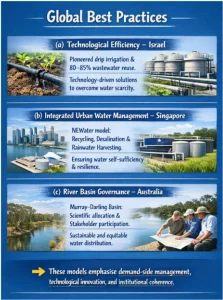
- Universal Drinking Water Access: The Jal Jeevan Mission aims to provide Functional Household Tap Connections (FHTCs) to all rural households, ensuring safe and reliable drinking water while reducing the burden on women and improving health outcomes.
- Sustainable Groundwater Management: The Atal Bhujal Yojana focuses on community-led groundwater management, promoting aquifer-based planning, water budgeting, and behavioural change in water-stressed regions.
- Irrigation Efficiency and Agricultural Reforms: The Pradhan Mantri Krishi Sinchai Yojana (PMKSY) promotes “Per Drop More Crop”, encouraging micro-irrigation techniques (drip and sprinkler systems) to enhance water-use efficiency in agriculture.
- Urban Water Infrastructure Development: The AMRUT Mission aims to improve urban water supply, sewerage networks, and wastewater management, addressing growing urban water demand and infrastructure gaps.
- Policy Framework and Integrated Water Management: The National Water Policy and the National Water Mission emphasise integrated water resource management (IWRM), conservation, and improving water-use efficiency across sectors.
- Emerging Measures: Reuse, Regulation, and Technology: India is increasingly adopting wastewater reuse policies, groundwater regulation frameworks, and digital monitoring systems (IoT, GIS) to improve efficiency, transparency, and sustainability in water governance.
Constitutional Provisions For Access to Water
- Accessibility to Water: Accessibility to Water refers to the availability of adequate, safe, and affordable water for drinking, cooking, and basic domestic needs within a reasonable distance and time from the place of use.
- Water as a Fundamental Right: In India, access to water is a Fundamental Right derived from Article 21 (Right to Life).
- The Supreme Court has repeatedly held that “clean water is a basic element of human rights.”
- It implies that every citizen must have access to sufficient, safe, and affordable water for domestic use.
- State Subject (Entry 17, List II): Water is primarily a State subject covering water supply, irrigation, canals, drainage, water storage, and water power.
- Union List (Entry 56, List I): Parliament can regulate and develop inter-State rivers and river valleys if it serves the public interest.
- Right to Water under Article 21: The Right to Life has been interpreted by the Supreme Court to include the Right to Clean and Safe Drinking Water (e.g., Subhash Kumar v. State of Bihar, 1991).
- Local Governance Empowerment: Articles 243G & 243W empower Panchayats and Municipalities to manage water supply, irrigation, and sanitation under the 11th and 12th Schedules.
Evolution of India’s Water Policies
- 1987 National Water Policy: The first National Water Policy highlighted the importance of a comprehensive water resource development strategy.
- It prioritized drinking water supply, irrigation, hydro-power generation, navigation, and industrial consumption.
- 2002 National Water Policy: This revision emphasized a national perspective in water planning, recognizing water as a shared resource.
- The policy advocated for community participation in water management and introduced a more integrated approach to water use.
- 2012 National Water Policy: The 2012 policy treated water as an economic good, promoting conservation and efficient use.
- It focused on integrated water resource management, rainwater harvesting, and increasing water availability by directly utilizing rainfall.
- It also stressed rationalizing water pricing to reflect its scarcity and economic value.
- Draft 2021 National Water Policy: The draft revision of the National Water Policy aimed to address current challenges in the water sector.
- A drafting committee was established to update and revise the policy to better reflect the changing needs of water resource management in India.
|
Enroll now for UPSC Online Classes
Challenges for Water Security in India
- Groundwater Depletion and Unsustainable Extraction: India faces a severe groundwater crisis, being the largest extractor globally, with groundwater supporting ~62% of irrigation and 85% of rural drinking water needs . Over-extraction has led to alarming depletion:
- Nearly two-thirds of districts are affected by groundwater stress
- Around 256 districts face critical or overexploited conditions
- In Rajasthan, over 70% of groundwater units are overexploited (2024–25 CGWB report)
- This indicates a shift from renewable use to mining of aquifers, threatening long-term water availability.
- Water Quality Crisis and Public Health Risks: Water security is increasingly undermined by deteriorating water quality:
- Rising contamination from heavy metals, sewage, and industrial effluents
- In Punjab, over 53% of groundwater samples exceeded safe uranium limits (2024)
- The 2025 Indore water contamination incident led to deaths and mass illness due to sewage leakage into drinking water
- This highlights that water insecurity is not just scarcity-driven but quality-driven, directly affecting public health and human capital.
- Demand–Supply Imbalance and Future Water Gap: India is heading toward a structural water deficit:
- Water demand is projected to exceed supply by 2030
- Total water demand is expected to rise significantly, creating a large gap between availability and requirement
- Per capita water availability is projected to fall below water stress thresholds (~1367 m³ by 2031)
- This reflects a systemic imbalance between rising demand and limited supply, exacerbated by population growth and urbanisation.
- Agricultural Distortions and Inefficient Water Use: Agriculture accounts for ~85% of freshwater use, often inefficiently :
- Water-intensive crops (rice, sugarcane) dominate in water-stressed regions
- Subsidised electricity encourages over-extraction through borewells
- In Punjab–Haryana, groundwater levels are rapidly declining due to paddy cultivation and export-driven production
- This creates a vicious cycle of resource depletion, linking water stress with agricultural policy distortions.
- Urban Water Crisis and Governance Failures: Rapid urbanisation has intensified water stress:
- Cities rely on groundwater, tanker supply, and distant sources, leading to inequity
- In Delhi, groundwater extraction has exceeded 137% in some areas
- High Non-Revenue Water (30–50%) indicates leakage and inefficiency
- Infrastructure gaps and coordination failures (e.g., Ghaziabad recharge delays due to funding issues) highlight governance deficits
- Urban water crises reflect failures in planning, infrastructure, and institutional coordination.
- Climate Change and Hydrological Uncertainty: Climate change is intensifying water stress:
- Erratic monsoons and rainfall variability disrupt recharge
- Groundwater recharge declined slightly in 2024 despite good rainfall
- Future projections indicate groundwater depletion could triple by 2080
- Water security is increasingly vulnerable to climate-induced variability and extremes.
- Governance Deficits and Fragmented Institutional Framework: Water governance in India remains fragmented and supply-driven:
- Multiple agencies with overlapping mandates
- Lack of river basin-level planning and aquifer-based management
- Weak enforcement of regulations and poor data integration
- The crisis reflects a governance failure rather than mere resource scarcity.
Way Forward
- Shift to Integrated Water Resource Management (IWRM): Adopt a river basin and aquifer-based approach, aligning governance with hydrological boundaries. Strengthen cooperative federalism and inter-state coordination mechanisms.
- Demand-Side Management and Agricultural Reforms: Promote crop diversification (millets, pulses over paddy)
- Expand micro-irrigation (drip, sprinkler systems)
- Reform MSP and subsidy structures to discourage water-intensive cropping
- This will reduce pressure on groundwater and improve water-use efficiency.
- Strengthening Water Quality Management: Expand sewage treatment infrastructure and enforce pollution norms
- Promote reuse of treated wastewater (industrial, agricultural use)
- Strengthen water quality monitoring systems
- Ensures safe and reliable water supply, reducing health risks.
- Urban Water Governance Reforms: Reduce Non-Revenue Water losses through infrastructure upgrades
- Promote rainwater harvesting and local storage systems
- Integrate urban planning with water resource management
- Cities must transition from supply expansion to demand management models.
- Climate-Resilient Water Systems: Integrate water management with climate adaptation strategies
- Invest in flood control, drought mitigation, and resilient infrastructure
- Enhance groundwater recharge and watershed management
- Builds resilience against climate variability and extreme events.
- Economic and Institutional Reforms: Introduce rational water pricing to incentivise conservation
- Reduce distortionary subsidies (electricity, irrigation)
- Strengthen regulatory frameworks and accountability mechanisms
- Moves toward efficient and sustainable resource allocation.
- Technology and Data-Driven Governance: Deploy IoT-based smart metering and monitoring systems
- Use AI and GIS tools for predictive water management
- Improve data transparency and participatory governance
- Enhances efficiency, accountability, and real-time decision-making.
- Community Participation and Traditional Knowledge: Promote local water budgeting and participatory management
- Revive traditional systems (e.g., stepwells, tanks—as seen in Telangana restoration efforts)
- Ensures sustainable and locally adaptive solutions.
Conclusion
The renewed focus during World Water Day 2026 reflects a growing realization that water security is central to sustainable development, public health, and social equity. The emerging concern lies not just in declining water availability, but in the failure to manage water as a shared, finite, and strategic resource, necessitating integrated and inclusive governance approaches.


 26 Mar 2026




.png)






 Current Affairs




 GS Foundation
 Optional Course
 Combo Courses
 Degree Program