The United States–Israel–Iran conflict intensified after airstrikes killed Iran’s Supreme Leader Ayatollah Ali Khamenei and senior Islamic Revolutionary Guard Corps (IRGC) officials.
- Israel’s Operation Lion’s Roar, reportedly named by the Israeli Prime Minister, targeted strategic sites, triggering Iranian missile retaliation and wider West Asian instability.
About Ayatollah Ali Khamenei
- Ayatollah Ali Khamenei was an Iranian Shiʿite cleric and political leader who served as Supreme Leader of the Islamic Republic of Iran from 1989 until his death in 2026.
- Absolute Authority: Since 1989, he served as Iran’s second Supreme Leader under the doctrine of Velayat-e Faqih (Guardianship of the Jurist), holding final say over the military, judiciary, and foreign policy, ranking above the elected president.
- “Axis of Resistance”: He was the architect of Iran’s regional power strategy, building and arming a sophisticated network of proxies including Hezbollah, Hamas, and the Houthis to challenge Western and Israeli interests.
- Resistance Economy & Nuclear Pride: He pivoted Iran’s trade toward China and Russia to survive sanctions and framed uranium enrichment as a non-negotiable symbol of national sovereignty and technological advancement.
|
The Decapitation Doctrine and the Succession Crisis
- The assassination of Ayatollah Ali Khamenei has catapulted Iran into an unprecedented Institutional Interregnum.
- Under Article 111 of the Iranian Constitution, an Interim Leadership Council—comprising President Masoud Pezeshkian, Chief Justice Mohseni-Ejei, and Ayatollah Alireza Arafi—has assumed control.
- The vacuum left by Khamenei is not merely a personnel loss but a structural shock.
- While the Assembly of Experts is constitutionally mandated to select a successor, the reported death of Mojtaba Khamenei (a key contender) in the same strikes has dismantled the “hereditary clerical” path.
- This leaves the Islamic Revolutionary Guard Corps (IRGC) as the primary arbiter of power, potentially leading to a “Garrison State” model where military pragmatism overrides traditional clerical oversight.
|
About the Recent Issue
Following the collapse of high-level nuclear negotiations in Geneva, Switzerland, a series of coordinated military operations redefined the security architecture of West Asia:
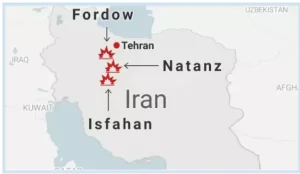
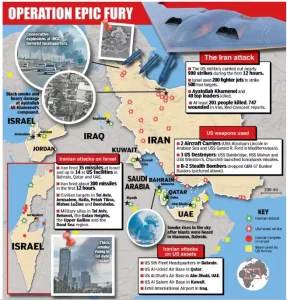
- Operation Roaring Lion (Israel): Launched on February 28, 2026, this involved precision airstrikes against Iranian nuclear infrastructure located in Natanz, Fordow, and Isfahan.
- While Israel’s declared objective is a “permanent nuclear rollback,” strategic history suggests such strikes primarily achieve Tactical Degradation, delaying capability by several years rather than complete elimination.
- Operation Epic Fury (USA): A joint campaign focused on the destruction of Ballistic Missile production sites and Islamic Revolutionary Guard Corps (IRGC) command centers.
- The strategic logic combines Deterrence Restoration with the political goal of Regime Destabilization, as evidenced by USA’s direct appeals to the Iranian public to “seize their own destiny.”
Tactical Evolution- The Dawn of “Scorpion Strike”:
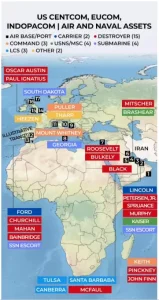
- The 2026 conflict marks a paradigm shift in the Revolution in Military Affairs (RMA). Operation Epic Fury witnessed the combat debut of Task Force Scorpion Strike, utilizing the LUCAS (Low-cost Uncrewed Combat Attack System).
- Grey-Zone Parity: The US effectively “reverse-engineered” the low-cost attrition warfare model previously dominated by Iran’s Shahed drones.
- Tactical Impact: By saturating Iranian air defenses with mass-produced, expendable autonomous swarms, the US achieved “precision at scale” without risking high-value manned assets, fundamentally altering the cost-exchange ratio of West Asian warfare.
|
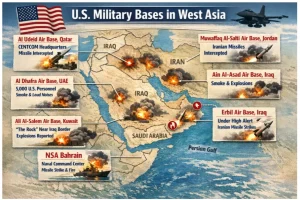
- Operation True Promise 4 (Iran): A multi-wave retaliatory strike utilizing Unmanned Aerial Vehicles (UAVs) and missiles against United States Central Command (CENTCOM) bases in Bahrain, Qatar, the United Arab Emirates (UAE), and Kuwait.
- This expansion of the combat theater to neutral Arab states signals Iran’s intent to impose a “regional cost” for any strike on its sovereign soil.
The End of Neutrality:
- The regional theater expanded violently as Operation True Promise 4 breached the sophisticated “missile shields” of the Gulf.
- The Dubai Flashpoint: The death of three expatriate workers in the UAE and damage to the Etihad Towers complex in Abu Dhabi have shattered the myth of “neutral safe havens.”
- Geopolitical Re-alignment: This forced an immediate diplomatic rupture, with the UAE withdrawing its ambassador from Tehran.
- For India, this signifies that its diaspora in the “neutral” Gulf is now as vulnerable as those in the direct combat zones of Iran or Israel.
|
Reasons for this Current Escalation
Several strategic and domestic triggers converged to end the long-standing era of “Strategic Ambiguity”:
- The Nuclear Threshold: Iran’s stockpile of 60% Enriched Uranium (approximately 440kg) reached a critical mass.
- While lower levels of enrichment are used for civilian power and medical research, 60% Enrichment has no routine civilian energy justification and represents a short technical step toward 90% Weapons-Grade material.
- The Begin Doctrine: Israel invoked its long-standing defense policy of pre-emptive strikes to prevent any regional adversary from acquiring Weapons of Mass Destruction (WMDs), arguing that waiting for a “nuclear breakout” was no longer a viable security option.
- The Begin Doctrine is Israel’s national security mandate to prevent any regional enemy from acquiring weapons of mass destruction—specifically nuclear weapons.
- Landmark Executions: The doctrine has been applied through three major military operations:
- 1981: Operation Opera (Iraq) – Israel destroyed the Osirak nuclear reactor near Baghdad. This was the first formal application of the doctrine.
- 2007: Operation Orchard (Syria) – Israel leveled the Al-Kibar facility, a secret North Korean-designed plutonium reactor in the Syrian desert.
- 2025–2026: The Iran Conflict – In June 2025 (Operation Rising Lion) and February 2026 (Operation Epic Fury), joint US-Israeli strikes targeted dozens of Iranian nuclear and missile sites.
- Domestic Political Signalling in the U.S.: Escalation may be influenced by the need to maintain deterrence credibility and reassure allies amid domestic political scrutiny.
- Regime Stability Concerns in Iran: External confrontation can serve as a mechanism for elite cohesion and nationalist mobilization, particularly during periods of economic stress or internal dissent.
- Ballistic Missile Arsenal: Iran’s long-range missile capability poses a direct strategic threat to Israel and U.S. military bases in West Asia.
- Proxy Warfare Strategy: Iran uses non-state armed groups to expand influence and avoid direct conventional war.
- Hezbollah: Functions as Iran’s northern deterrent arm, possessing a large rocket and missile stockpile targeting Israel.
- Hamas: Iran-backed group in Gaza whose confrontation with Israel fuels regional escalation.
About the Nuclear Programme of Iran
- The International Atomic Energy Agency (IAEA) warns that Iran is now “the only non-nuclear-weapon state producing such material”, calling it a “serious concern.”
- The IAEA report confirms that Iran did not declare nuclear material and activities at three sites: Lavisan-Shian; Varamin; Turquzabad.
- These locations were part of an undeclared nuclear program active until the early 2000s.
Technical Status & “Breakout”
- Stockpile: Before the latest strikes, Iran held approximately 441 kg of 60% enriched uranium. This is enough, if enriched further, for roughly 10 nuclear weapons.
- The “Isfahan” Tunnel: Much of this material is believed to be stored in a deeply hardened underground complex at Isfahan. Satellite imagery has shown intense vehicular activity there, suggesting Iran is attempting to secure the material against airstrikes.
- Breakout Time: Effectively zero. Technically, Iran has the material and the “know-how” to produce weapons-grade uranium in days, though the recent bombing of centrifuge halls has slowed their physical capacity to do so.
Uranium Enrichment
- Uranium enrichment is the process of increasing the concentration of the uranium-235 (U-235) isotope in natural uranium.
- It is done to make it suitable for use as fuel in nuclear reactors or, at higher enrichment levels, in nuclear weapons.
- Natural Uranium Composition: Natural uranium consists mostly of U-238 (99.3%) and only 0.7% U-235.
- U-235 is fissile, meaning it can sustain a nuclear chain reaction, while U-238 is not.
- Enrichment Levels:
- Low-enriched uranium (LEU): 3–5% U-235 (used in most nuclear power reactors).
- Weapons-grade uranium: 90% or more U-235 (used in nuclear bombs).
- Non-Proliferation Concerns: Uranium enrichment is closely monitored because it can be used for both peaceful (energy) and military (weapons) purposes.
|
Historical Context- The Four Phases of Iran-Israel Relations
To understand 2026, one must view it through the prism of four distinct historical eras:
- Strategic Cooperation (1948–1979): The “Periphery Doctrine” saw Iran and Israel as quiet allies against Arab nationalism (e.g., Project Flower missile R&D).
- Ideological Rupture (1979–1990): The Islamic Revolution redefined Israel as the “Little Satan,” though covert pragmatism persisted during the Iran-Iraq War (Iran-Contra Affair).
- The Shadow War (1990–2020): Characterized by proxy warfare via the “Axis of Resistance” (Hezbollah/Hamas) and the dawn of Fifth-Generation warfare (Stuxnet, 2010).
- Open Confrontation (2021–2026): Direct state-on-state exchanges, culminating in the 2026 strikes that shifted the objective from “Deterrence” to “Regime Destabilization.”
The Current Scenario
- Tactical Degradation: Initial battle damage assessments suggest significant destruction of Iranian centrifuge assemblies and missile storage facilities, although Iran’s “nuclear knowledge” and scientific expertise remain intact.
- Diplomatic Deadlock: The United Nations Security Council (UNSC) remains paralyzed by Veto Politics, with Russia and China condemning the strikes as a violation of sovereignty, while Western powers defend them as a necessary act of “anticipatory self-defense.”
- Evolution of Hybrid Warfare (Cyber): The 2026 conflict has moved beyond the “kinetic” battlefield.
- The reported deployment of Stuxnet 3.0 against Iranian centrifuge clusters and retaliatory Iranian cyber-probing of Israeli and allied water/power grids represents a shift to Fifth-Generation Warfare.
- Stuxnet, a malicious computer virus: Used to attack a uranium enrichment facility at Iran’s Natanz nuclear site, it was the “first publicly known cyberattack on industrial machinery”.
- For India, this highlights a critical vulnerability, the potential for “Digital Spillover” where regional instability translates into cyber-attacks on Indian critical infrastructure or undersea cable landings in Mumbai.
Combat Debut of the LUCAS Kamikaze Drone
- First Combat Deployment: United States Central Command (CENTCOM) officially deployed the LUCAS drone through Task Force Scorpion Strike.
- The system was used alongside Tomahawk Cruise Missiles to strike Iranian military sites, signifying its transition from a prototype to a core component of the United States strike inventory.
- Technical Profile and Origin: Developed by SpektreWorks, the LUCAS is a “one-way” loitering munition reverse-engineered from the Iranian Shahed-136.
- It carries a 40-pound explosive payload with an estimated 500-mile range. Its primary advantage is a low unit cost of $35,000, allowing for mass deployment that is economically sustainable.
- Strategic Saturation Tactics: Unlike traditional Unmanned Aerial Vehicles (UAVs), the LUCAS is designed to be expendable.
- It allows the military to utilize “swarm” tactics to overwhelm enemy Air Defense Systems through sheer volume, forcing the adversary to expend expensive interceptor missiles on low-cost targets.
- Combat-Driven Iteration: The United States military is using active combat as a “live laboratory” for the LUCAS.
- Operating in environments with heavy Electronic Jamming provides engineers with real-world data to rapidly update Navigation Algorithms and counter-measure software, bypassing the slow pace of traditional procurement cycles.
- Transformation of Warfare: The success of LUCAS confirms a global trend where small, autonomous systems provide strategic results previously reserved for Fighter Jets or Armored Divisions.
- Future conflicts are increasingly expected to be defined by networked, autonomous strikes that bypass traditional battlefield logistics and frontline human exposure.
|
Conflict and Its Impact on the World
- Energy Shock: Historical data from the International Monetary Fund (IMF) suggests that every $10 rise in Crude Oil prices leads to a 0.2% decline in Global Gross Domestic Product (GDP).
- With Brent Crude surging past $100 per barrel, the world faces severe Recessionary Pressures.
- Maritime Insecurity: The conflict has turned the Strait of Hormuz (which handles 21% of global oil) into a “high-risk zone.”
- This has led to a ten-fold increase in War Risk Insurance Premiums and massive costs associated with rerouting commercial shipping around the Cape of Good Hope.
- China’s Strategic Calculus: China employs a logic of Strategic Opportunism.
- While China faces its own energy vulnerabilities, it gains a systemic advantage if United States military assets remain “fixed” in a costly West Asian theater, thereby reducing American “Pivot to Asia” capabilities.
India’s Strategic Maritime Footprint in West Asia
India’s military presence in West Asia is defined not by sovereign “fortress” bases, but by a sophisticated network of Strategic Access Agreements and Logistics Nodes. This “light footprint” strategy allows India to project power and secure sea lanes while avoiding the political baggage of permanent foreign stations.
- Oman- The Strategic Anchor: Oman remains India’s most critical security partner in the region, acting as a gateway to the North Arabian Sea and the Persian Gulf.
- Duqm Port: The crown jewel of India’s maritime strategy. India holds a dedicated logistics and maintenance agreement here, providing the Indian Navy with a deep-water replenishment hub capable of supporting aircraft carrier groups outside the volatile Strait of Hormuz.
- Ras al Hadd: A critical intelligence node. India operates a listening post (electronic surveillance station) at this location, monitoring naval traffic and communications across the Arabian Sea, directly across from Pakistan’s Gwadar Port.
- Muscat Naval Base: India maintains institutionalized berthing rights and access to cargo-handling facilities, ensuring a permanent “warm” presence for Indian warships on patrol.
- Iran- The Logistics & Connectivity Gateway: While primarily a commercial project, the Indian-operated Shahid Beheshti Terminal at Chabahar Port serves a dual-use strategic function.
- The “Gwadar Counter”: Chabahar provides a vital bypass to Pakistan, connecting India to Central Asia and acting as a strategic counterweight to Chinese-funded infrastructure.
- 2026 Security Status: Due to the surge in regional drone warfare and escalating US-Iran-Israel tensions, the 2026 Union Budget reportedly completed its total standing commitment of $120 million to the port, but made no fresh allocations for 2026-27.
- India is currently prioritizing security hardening and diplomatic caution over rapid expansion in this high-risk zone.
- United Arab Emirates (UAE)- The Interoperability Partner: The relationship with the UAE has transitioned from buyer-seller to a deep-tier defense partnership, formalized by the January 2026 Strategic Defence Partnership Framework Agreement.
- Integrated Access: Rather than a base, the agreement grants Indian assets “institutionalized interoperability.” This allows for seamless use of UAE facilities for emergency maintenance, refueling, and rapid deployment.
- Operational Hubs: Joint exercises like Desert Eagle (Air Force) and Zayed Talwar (Navy) have turned UAE installations, such as Al Dhafra Air Base, into familiar staging grounds for Indian personnel and hardware.
|
Conflict and Its Impact on India
- Macroeconomic Stress: India receives over $125 Billion in Remittances annually; a regional labor market contraction would severely hit Indian household incomes.
- Furthermore, rising oil prices widen India’s Current Account Deficit (CAD) and fuel domestic Inflation, particularly in food and transport sectors.
- Connectivity Paralysis: The crisis has effectively halted the India-Middle East-Europe Economic Corridor (IMEC).
- This geoeconomic disruption potentially strengthens China’s relative leverage as the Belt and Road Initiative (BRI) land routes through Central Asia remain more stable alternatives.
- Supply Disruption Risk: The conflict threatens energy flows through the Strait of Hormuz, a critical transit route for India’s Gulf imports. Since India sourced ~90% of LPG, 40% of LNG, and 35% of crude oil from the Persian Gulf (2025), any disruption can directly affect availability.
- Rising Import Bill & Inflation: Escalation increases global crude and gas prices, freight and insurance costs, leading to a higher energy import bill, pressure on the current account deficit, and potential inflationary spillovers in India.
- Diaspora Security & The “Exodus” Scale: With over 9 million Indians in the Gulf, a full-scale regional war presents a humanitarian challenge that would dwarf the 1990 Kuwait airlift.
-
- A mass return would not just be a logistical crisis but an economic one, triggering a “Remittance Collapse” in states like Kerala and Tamil Nadu.
- The I2U2 Diplomatic Tightrope: The 2026 crisis has effectively paralyzed the I2U2 grouping (India, Israel, UAE, USA).
- India finds itself in a “Strategic Quad-lemma,” where two partners (Israel/USA) are in active combat with a third vital partner (Iran), while the fourth (UAE) is a targeted neutral party.
- This forces New Delhi to shift from “Minilateral Cooperation” on food/energy to pure “Conflict Management.”
| India’s Budgetary “Hedge” and Connectivity Paralysis:
India’s Union Budget 2026-27 signaled a significant tactical retreat by making zero fresh allocations for the Chabahar Port.
- Tariff Avoidance: This “Strategic Pause” is a direct response to the Trump administration’s 25% tariff threat on nations engaging with Iran.
- Corridor Pivot: With the IMEC (India-Middle East-Europe Economic Corridor) halted due to kinetic damage to Arabian infrastructure, New Delhi faces a “Connectivity Cul-de-sac.”
- While the INSTC (International North-South Transport Corridor) remains a theoretical alternative, its dependence on a volatile Iran makes it a “frozen asset” for the current fiscal year.
|
India & Israel- The “Special Strategic” Leap
Recently, both nations (February 25–26, 2026) officially elevated the relationship to a Special Strategic Partnership for Peace, Innovation, and Prosperity.
- Defense Co-Development: Shifting from a buyer-seller model, a new $10 billion defense roadmap focuses on joint production of AI-enabled drones, semiconductors, and the integration of Israeli Iron Dome technology into India’s air defense architecture.
- Economic Integration: Formal Free Trade Agreement (FTA) negotiations commenced on February 23, 2026. This aims to reverse the recent dip in bilateral trade, which fell to $3.62 billion (FY 24-25) due to regional instability.
 Technological Fusion: A new Critical and Emerging Technologies (iCET-style) Partnership was launched, covering quantum computing, cybersecurity, and biotechnology.
- Labor & Digital Mobility: A landmark pact allows up to 50,000 Indian workers to move to Israel over five years. Additionally, India’s UPI is being integrated into the Israeli payment ecosystem.
- IMEC Corridor: Despite the conflict, both nations reaffirmed the India-Middle East-Europe Economic Corridor (IMEC) as a vital strategic alternative to China’s influence.
India & Iran- The Strategic Tightrope
The relationship is under severe pressure following the U.S.-Israeli military strikes on Iranian infrastructure and the threat of expanded U.S. sanctions.
- Chabahar Port “Strategic Pause”: While India fulfilled its $120 million commitment in February 2026, the Union Budget 2026 made no fresh allocations.
- India is operating under a U.S. sanctions waiver that expires on April 26, 2026, making future investment highly uncertain.
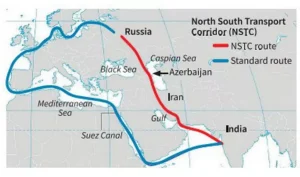
- The INSTC Lifecycle: The International North-South Transport Corridor remains the “Eastern Route” for reaching Russia and Central Asia.
- However, the recent blockade of the Strait of Hormuz has made this route logistically high-risk and expensive.
- Energy & Economic Buffers: India continues to maintain zero oil imports from Iran to avoid U.S. secondary sanctions. New Delhi is currently utilizing Strategic Petroleum Reserves (SPR) to mitigate the 2026 global oil price spikes caused by the conflict.
- Countering China: India’s presence in Iran serves as a crucial geopolitical anchor to prevent a total Sino-Iranian monopoly over Eurasian transit routes, despite the current “freeze” in active projects.
- Vishwa Bandhu Diplomacy: India is acting as a non-partisan voice for de-escalation, utilizing its unique position as a friend to both sides to protect the 9,000 Indian nationals still residing in Iran.
Associated International Law
The military actions have ignited a robust debate over global legal norms:
- Article 51 of the UN Charter: The United States and Israel claim the inherent right of Individual or Collective Self-Defense against an imminent nuclear threat.
- The Caroline Test: Proponents argue the strikes meet the international legal criteria of Necessity and Proportionality, claiming the nuclear threat was “instant and overwhelming, leaving no choice of means, and no moment for deliberation.”
- Non-Proliferation Treaty (NPT): If Iran successfully crosses the nuclear threshold despite military intervention, the credibility of international non-proliferation norms will be fundamentally eroded, potentially triggering a regional arms race.
|
Way Forward
- Economic Shock Absorption: India must immediately activate its Strategic Petroleum Reserves (SPR) and hedge long-term oil import contracts to insulate the domestic economy from extreme price volatility.
- Strategic Hedging: India should avoid overt alignment with any specific power bloc, maintaining quiet defense ties with Israel while utilizing Oman or the UAE as backchannel intermediaries to facilitate regional de-escalation.
- Defense Indigenization: India should fast-track defense manufacturing partnerships with Israel on Indian soil. This would ensure a secure production base for high-technology equipment, regardless of regional stability in West Asia.
- National Gas Grid & Strategic Buffers: Beyond the current Strategic Petroleum Reserves (SPR), India must fast-track a National Policy for Strategic Gas Reserves to insulate its fertilizer and power sectors from LNG spot-price volatility.
- Mission Samudra Manthan: The government should treat deep-water exploration as a national security emergency to reduce the 88% import dependency that remains India’s “Achilles’ heel” in West Asia.
- The “Vishwa Bandhu” Backchannel: India should leverage its unique position to facilitate a “Maritime De-escalation Zone” in the Arabian Sea, ensuring that commercial energy flows remain insulated from the ideological warfare of the “Resistance Axis” and the “Lion’s Roar” offensive.
Conclusion
The 2026 West Asia Crisis forces India to pivot from Strategic Ambiguity to Resilient Statecraft. While deepening High-Tech Defense with Israel, India must hedge against Hormuz Blockades and Sanction Risks to secure its Energy Interests and Eurasian Connectivity ambitions.


 2 Mar 2026









.png)






 Current Affairs




 GS Foundation
 Optional Course
 Combo Courses
 Degree Program