The ongoing conflict in West Asia has emerged as a critical strategic concern for India, with the government highlighting its direct implications for energy security, trade routes, diaspora safety, fertilizer supply, inflation, and national security.
About the West Asia Region
- The region includes the six members of the Gulf Cooperation Council (GCC) — Bahrain, Kuwait, Oman, Qatar, Saudi Arabia, and the United Arab Emirates — along with countries such as Iran, Iraq, Israel, Jordan, Lebanon, Syria, and Yemen.
- It is a strategic hub for global energy supplies, maritime trade routes, and industrial raw materials.
|
Why Does West Asia Matters to India?
- Energy Security Backbone: West Asia serves as the primary energy lifeline for India, accounting for nearly half of its crude oil imports and a substantial share of natural gas supplies, making India structurally dependent on the region.
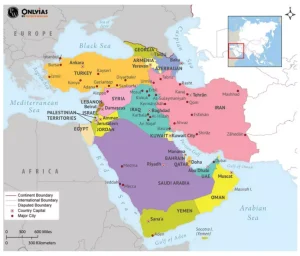 Strategic Maritime Trade Artery: West Asia lies along India’s vital Sea Lines of Communication (SLOCs) that connect it to Europe, Africa, and beyond, making it indispensable for the smooth functioning of India’s external trade.
 - Diaspora Security and Remittance Economy: The region hosts over one crore Indians, forming a crucial component of India’s overseas population whose safety, welfare, and evacuation during crises remain a top foreign policy priority.
- Fertilizer, LNG, and Industrial Supply Dependence: Beyond hydrocarbons, West Asia is a key supplier of LNG, fertilizers, and critical industrial inputs such as ammonia, urea, and petrochemicals, which are essential for India’s agriculture, power generation, and manufacturing sectors.
- Geopolitical and Strategic Balancing Arena: West Asia represents a complex geopolitical landscape where India maintains multi-vector diplomatic relations with diverse actors such as Iran, Israel, Saudi Arabia, and United Arab Emirates, requiring a delicate balance to safeguard its strategic interests.
- Macroeconomic Stability and Inflation Transmission Channel: Instability in West Asia acts as a direct transmission channel for imported inflation into India, primarily through rising crude oil prices, increased logistics costs, and disruptions in fertilizer supply.
Direct and Immediate Repercussions for India
- Energy Security and Macroeconomic Stress:
- The Imported Inflation Trap: Geopolitical tensions in the Persian Gulf rapidly translate into domestic instability.
- Brent crude rising above $100/barrel triggers a domino effect: rising fuel prices, higher logistics costs, and intense pressure on the Current Account Deficit (CAD).
- Monetary Policy Complications: As noted by the Reserve Bank of India (RBI), every $10 increase in crude prices significantly widens the CAD and pushes CPI inflation upward, often forcing a tighter monetary policy that can dampen growth.
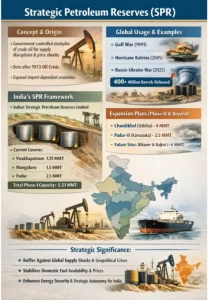
- Buffer Limitations: Despite diversifying sources to ~41 countries and planning Phase-II expansion of Strategic Petroleum Reserves (SPR), current capacity is a bottleneck.
- Official data shows only ~3.372 MMT (64%) of the existing 5.33 MMT is filled, indicating a limited short-term shock absorption capacity against prolonged disruptions.
- Structural Dependence on LPG and LNG:
- Supply Chain Exposure: India’s transition to cleaner fuels has created a structural reliance on imports, with 60% of LPG and nearly 50% of natural gas consumption met through external sources.
- Sectoral Disruptions: A blockade or slowdown in West Asian maritime routes simultaneously threatens:
- Households: Impacting cooking fuel affordability and the success of the Pradhan Mantri Ujjwala Yojana.
- Urban Infrastructure: Risks to City Gas Distribution (CGD) networks (PNG and CNG).
- Industrial Output: Cost escalation for gas-based industries and power plants.
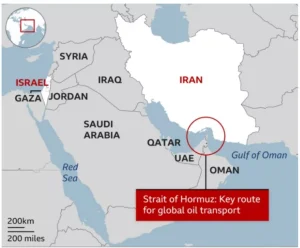
- The Maritime Chokepoint: The International Energy Agency (IEA) identifies India as a high-risk importer due to its dependence on long-distance supply chains passing through the Strait of Hormuz, which handles ~20% of global oil trade.
- The Energy–Agriculture–Food Security Nexus:
- Fertilizer Crisis: Gas is the primary feedstock for fertilizers. Because ~71% of India’s urea imports and critical LNG supplies transit the Strait of Hormuz, the crisis directly threatens “Aatmanirbharta in Urea.”
- Policy Intervention: To mitigate this, the Natural Gas (Supply Regulation) Order, 2026 was issued, mandating that fertilizer plants receive at least 70% of their average consumption to prevent a drop in farm productivity and a subsequent rise in food inflation.
- Buffer Strategy: The current climate necessitates a shift from “Just-in-Time” logistics to “Just-in-Case” buffers for essential agricultural inputs.
- Diaspora Protection and Maritime Strategic Interests:
- Humanitarian Pillar: Diaspora safety is now a core pillar of Indian foreign policy. With over 1 crore (10 million) Indians in the Gulf, India must maintain rapid evacuation capabilities and deep diplomatic coordination.
- Economic Contribution: This region is vital for remittances, which reached a record $125+ billion in 2023, supporting India’s forex stability.
- Maritime Security:
- Operation Sankalp: The Indian Navy remains deployed in the Gulf of Oman and the Gulf of Aden to counter piracy and secure merchant shipping.
- Seafarer Risk: Indian seafarers constitute ~10% of the global maritime workforce, making them uniquely exposed to attacks on commercial vessels and surging insurance premiums (which can rise 2–3 times during regional tensions).
- Strategic Imperatives for Resilience:
- Limits of Growth: The crisis demonstrates that strong GDP growth and healthy forex reserves alone cannot insulate India from external shocks. Strategic autonomy requires resilience-building alongside growth.
- Strategic Diversification: Both NITI Aayog and the IEA emphasize that India must accelerate its energy transition to renewables and complete its SPR expansions to reduce “strategic exposure.”
- Systemic Resilience: India must evolve from a passive recipient of global price shocks to a proactive architect of resilient supply chains, ensuring that far-removed disruptions do not cause immediate domestic paralysis.
Enroll now for UPSC Online Course
Key Lessons for India
- From Import Dependence to Energy Self-Reliance: The ongoing crisis in West Asia reinforces that true energy security lies in reducing structural dependence on imported hydrocarbons, not merely diversifying suppliers.
- With ~85% crude import dependence (Ministry of Petroleum and Natural Gas), India remains highly exposed to external shocks.
- A sustainable pathway lies in large-scale electrification—including electric mobility, electrified public transport, rail electrification, and electric cooking—supported by renewable energy expansion.
- Strengthening and Optimizing Strategic Petroleum Reserves (SPR): The crisis has revived attention on India’s SPR as a key buffer against supply disruptions.
- While India’s total crude & product stocks cover ~70–75 days of demand, its dedicated SPR capacity (5.33 MMT, ~9–10 days) remains limited compared to major economies (IEA benchmark: 90 days of net imports).
 Holistic Energy Diversification: While India has diversified crude sourcing to ~41 countries, the crisis shows that supplier diversification alone is insufficient. True resilience requires:
- Route diversification: Reducing overdependence on chokepoints like the Strait of Hormuz
- Product diversification: Expanding alternatives such as biofuels, gas, hydrogen, and renewables
- Technological diversification: Strengthening refining flexibility, storage, and fuel-switching capabilities
- Policy frameworks by NITI Aayog emphasize the need for a holistic diversification strategy covering supply, logistics, and technology ecosystems.
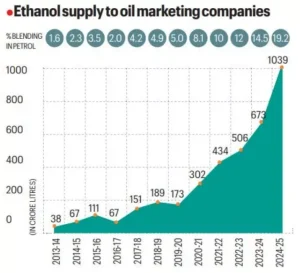
- Ethanol Blending as a Strategic Energy Lever: India’s ethanol blending programme has emerged as a key geopolitical resilience tool, not merely an environmental initiative.
- Ethanol blending has increased from ~1.5% (2013-14) to ~18–20% (2024-25) under the Ethanol Blending Programme, significantly reducing crude import requirements.
- Global experience, especially from Brazil demonstrates that higher blending mandates (E27–E30) and flex-fuel vehicle ecosystems can substantially cut fuel import dependence.
 Building Indigenous Energy R&D and Industrial Capacity: A key historical lesson since the 1973 Oil Shock is that energy security requires indigenous technological capability, not just import strategies.
 -
- Earlier efforts such as coal gasification lacked sustained policy and industrial backing.
- The renewed push under initiatives like the National Coal Gasification Mission (target: 100 MT by 2030) reflects a strategic shift toward domestic production of fuels, chemicals, and fertilizers. This highlights the need for:
- Long-term investment in clean energy R&D
- Pilot projects and commercialization pathways
- Integration of industry, academia, and policy ecosystems
Historical Case Study- 1973 Oil Shock & Coal Gasification:
- Context and Crisis Trigger: The 1973 Oil Crisis, triggered by the OPEC oil embargo, exposed India’s extreme dependence on imported oil, leading to severe economic stress, inflation, and energy insecurity.
- The episode marked a turning point in recognising energy as a strategic vulnerability.
- India’s Policy Response: In response, India explored alternative energy pathways, notably coal gasification, which had been earlier proposed by scientist Syed Husain Zaheer.
- However, due to policy inertia, weak institutional backing, and limited industry integration, the technology failed to scale in time to mitigate the crisis impact.
- Missed Opportunity: The delayed adoption meant that India continued to remain vulnerable to oil shocks, and the potential benefits of coal-based alternatives were realised only much later.
- As later acknowledged by Indira Gandhi, early technological adoption could have significantly reduced the severity of the crisis impact.
- Key Lesson for Contemporary Policy: Energy security cannot rely on reactive crisis management alone; it requires:
- Long-term policy vision and strategic foresight
- Timely adoption and scaling of alternative technologies
- Strong industry–research–government linkages
- Relevance Today: The ongoing crisis in West Asia mirrors similar vulnerabilities, reinforcing the need for proactive investment in indigenous technologies (e.g., green hydrogen, coal gasification) and structural reduction in import dependence.
|
Way Forward
- Short-Term- Stabilisation and Crisis Management:
- Securing Critical Supply Chains and Maritime Routes: India must prioritise stabilising essential supply chains and limiting shock transmission from the crisis in West Asia.
- This requires securing maritime trade routes, especially around the Strait of Hormuz, through enhanced naval vigilance, convoy mechanisms, and international maritime coordination, ensuring uninterrupted trade and energy flows.
- Ensuring Continuity of Energy and Fertilizer Supplies: The government must guarantee uninterrupted availability of crude oil, LPG, LNG, and fertilizers by activating contingency procurement contracts and increasing reliance on spot market diversification.
- This reduces the risk of supply shortages and price spikes across energy, agriculture, and industrial sectors.
- Preventing Domestic Market Distortions: There is a critical need to curb hoarding, speculation, and artificial price inflation through strict regulatory oversight, market intelligence, and real-time monitoring mechanisms.
- This ensures price stability and equitable access to essential commodities for consumers and industries.
- Strengthening Strategic Petroleum Reserve Utilisation: India should opportunistically fill its Strategic Petroleum Reserves (SPR) during periods of global price moderation to enhance its emergency energy buffer.
- Efficient reserve management will improve shock absorption capacity during prolonged disruptions.
- Robust Diaspora Protection and Crisis Preparedness: Diaspora safety must remain a top priority, given the large Indian population in the region.
- This requires evacuation readiness, strong embassy coordination, real-time advisories, and crisis helplines, ensuring a swift and coordinated humanitarian response.
- Medium-Term- Building Resilience and Flexibility:
- Institutionalising Energy, Trade, and Logistics Resilience: India must focus on embedding resilience across critical systems, ensuring that energy, trade, and logistics networks can withstand external shocks from regions like West Asia.
- This involves strengthening institutional frameworks, coordination mechanisms, and crisis-response protocols across sectors.
- Expanding and Optimising Strategic Petroleum Reserves (SPR): India should expand SPR capacity and improve reserve management practices, ensuring that reserves act as a dynamic shock absorber rather than a passive stockpile.
- Timely filling, strategic release mechanisms, and integration with commercial storage will enhance energy security and price stabilisation capacity.
- Enhancing Energy Sourcing Flexibility: A balanced approach combining long-term supply contracts and spot market procurement is essential to ensure price efficiency and supply reliability.
- India must also expand supplier diversification and route diversification, reducing overdependence on specific regions or chokepoints.
- Accelerating Fuel Diversification and Gas-Based Economy: India needs to scale up alternative fuels such as ethanol blending, compressed biogas (CBG), and natural gas, thereby reducing reliance on crude oil.
- Expansion of City Gas Distribution (CGD) networks will strengthen urban energy access and cleaner fuel adoption, supporting both energy security and environmental goals.
- Promoting Transport Electrification: Intensifying the electrification of public transport systems, including electric buses and railway electrification, is critical to lower oil consumption in the transport sector, which accounts for a major share of crude demand.
- This shift will also contribute to reduced emissions and long-term cost efficiency.
- Strengthening Maritime Contingency and Trade Security: India must enhance maritime contingency planning through risk-sharing mechanisms, shipping insurance frameworks, and strategic partnerships with key maritime nations.
- This will ensure continuity of trade flows, protection of shipping assets, and resilience against geopolitical disruptions affecting global sea lanes.
- Building Resilience: While the India–Middle East–Europe Economic Corridor (IMEEC) faces delays due to ongoing conflict in West Asia, India must leverage the International North–South Transport Corridor (INSTC) and Chennai–Vladivostok Eastern Maritime Corridor as strategic alternatives, ensuring logistics diversification and resilience against emerging “corridor conflicts.
- Long-Term- Achieving Structural Energy Sovereignty:
- Transitioning Towards Energy Sovereignty: India must shift from managing import dependence to structurally reducing it, aiming for genuine energy sovereignty.
- This requires a systemic transformation of the energy mix, reducing exposure to external geopolitical shocks such as those in West Asia.
- Accelerating Renewable Energy Expansion and Grid Modernisation: A large-scale push toward renewable energy (solar, wind, hybrid systems) must be complemented by advanced battery storage solutions and grid modernisation to ensure reliability, stability, and scalability.
- Strengthening transmission infrastructure and smart grids will enable efficient integration of intermittent renewable sources.
- Building Domestic Clean Energy Manufacturing Ecosystems: India should develop indigenous manufacturing capacity in electric vehicles (EVs), battery technologies, and green hydrogen, aligning with global energy transition trends.
- This will not only enhance energy security but also promote industrial growth, job creation, and technological leadership.
- Promoting Demand-Side Electrification and Energy Substitution: Expanding electric mobility, electric cooking, and overall demand-side electrification can significantly reduce dependence on imported crude oil and LPG.
- This shift will also contribute to lower emissions, improved air quality, and long-term cost efficiency.
- Investing in Strategic R&D and Indigenous Technologies: Sustained investment in research and development (R&D), pilot projects, and innovation ecosystems is critical for building long-term resilience.
- Focus areas should include green hydrogen, advanced biofuels, and coal gasification for chemicals and fertilizers, enabling diversified and self-reliant energy pathways.
- Strengthening Institutional Frameworks and Policy Ecosystems: Achieving energy sovereignty requires robust institutional mechanisms, policy continuity, and effective governance structures.
- Enhanced industry-academia collaboration, private sector participation, and regulatory stability will be essential to scale innovations and ensure sustained transition.
Conclusion
The crisis in West Asia is not merely a foreign policy challenge but a comprehensive stress test of India’s strategic autonomy, revealing the deep interlinkages between energy, food, maritime, diaspora, and economic security. The enduring lesson is that resilience lies not in managing recurring shocks, but in systematically reducing external dependence through electrification, diversification, domestic capacity-building, and long-term strategic foresight.


 24 Mar 2026


.png)




 Current Affairs




 GS Foundation
 Optional Course
 Combo Courses
 Degree Program