White Revolution 2.0: Boosting Milk Production and Women-Led Dairy Cooperatives

11 Feb 2026

White Revolution 2.0: Boosting Milk Production and Women-Led Dairy Cooperatives

Union Minister for Home and Cooperation discussed White Revolution 2.0 in a written reply to the Lok Sabha.

About White Revolution 2.0

  • It is an initiative aimed at boosting milk production while promoting women’s empowerment and addressing malnutrition.
  • White Revolution 2.0 focuses on four priority areas:
    • Women’s Empowerment
      • Aims to empower women milk farmers by integrating them into formal economic systems.
      • Strengthen women-led dairy institutions and Self-Help Group (SHG) linkages.
    • Enhancing Local Milk Production
      • The initiative aims to increase milk procurement by dairy cooperatives by 50 per cent over the next five years.
      • Target to increase cooperative-led milk procurement from 660 lakh kg per day to 1,007 lakh kg per day.
    • Strengthening Dairy Infrastructure
      • Large-Scale Cooperative Development: White Revolution 2.0 includes setting up and strengthening around 1.20 lakh new and existing cooperative institutions, including
        • Dairy Cooperative Societies (DCS)
        • Multipurpose Dairy Cooperative Societies (M-DCS)
        • Multipurpose Primary Agricultural Credit Societies (M-PACS)
    • Boosting Dairy Exports.
      • Target to increase India’s share in global milk production from one-fourth to one-third by 2030.
  • Nodal Ministry: Ministry of Cooperation
  • Implementing Support: Department of Animal Husbandry & Dairying (DAHD), National Dairy Development Board (NDDB), and State Dairy Federations.
  • Funding: Activities under White Revolution 2.0 are being funded through the National Dairy Development Programme 2.0 (NPDD 2.0) under the Department of Animal Husbandry and Dairying.
  • Coverage Expansion Plans:
    • New Cooperatives in Uncovered Areas: The programme proposes setting up 75,000 new Dairy Cooperative Societies in uncovered regions.
    • Strengthening Existing Cooperatives: Around 46,422 existing DCSs will be strengthened to improve market access, income opportunities, and nutritional availability

Dairy Sector in India

  • Global Position:
    • India has remained the world’s largest milk producer since 1998 (25% of global milk output), ahead of the USA and Pakistan.
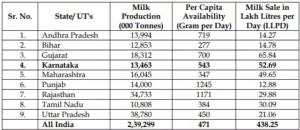
    • White Revolution 2.0Total Milk Production reached 247.87 million tonnes (2024–25), registering a 3.58% rise over 239.30 million tonnes (2023–24).
    • New Zealand is the largest exporter of dairy products, while China is the world’s largest dairy importer.
      • India ranks 49th in milk exports, indicating limited export penetration.
  • Per Capita Availability: Increased from 319 g/day (2014–15) to 485 g/day (2024–25).
  • Top Milk-Producing States: As per Basic Animal Husbandry Statistics 2025, leading milk producers are Uttar Pradesh (15.66%), Rajasthan (14.82%), Madhya Pradesh (9.12%), Gujarat (7.78%), Maharashtra (6.71%)
  • Contribution to Agricultural GDP: The milk group (milk, ghee, butter, lassi) contributed nearly 40% of the total output value from the agriculture, livestock, forestry and fishing sector in 2022–23.

About White Revolution

  • A nationwide cooperative milk movement implemented in three phases over three decades, led by social entrepreneurs, political leadership, and millions of dairy farmers.
  • Launch: “Operation Flood” was launched in 1970, initiating the ‘White Revolution’ in India.
  • Leadership: Led by Dr. Verghese Kurien, who spearheaded the world’s largest dairy development programme from Anand, Gujarat.
  • Objective: To transform India from a milk-deficient country into the world’s largest milk producer through cooperative-based dairy development.

Phases of Operation Flood

  • Phase I (1970–1980): Foundation Phase
    • Covered 10 states.
    • Rural milk procurement increased from 0.46 million litres/day (1960s) to 2.2 million litres/day.
  • Phase II (1981–1985): Expansion Phase
    • Expanded to 43,000 villages; Covered 4.25 million producers
    • Established 136 milk sheds supplying to 290 urban markets
  • Phase III (Mid-1980s to Mid-1990s): Consolidation Phase:
    • Membership increased to 10 million farm families.
    • Focus shifted to Veterinary healthcare, Breed improvement, Productivity enhancement, Strengthening dairy cooperative institution

Dairy Cooperatives in India

  • Dairy cooperatives operate across nearly 70% of India’s districts, reflecting wide institutional reach.
  • As of 2025, India’s cooperative dairy ecosystem comprises: 22 milk federations, 241 district cooperative unions, 28 marketing dairies and 25 Milk Producer Organisations (MPOs).
  • Together, they cover about 2.35 lakh villages and have 1.72 crore dairy farmers as members
  • States with strong cooperative penetration include: Gujarat, Maharastra, Kerala, Sikkim, Puducherry
  • Over 48,000 women-led cooperatives and 16 all-women MPOs operate under NDDB Dairy Services
    • The all-women Shreeja MPO (Andhra Pradesh) is a leading example of empowerment.
  • Examples of Multi state Dairy cooperatives:
    • Kamdhenu Dairy Multi State Co-operative Society Limited
    • Nature Delight Multi State Cooperative Dairy & Agro Products Ltd.

Check Out UPSC CSE Books

Visit PW Store


online store 1

Other Government Initiatives for the Dairy Sector

  • Rashtriya Gokul Mission (2014): Launched to promote, conserve, and scientifically develop indigenous bovine breeds for improving milk productivity.
  • National Programme for Dairy Development (NPDD) (2014): Aims to strengthen infrastructure for quality milk production, procurement, processing, and marketing through State Implementing Agencies.
  • Livestock Health and Disease Control Programme (LHDCP) (2019): Provides financial assistance to States/UTs for vaccination against major diseases like Foot and Mouth Disease (FMD), Brucellosis, and Classical Swine Fever (CSF), and supports ASCAD for control of emerging and zoonotic diseases.
  • National Artificial Insemination Programme (NAIP) (2019): Promotes scientific breeding through artificial insemination to improve productivity and prevent the spread of reproductive/genital diseases in livestock. Under this Programme, free insemination services are provided at the farmers doorstep.
  • Animal Husbandry Infrastructure Development Fund (AHIDF) (2020): Set up under AtmaNirbhar Bharat Abhiyan to support dairy processing, value addition, and infrastructure creation.
  • National Livestock Mission (NLM) (2014-15): Promotes sustainable growth in the livestock sector with focus on employment generation, entrepreneurship, higher per-animal productivity, and increased output of milk, meat, eggs, and wool.

Enroll in SRIJAN Prelims Crash Course

Need help preparing for UPSC or State PSCs?

Connect with our experts to get free counselling & start preparing

Aiming for UPSC?

Download Our App

      
Quick Revise Now !
AVAILABLE FOR DOWNLOAD SOON
UDAAN PRELIMS WALLAH
Comprehensive coverage with a concise format
Integration of PYQ within the booklet
Designed as per recent trends of Prelims questions
हिंदी में भी उपलब्ध
Quick Revise Now !
UDAAN PRELIMS WALLAH
Comprehensive coverage with a concise format
Integration of PYQ within the booklet
Designed as per recent trends of Prelims questions
हिंदी में भी उपलब्ध

<div class="new-fform">


    </div>

    Subscribe our Newsletter
    Sign up now for our exclusive newsletter and be the first to know about our latest Initiatives, Quality Content, and much more.
    *Promise! We won't spam you.
    Yes! I want to Subscribe.