Over the past six decades, women’s voter participation has risen sharply, often matching or surpassing men, but their political representation and power remain limited.
About Women’s Political Participation
- Women’s Political Participation in India refers to the involvement of women in the political process, including voting, contesting elections, participating in political parties, decision-making, and holding public office at local, state, and national levels.
- In essence, it reflects the extent to which women influence political institutions, public policies, and governance in a democratic system.
Women’s Participation: Overview
- Participation in Campaign Activities: Women’s participation in campaign activities has been gradually increasing, though a clear gender gap persists.
- For Example: Attendance at election meetings and rallies rose from 9 percent in 2009 to around 16 percent in recent elections, while men’s participation has remained roughly double.
- LokSabha Representation: The percentage of women MPs in the Lok Sabha had been very low between 5% and 10% till 2004.
- It rose marginally to 12% in 2014 and currently stands at 14% in the 18th Lok Sabha.
- The 17th Lok Sabha has the highest ever number of women politicians with a total of 78 but declined to 74 in 18th Lok Sabha.
- Party Wise Representation: Trinamool Congress has the highest proportion of women MPs in the current Lok Sabha at 38%.
- The ruling Bharatiya Janata Party and principal Opposition Congress party have around 13% each.
- Naam Tamilar Katchi, a State party in Tamil Nadu, has been following a voluntary quota of 50% for women candidates in the last three general elections.
Challenges for Women in Political Participation
- Privileged Background: Data from the Lokniti–CSDS study on women and politics show that 58 percent of women believe it is easier for a woman from a political family to enter politics.
- 57 percent of women feel that women from higher economic backgrounds have an advantage.
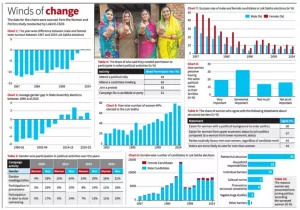 Male Preference in Ticket Allocation: Nearly half (44 percent) think that political parties prefer men when allocating tickets, and a similar proportion believe that voters favour male candidates over female.
- Social Barriers: Patriarchal structures are the biggest obstacle, cited by 22 percent of women, followed by household responsibilities (13 percent) and individual-level constraints such as lack of confidence, awareness or experience (12 percent), Cultural norms (7 percent) and financial or structural constraints (6 percent).
- Nomination Bias: Political parties often justify limited nominations by arguing that women are less “electable.” Yet success rate data complicates this claim.
- For Example: In 2019, 11 percent of women candidates won, compared to 6 percent of men. In 2024, the success rates were 9 percent for women and 6 percent for men.
- Need for Family Permission: The Lokniti –CSDS Survey on Women and Politics, conducted in 2019, shows that most women report requiring approval for activities such as attending rallies, candidate meetings, or campaigning.
Importance Of Women’s Participation In Politics
- Inclusive Political representation: Women’s participation ensures that political institutions are more representative of the population, enhancing the legitimacy of democratic processes.
- Focus on Social Issues: Female leaders often prioritise issues such as healthcare, education, and social welfare, improving the quality of life for communities.
- For example: Chhavi Rajawat: Often hailed as the changing face of rural Rajasthan, Chhavi also addressed delegates at the UN’s 11th Info poverty World Conference in 2011.
- Promoting Gender Equality: Women’s political participation challenges traditional gender roles and promotes gender equality in all spheres of life.
- Six countries have 50 per cent or more women in parliament in single or lower houses: Rwanda (61 per cent), Cuba (56 per cent), Nicaragua (54 per cent), Andorra (50 per cent), Mexico (50 per cent), New Zealand (50 per cent), and the United Arab Emirates (50 per cent)
- Conflict Resolution: Women’s involvement in peacebuilding efforts can contribute to more sustainable solutions to complex societal challenges.
- For example: Leymah Gbowee, a Liberian peace activist, played a key role in the peace process that ended the Second Liberian Civil War.
- Empowering Future Generations: Female political leaders serve as role models, inspiring other women and girls to pursue leadership roles in various sectors.
- Draupadi Murmu as the first female tribal President of India has inspired young girls and women to pursue leadership positions in politics and public service.
Way Forward
- Develop Aspirational Women Leaders: Political parties should identify and groom women from Self-Help Groups (SHGs), NGOs and Panchayats, leveraging the leadership pool created by the 73rd Constitutional Amendment Act and 74th Constitutional Amendment Act.
- Internal Party Reforms: Parties should adopt internal quotas for ticket distribution and integrate women into core organisational structures and decision-making bodies.
- Financial and Institutional Support: Provide financial assistance, mentorship programmes and safe political environments for women candidates.
- Changing Social Attitudes: Promote women’s leadership and address societal barriers that restrict women’s participation in public life.
Gender Gap in Voter Turnout in India
| Period / Election |
Male Turnout (%) |
Female Turnout (%) |
Gender Gap (Percentage Points) |
Key Trend |
| 1967 Lok Sabha Election |
66.7 |
55.5 |
11.2 |
Large gender gap in participation |
| 1971 Lok Sabha Election |
— |
— |
11.8 |
Gap widened slightly |
| 1980s–2000s |
— |
— |
Gradual decline |
Structural barriers slowly reduced |
| 2009 Lok Sabha Election |
— |
— |
4.4 |
Significant narrowing of gap |
| 2014 Lok Sabha Election |
— |
— |
1.5 |
Near parity in participation |
| 2019 & 2024 Lok Sabha Elections |
Nearly equal |
Nearly equal |
~0 |
Women voted at similar rates as men |
Government Initiatives to Boost Political Participation of Women
| Initiative / Law |
Year |
Key Objective |
Impact on Women’s Political Participation |
| 73rd Constitutional Amendment Act |
1992 |
Reserved one-third seats for women in Panchayats |
Brought millions of women into grassroots politics |
| 74th Constitutional Amendment Act |
1992 |
Provided 33% reservation for women in Urban Local Bodies |
Increased women’s representation in municipalities |
| The Constitution (106th Amendment) Act, 2023 (Women’s Reservation Act / Nari Shakti Vandan Adhiniyam) |
2023 |
33% reservation for women in Lok Sabha and State Assemblies |
Aims to improve representation at higher political levels |
| Mahila Shakti Kendra Scheme |
2017 |
Empower rural women through community participation and awareness |
Encourages women’s engagement in governance |
| Beti Bachao Beti Padhao |
2015 |
Improve status of girls through education and empowerment |
Indirectly promotes future political participation |
| Mission Shakti |
2022 |
Strengthen women’s safety, empowerment and leadership |
Supports women’s participation in public life |


 13 Mar 2026







.png)






 Current Affairs




 GS Foundation
 Optional Course
 Combo Courses
 Degree Program