Books

IFoS Chemistry syllabus 2026 covers atomic structure, chemical bonding, organic reaction mechanisms, and coordination chemistry topics expected in the competitive forest service test. Learning about the IFoS Chemistry syllabus and exam pattern 2025-2026 can help candidates become aware of the question format, duration, and marking approach for effective preparation.
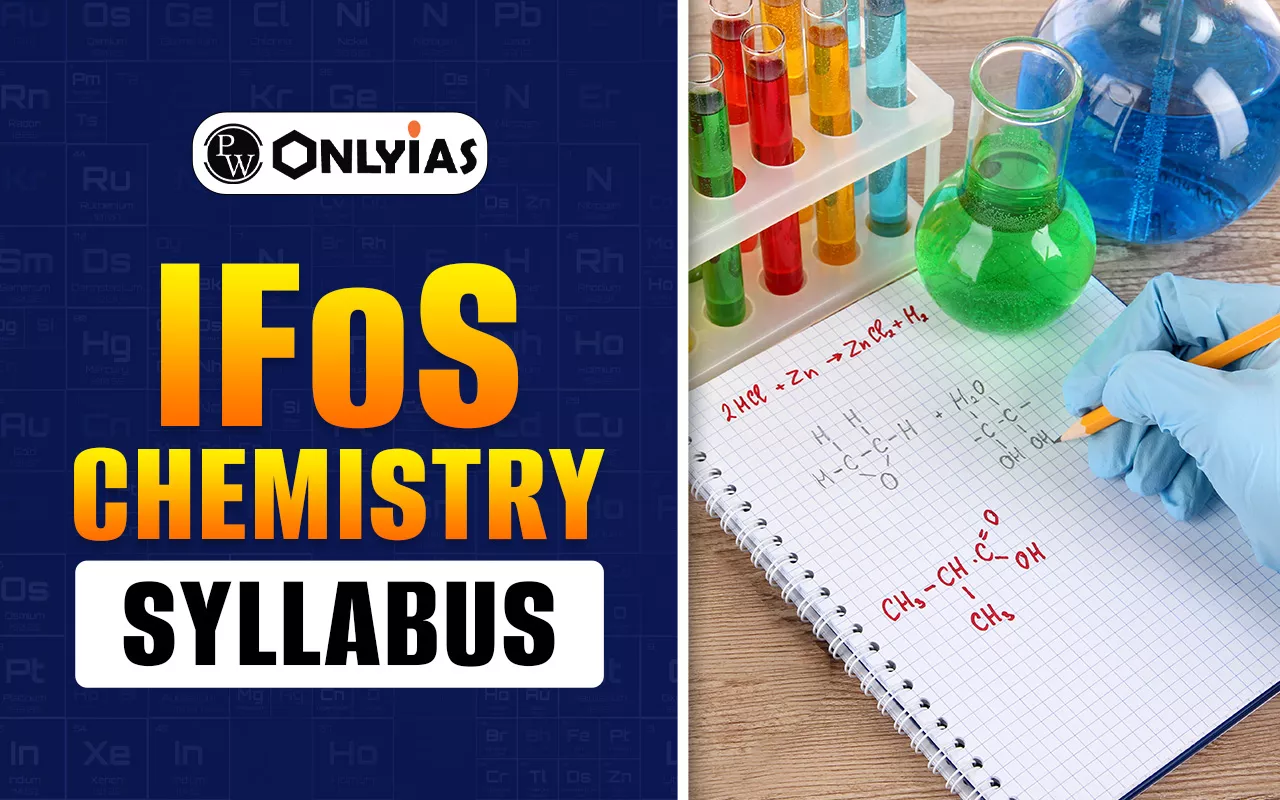
IFoS Chemistry syllabus 2026 can help aspirants who are planning to appear for the Indian Forest Service Examination. The syllabus is designed to assess the deep conceptual understanding and analytical skills required for an optional subject in the Main (Written) stage. IFoS Chemistry syllabus 2026 further helps candidates make preparation plans with exam expectations. In addition, the syllabus remains rigorous to ensure candidates possess the scientific background necessary for forest service roles.
The Indian Forest Service Chemistry syllabus includes two core papers that test physical, inorganic, and organic chemistry. Each paper carries equal importance and contributes to the overall merit score in the Main examination. The UPSC IFoS Chemistry syllabus follows a traditional university-level format to help candidates from science and engineering backgrounds demonstrate their subject expertise.
Further, here are the details of the syllabus and pattern of the IFoS exam:
| IFoS Chemistry Syllabus 2026 Overview | |
| Particulars | Expected Details |
| Exam Name | Indian Forest Service Examination |
| Common Name | IFoS 2025/2026 |
| Conducted By | Union Public Service Commission (UPSC) |
| Exam Purpose | Selection for Indian Forest Service |
| Exam Mode | Written (Offline/Pen & Paper) |
| Exam Date | Main Exam – As per UPSC Calendar |
| Syllabus Topics | Atomic Structure, Bonding, Thermodynamics, Organic Mechanisms |
| Syllabus Nature | Academic/Subject-Specific (Optional) |
Note: The syllabus structure is based on the official UPSC Indian Forest Service notification. Candidates can learn more by visiting the official online portal.
Candidates preparing for the Indian Forest Service Examination can download the detailed IFoS Chemistry Syllabus PDF to streamline their preparation. The PDF contains a comprehensive breakdown of both Paper I and Paper II, including topics such as Atomic Structure, Thermodynamics, and Organic Reaction Mechanisms. Having a hard copy or a saved digital version of the official UPSC IFoS Chemistry syllabus helps aspirants track their progress and ensure no critical topic is missed during revision.
The IFoS Chemistry syllabus section wise format helps candidates understand topic distribution clearly. Candidates should plan daily study sessions and revision cycles for each paper in a proper manner. The Chemistry IFoS preparation syllabus requires students to study effectively to score more in the examination.
The IFoS Chemistry Paper 1 syllabus focuses on Physical and Inorganic chemistry. The section is expected to test theoretical foundations, mathematical applications, and properties of elements. Further, questions in Paper 1 are generally framed to assess conceptual clarity in atomic and molecular levels.
| IFoS Chemistry Paper 1 Syllabus | |
| Topic Area | Expected Coverage |
| Atomic Structure | Quantum theory, Heisenberg’s uncertainty principle, Schrödinger wave equation |
| Chemical Bonding | Ionic bond, Lattice energy, VBT, Resonance, Molecular Orbital Theory |
| Solid State | Crystal systems, Bragg’s law, X-ray diffraction, crystal defects |
| Thermodynamics | Laws of thermodynamics, entropy, free energy, Nernst heat theorem |
| The Gaseous State | Equation of state for real gases, Maxwell’s distribution of speeds |
Note: The topic list for Paper 1 reflects patterns based on the official IFoS Chemistry detailed syllabus.
The IFoS Chemistry Paper 2 syllabus evaluates Organic and Analytical chemistry. This section checks understanding of reaction mechanisms, polymers, and spectroscopy. Detailed study of carbon-based compounds is crucial for this paper. Here are a few Chemistry optional IFoS syllabus topics:
| IFoS Chemistry Paper 2 Syllabus | |
| Topic Area | Expected Coverage |
| Reaction Mechanisms | Nucleophilic substitution (SN1, SN2), Electrophilic addition, Elimination reactions |
| Polymers | Classification, Addition and condensation polymerization |
| Spectroscopy | Rotational, Vibrational, and Electronic spectra (UV-Vis/IR/NMR) |
| Biochemistry | Structure and role of carbohydrates, amino acids, and proteins |
| Organic Synthesis | Preparation and reactions of common functional groups |
Note: The topics mentioned here align with the IFoS Chemistry topics list provided in official notifications.
The UPSC IFoS Chemistry syllabus and exam pattern together define the structure of the test. While the Preliminary stage is objective, the Main stage for Chemistry is a descriptive written test. All papers carry specific marks and contribute to the final ranking.
Further, here are the exam pattern details:
| IFoS Main Exam Pattern Details | |
| Feature | Expected Details |
| Mode | Written (Descriptive) |
| Number of Papers | Two (Paper I & Paper II) |
| Language | English (Mandatory) |
| Duration | 3 Hours per paper |
| Total Marks | 200 Marks per paper |
Note: The above-mentioned exam pattern details are based on the official UPSC brochure. Candidates are advised to check the official portal for the latest updates on the IFoS Chemistry syllabus PDF.
Learning about the IFoS Chemistry 2026 important topics can help candidates score well. Candidates may prioritise these areas during revision without ignoring complete syllabus coverage.
| IFoS Chemistry 2026 Important Topics | |
| Section | Key Topic Focus |
| Physical Chemistry | Thermodynamics, Chemical Kinetics, and Quantum Mechanics |
| Inorganic Chemistry | Coordination compounds and Chemical Bonding |
| Organic Chemistry | Named reactions and Reaction Mechanisms |
| Analytical | Spectroscopy and Instrumental methods |
Check Out UPSC CSE Books
Visit PW Store
To prepare for the IFoS Chemistry mains syllabus, candidates should practice descriptive answer writing to improve their speed and presentation. Further, a balanced focus on numerical solving and theory can strengthen the overall performance. Here are a few useful tips:
Ready to boost your UPSC 2026 preparation? Join PW’s UPSC online courses today!

The IFoS Chemistry syllabus includes Paper I (Physical/Inorganic) and Paper II (Organic/Analytical). It covers university-level science topics for forest service aspirants.
The IFoS exam syllabus is fixed as per the official notification. However, candidates should stay updated with any minor changes published by UPSC annually.
The IFoS Chemistry syllabus download shows it is divided into two descriptive papers, each focusing on different branches of chemistry.
Yes, the Paper 1 syllabus includes quantitative aspects like the Schrödinger wave equation and thermodynamic calculations.
The syllabus is well-suited for engineering and science graduates as it aligns with higher education curricula in Chemistry.






Connect with our experts to get free counselling & start preparing
Books
Udaan (Prelims Wallah)
Prahaar (Mains Wallah)
Q&A Bank (Prelims & Mains)
Budget & Economic Survey
NCERT Wallah
Marks Booster
हिंदी माध्यम विशेष शृंखला
 Current Affairs
Monthly Current Wallah
Subject Wise Current Affairs
Editorial Analysis
Editorial PDFs
News of The Day
Download Our App



Download Our App
<div class="new-fform">
</div>



 GS Foundation
 Optional Course
 Combo Courses
 Degree Program