Books

Important Seas of the World are crucial for geography and UPSC preparation, especially for map-based questions. Focus on their location, classification, and strategic importance. Practice maps regularly, revise key seas continent-wise, and understand sea-strait linkages to improve accuracy in exams.
Important Seas of the World: The Earth is a water-dominated planet, with approximately 71% of its surface covered by saline water bodies. Understanding the relationship between world seas and oceans is fundamental for geography students as these bodies regulate climate, support biodiversity, and facilitate 90% of global trade.
While oceans are vast, open water bodies, seas are typically smaller, shallower, and partially enclosed by land. For competitive exams, knowing the list of important seas of the world is vital for understanding international relations and ecological zones.
Seas are generally categorized based on their degree of enclosure by landmasses.
To build a strong foundation in geography, one must recognize the list of seas in the world that hold environmental and political weight. Key entries include the Mediterranean Sea, which serves as a bridge between three continents; the Caribbean Sea, famous for its coral reefs; and the South China Sea, a hub of modern maritime disputes.
These bodies of water are not just geographical entities but are the lifelines of the nations that border them.
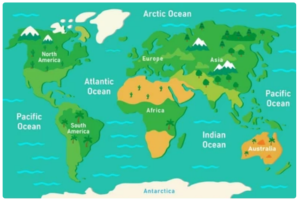
Understanding the location and features of major seas is key. Refer to a world seas and oceans map to visualize these locations clearly, as UPSC often asks map-based questions.
The Arabian Sea is part of the northern Indian Ocean. It borders Pakistan, Iran, and India. The Gulf of Aden connects it to the Red Sea. Historically, it was a vital trade route. Monsoon winds strongly influence its marine life and weather patterns.
This marginal sea of the Pacific Ocean is a global maritime hub. It lies between China, Vietnam, and the Philippines. The South China Sea is rich in oil, gas, and fishing grounds. It also sees many territorial disputes among nations.
The Mediterranean Sea is almost entirely landlocked by Europe, Africa, and Asia. The Strait of Gibraltar links it to the Atlantic Ocean. This sea was a center for ancient civilizations and remains a major trade route. Its waters are saltier due to high evaporation.
The Red Sea separates Africa from the Arabian Peninsula. It connects to the Indian Ocean through the Bab-el-Mandeb strait. This sea is known for its high salinity and vibrant coral reefs. It is also a crucial shipping lane, linking to the Suez Canal.
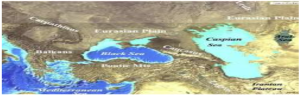
Located between Eastern Europe and Western Asia, the Black Sea is an inland sea. It borders Turkey, Bulgaria, Romania, Ukraine, Russia, and Georgia. Its deep waters have an anoxic (oxygen-free) layer. The Bosporus Strait connects it to the Mediterranean.
The Caspian Sea is the world’s largest inland body of water. It is bordered by Russia, Kazakhstan, Turkmenistan, Iran, and Azerbaijan. This “sea” is technically a lake due to its enclosure. It holds significant oil and natural gas reserves.
The Sargasso Sea is unique as it is defined only by ocean currents. It has no land boundaries. This sea is found in the North Atlantic Ocean. It is known for its floating Sargassum seaweed mats. These mats support diverse marine ecosystems.
Click to Explore UPSC Offline Coaching
Identifying the largest seas in the world helps in understanding the scale of maritime ecosystems. Below is a ranking based on surface area:
| Rank | Sea Name | Area (Approx. Sq Km) | Ocean Connection |
| 1 | Philippine Sea | 5,695,000 | Pacific |
| 2 | Coral Sea | 4,791,000 | Pacific |
| 3 | Arabian Sea | 3,862,000 | Indian |
| 4 | South China Sea | 3,500,000 | Pacific |
| 5 | Caribbean Sea | 2,754,000 | Atlantic |
| 6 | Mediterranean Sea | 2,500,000 | Atlantic |
| 7 | Bering Sea | 2,260,000 | Pacific |
| 8 | Sea of Okhotsk | 1,583,000 | Pacific |
| 9 | Gulf of Mexico | 1,507,000 | Atlantic |
| 10 | Sea of Japan | 1,048,000 | Pacific |
Map-based learning is the most effective way to tackle geography questions. Using an important seas of the world map allows aspirants to visualize the “bordering countries,” a frequent area of questioning in the UPSC Prelims.
Students should focus on the Caspian Sea (landlocked), the Black Sea (strategic gateway), and the Red Sea (trade route).
Certain regions are consistently highlighted in the news, making them important seas for UPSC.
Check Out UPSC CSE Books
Visit PW Store
UPSC Offline Centres List
City
UPSC Offline Centres
Pantna
UPSC Coaching in Patna
Delhi
UPSC Coaching in Delhi
Lucknow
UPSC Coaching in Lucknow
Indore
UPSC Coaching in Indore
Jaipur
UPSC Coaching in Jaipur
Chandigarh
UPSC Coaching in Chandigarh
Bengaluru
UPSC Coaching in Bengaluru
Muzaffarpur
UPSC Coaching in Muzaffarpur
Prayagraj
UPSC Coaching in Prayagraj
Explore UPSC Test Series

The Philippine Sea is the largest sea in the world by surface area, spanning over 5.6 million square kilometers within the Western Pacific Ocean.
You can use the mnemonic "TARIK" to remember the countries: Turkmenistan, Azerbaijan, Russia, Iran, and Kazakhstan, which are essential for important seas for UPSC preparation.
The main difference between world seas and oceans is that seas are smaller and usually located where land and ocean meet, often being partially enclosed by landmasses.
Marginal seas are significant because they are highly productive biologically and are often the site of major human activities like fishing, shipping, and offshore oil drilling.



Explore SRIJAN Prelims Crash Course


Connect with our experts to get free counselling & start preparing
Books
Udaan (Prelims Wallah)
Prahaar (Mains Wallah)
Q&A Bank (Prelims & Mains)
Budget & Economic Survey
NCERT Wallah
Marks Booster
हिंदी माध्यम विशेष शृंखला
 Current Affairs
Monthly Current Wallah
Subject Wise Current Affairs
Editorial Analysis
Editorial PDFs
News of The Day
Download Our App



Download Our App
<div class="new-fform">
</div>

 GS Foundation
 Optional Course
 Combo Courses
 Degree Program