Books

India Exits Chabahar Port? The US is pressuring India to leave Chabahar due to Iran sanctions, but the port remains vital for bypassing Pakistan, accessing Afghanistan and Central Asia, countering China’s Gwadar, supporting INSTC trade, and ensuring energy security.
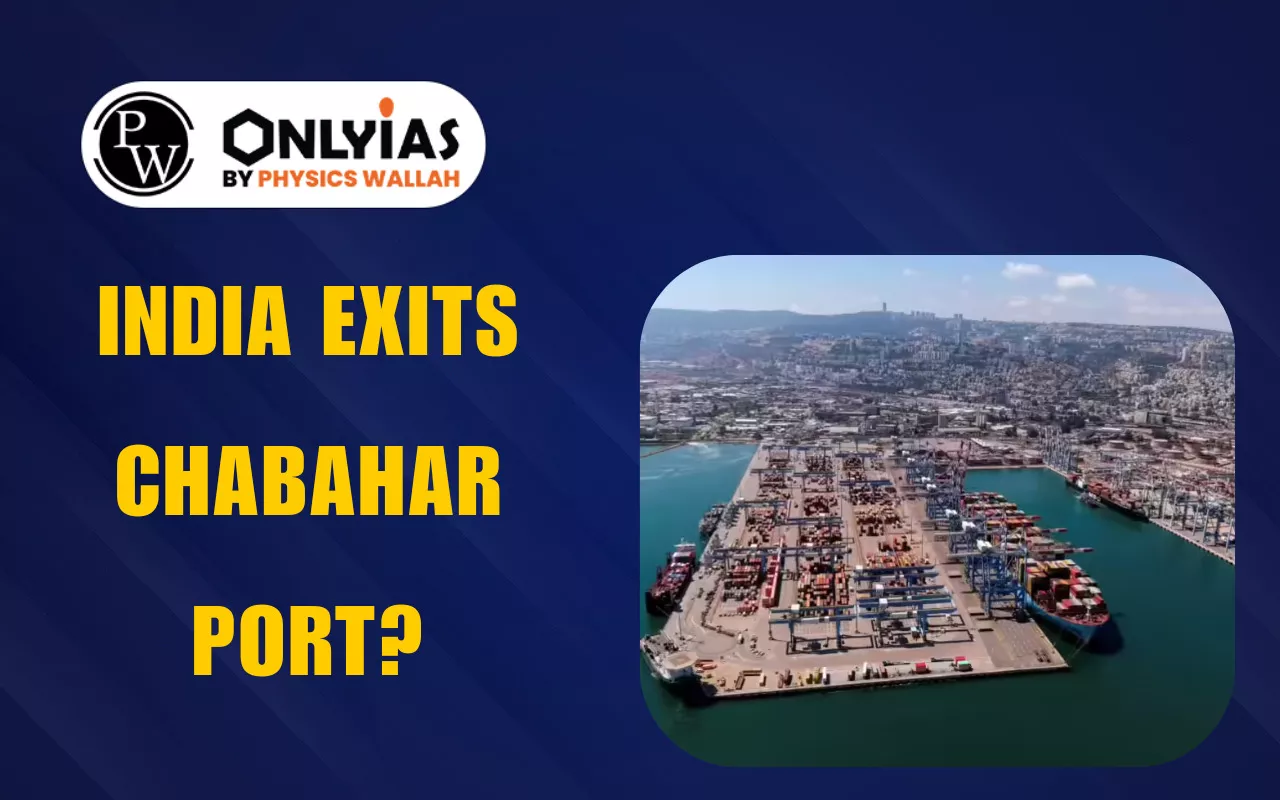
India Exits Chabahar Port? This question has been gaining attention due to growing international pressures. The United States has been pressuring India to stop its involvement with Chabahar Port in Iran because of US sanctions against Iran. This port is strategically important for India as it allows the country to bypass Pakistan and connect directly with Afghanistan and Central Asia. Chabahar is also a counter to China’s Gwadar Port and a vital part of the International North-South Transport Corridor (INSTC).
Chabahar Port is very important for India. It allows India to bypass Pakistan, which is crucial because India cannot use routes through Pakistan for trade or strategic purposes. The port helps India reach Afghanistan and Central Asia directly. It is also part of the International North-South Transport Corridor (INSTC). This corridor is a long trade route connecting India, Iran, Afghanistan, Russia, Central Asia, and Europe. Using this route reduces trade time and cost compared to the Suez Canal route.
Explore UPSC Foundation Courses

Explore UPSC Foundation Courses
The port is not only important for trade. It also helps India in energy security. The Strait of Hormuz, near Chabahar, is a major route for oil shipments. By using Chabahar, India secures better control over its energy supply. The port has also been used to send wheat to Afghanistan and fertilizers to Iran.
Access to global ports is crucial for national development. For India, Chabahar Port offers a unique advantage. India and Iran signed an agreement allowing India to develop and operate the port. Its location provides India with strategic and trade benefits that cannot be obtained elsewhere.
Chabahar Port is essential for India for multiple reasons:
| Port Name | Location | Developer | Strategic Context |
| Chabahar Port | Iran | India | Direct alternative, strategic counter |
| Gwadar Port | Pakistan | China | Nearby port, China-Pakistan initiative |
The main challenge for India comes from the US sanctions on Iran. The US alleges that Iran is developing a nuclear bomb and pressures other nations, including India, to restrict engagement with Iran.
India’s engagement with Chabahar started in 2003, with a formal agreement in 2015. The port is important for strategic, security, and economic reasons.
| Trade Routes | |||
| Route Type | Path | Advantages | Disadvantages |
| Current Sea Route | India → Arabian Peninsula → Suez Canal → Russia/Europe | Large capacity | Long, costly, time-consuming |
| Chabahar Route | India → Chabahar → Multi-modal → Russia/Europe | Shorter, faster, cheaper | Requires international cooperation |
The Chabahar Port is a key gateway to the International North-South Transport Corridor (INSTC), a 7,200 km multi-modal network linking India, Iran, Afghanistan, Russia, Central Asia, and Europe. It reduces dependence on the Suez Canal and cuts transit time and costs.
Explore UPSC Prarambh Course

Explore UPSC Prarambh Course
Chabahar Port is already operationally valuable:
Check Out UPSC CSE Books
Visit PW Store
Despite the pressure, total abandonment of the port is unlikely because of its massive strategic value:
If you are preparing for UPSC, understanding rivers like the Sutlej is essential. Explore PW OnlyIAS Courses to build strong conceptual clarity with mentors’ guidance and structured learning.
Explore UPSC Test Series

It provides a direct route to Afghanistan and Central Asia, bypassing Pakistan.
India is negotiating with the US, but a total exit is unlikely because of its strategic value.
Chabahar serves as India’s counter to China’s Gwadar Port in Pakistan.
It acts as a key gateway for the International North-South Transport Corridor, reducing trade time and costs.
Yes, India has shipped wheat to Afghanistan and goods like pesticides to Iran via the port.



Explore SRIJAN Prelims Crash Course


Connect with our experts to get free counselling & start preparing
Books
Udaan (Prelims Wallah)
Prahaar (Mains Wallah)
Q&A Bank (Prelims & Mains)
Budget & Economic Survey
NCERT Wallah
Marks Booster
हिंदी माध्यम विशेष शृंखला
 Current Affairs
Monthly Current Wallah
Subject Wise Current Affairs
Editorial Analysis
Editorial PDFs
News of The Day
Download Our App



Download Our App
<div class="new-fform">
</div>

 GS Foundation
 Optional Course
 Combo Courses
 Degree Program