Books

Jhelum River is a major tributary of the Indus River system. It originates from Chashma Verinag in Jammu and Kashmir. Known by ancient names like Vitasta, it flows through the Kashmir Valley, covering about 165 km in India. The river sustains the region before joining the Chenab River in Pakistan. Understanding its course and tributaries is vital for competitive exams.
The Jhelum River is one of the most important rivers in South Asia. It has shaped cultures, supported civilizations, and fed millions of people for thousands of years. Known for its scenic valley and deep history, this river flows from the majestic Himalayas through valleys, plains, and fertile lands, finally joining a larger river system. Read on to learn more about the Jhelum River for UPSC exam preparation.
The Jhelum River forms part of the larger Indus River system. The Jhelum river origin is a magnificent spring. This spring is called Chashma Verinag. It lies at the foothills of the Banihal pass in the southeastern Kashmir Valley.
The Jhelum River ancient name dates back to Vedic times. In old Sanskrit texts, it was called Vitástā. This name appears in ancient texts like the Nilamata Purana and possibly the Rigveda.
Explore UPSC Foundation Courses

Explore UPSC Foundation Courses
Greek historians, including those who wrote about Alexander the Great’s campaign, referred to the river as the Hydaspes River. The Greek name is one of the Jhelum River old names known widely in history.
The Jhelum River flows westward through the Kashmir Valley. The river flows roughly northwest from Verinag and then reaches Wular Lake, one of Asia’s largest freshwater lakes, before continuing westward. After leaving the valley, it cuts through deep gorges in the Pir Panjal range.
Here is the Jhelum River map for students:
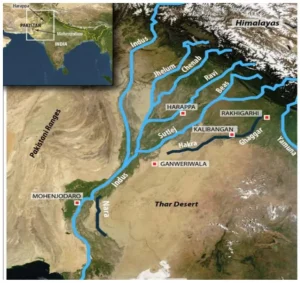
From there, it enters Pakistan-administered Kashmir near Muzaffarabad, where it picks up several tributaries, including the Kishanganga (Neelum) River. The river then bends south into the plains of Pakistan and flows past the city named after it, Jhelum, before finally meeting the Chenab River near Trimmu in Punjab province.
Jhelum River’s total length is approximately 402 km. About 165 km of the Jhelum river course lies within India.
The total Jhelum river basin area is about 34,775 sq km. Around 17,622 sq km of this basin is in India. It covers parts of Jammu and Kashmir in India, Azad Jammu and Kashmir, and Punjab in Pakistan. The basin supports millions by providing water for irrigation, drinking, and ecosystems.
Because the river flows from high mountains into plains, its basin includes rugged hills, wide valleys, and fertile farmlands. This mix gives it great agricultural and ecological importance.
Its banks are often higher than the land behind them. This can lead to floods in lower, swampy areas during heavy rainfall.
Several streams contribute to the Jhelum River, including:
Check Out UPSC CSE Books
Visit PW Store
Jhelum River hydropower projects are located in India mainly in Jammu & Kashmir. These include the operational Uri-I (480 MW) and Uri-II (240 MW) projects. Larger projects such as Sawalkote (1,856 MW) are under development or at the planning stage. However, some of these projects have faced disputes with Pakistan under the Indus Waters Treaty (IWT).
The Jhelum River system plays a significant role in hydroelectric power generation, particularly in its lower reaches. Here are some hydropower projects on the river:
The Jhelum River is one of the most critical rivers of the Indus River system, with multi-dimensional importance:
Ready to boost your UPSC preparation? Join PW’s UPSC online courses today!
Explore UPSC Test Series

The ancient Sanskrit name for the Jhelum River is Vitasta.
The Jhelum river origin is Chashma Verinag spring, located at the foothills of the Banihal pass in the Kashmir Valley.
The Jhelum River ultimately joins the Chenab River in Pakistan.
The Jhelum River flows for about 165 km within India.



Explore SRIJAN Prelims Crash Course


Connect with our experts to get free counselling & start preparing
Books
Udaan (Prelims Wallah)
Prahaar (Mains Wallah)
Q&A Bank (Prelims & Mains)
Budget & Economic Survey
NCERT Wallah
Marks Booster
हिंदी माध्यम विशेष शृंखला
 Current Affairs
Monthly Current Wallah
Subject Wise Current Affairs
Editorial Analysis
Editorial PDFs
News of The Day
Download Our App



Download Our App
<div class="new-fform">
</div>

 GS Foundation
 Optional Course
 Combo Courses
 Degree Program