Core Demand of the Question
- Discuss arguments for urbanization leading to more segregation and/or marginalization of the poor in Indian metropolises
- Discuss arguments against urbanization leading to more segregation and/or marginalization of the poor in Indian metropolises
|
Answer
Introduction
The allure of Indian metropolises draws millions with the promise of employment and prosperity. Yet, the reality of urban life often paints a different picture for the most vulnerable. This exploration assesses urbanization’s role in segregating and marginalizing the poor, and the resulting human cost and challenges to equitable city-building.
Body
Arguments for Urbanization Leading to Segregation/Marginalization of the Poor
- Rise of informal settlements: Rapid urbanization often outpaces the supply of affordable housing, pushing migrants and the urban poor into unplanned slums.
Eg: Dharavi in Mumbai, one of Asia’s largest slums.
- Gentrification and displacement: Redevelopment and beautification projects tend to evict slum dwellers without adequate rehabilitation.
Eg: The Yamuna Pushta evictions displaced thousands for riverfront beautification ahead of global events.
- Unequal access to services: Slum residents often lack clean drinking water, quality healthcare, and public sanitation, worsening their living conditions.
- Social segregation by design: Urban planning often fosters spatial division through exclusive gated communities and limited public spaces.
- Neglect in urban planning: Master Plans frequently focus on commercial growth and elite housing, sidelining low-income housing needs.
Eg: The Delhi Master Plan 2041 initially lacked strong provisions for EWS housing near employment hubs.
Arguments Against Urbanization Leading to Segregation/Marginalization
- Economic opportunities: Cities offer employment in formal and informal sectors, helping migrants improve their livelihoods.
Eg: Construction work provides daily wages to thousands of migrants.
- Improved access to services: Urban areas provide better connectivity, healthcare, and schooling compared to rural belts.
- Welfare schemes: Government programs aim to reduce urban inequality.
Eg: PM Awas Yojana (Urban) targets affordable housing for EWS and LIG families.
- Slum rehabilitation models: Progressive schemes offer formal housing and amenities.
Eg: Slum Rehabilitation Authority schemes rehouse slum dwellers with improved services.
- Urban governance innovations: Participatory tools like ward sabhas ensure the poor have a voice.
Way Ahead
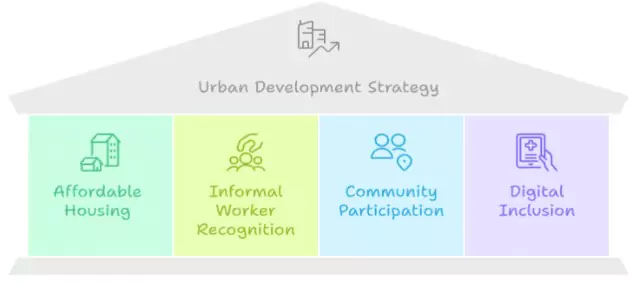
- Affordable housing push: Accelerate public rental housing and PMAY delivery in urban slums.
Eg: Ahmedabad’s housing board has initiated low-cost rental models for migrant workers.
- Recognize informal workers: Provide legal identity and protection to vendors and domestic workers.
Eg: The Street Vendors Act, 2014 ensures vending zones and licenses.
- Promote community participation: Involve slum associations in municipal planning.
Eg: Mumbai’s ALMs (Advanced Locality Management) allow local input into civic issues.
- Ensure digital inclusion: Strengthen access to online welfare schemes and services.
Eg: Digital Seva Kendras in urban poor areas can bridge the digital divide.
Conclusion
Urbanization in India must shift from being economy-centric to equity-centric, aligning with SDG 11 (Sustainable Cities) and SDG 10 (Reduced Inequalities), to ensure that growth empowers the urban poor who are essential to the city’s daily functioning.
 July 14, 2025