Answer:
Approach:
- Introduction: Define e-waste and highlight its growing relevance as a significant environmental and health concern in the context of rapid technological advancements.
- Body:
- Begin by outlining the primary challenges presented by e-waste.
- Delineate essential measures for responsible disposal on a domestic scale.
- Extend the discussion to a global scale, focusing on strengthening international agreements, creating standardized guidelines for e-waste management, facilitating the transfer of technology, and emphasizing corporate responsibility.
- Conclusion: Conclude, emphasizing the dual benefits of environmental protection and resource recovery.
|
Introduction:
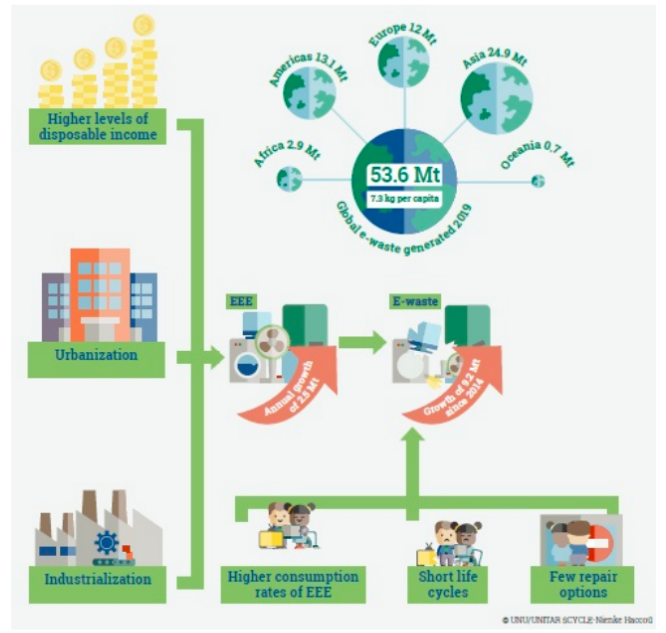
Electronic waste, or e-waste, refers to discarded electronic or electrical devices. It has become a pressing global concern. The Global E-waste Monitor 2020 reported that in 2019 alone, 53.6 million metric tonnes of e-waste was produced worldwide. Alarmingly, the Global Transboundary E-waste Flows Monitor 2022 indicates that almost 10% of this total, or 5.1 Mt, crossed international borders, with a significant portion being shipped without proper controls. These numbers emphasize the urgent need for better e-waste management in the face of its rapid growth and potential environmental and health impacts.
Body:
Challenges of E-Waste:
- Toxic Elements: E-waste contains toxic elements like lead, mercury, and cadmium which can lead to soil, water, and air contamination if not disposed of properly.
- Informal Processing: In countries like India, a substantial amount of e-waste is processed informally, exposing workers to health risks and leading to environmental degradation.
- Transboundary Movement: Developed countries often ship e-waste to developing countries, sometimes under the guise of ‘second-hand goods’, leading to dumping in nations ill-equipped to handle it.
Essential Measures for Responsible and Environmentally Safe Disposal of E-Waste:
Domestic Scale:
- Legislation and Regulation: Formulate stringent laws regulating e-waste disposal.
- For example, India’s E-Waste (Management) Rules, 2016 mandates producers to take responsibility for the collection and exchange of e-waste.
- Promote Formal Recycling: Encourage setting up of formal recycling units with proper technology to recover metals and reduce hazardous impacts.
- Public Awareness Campaigns: Sensitize the public about the harmful effects of e-waste and the importance of proper disposal methods.
- Producer Responsibility: Manufacturers should be mandated to take back old products, ensuring they are recycled or disposed of safely.
Global Scale:
- International Agreements: Strengthen international agreements, like the Basel Convention, that control transboundary movement of hazardous wastes.
- Standardized Guidelines: Create standardized e-waste management guidelines ensuring best practices are shared and implemented globally.
- Transfer of Technology: Developed countries should assist developing nations in acquiring the technology for safe e-waste disposal.
- For instance, the UNEP’s Solving the E-Waste Problem (StEP) initiative promotes sustainable e-waste handling by facilitating technology and knowledge transfer.
- Corporate Responsibility: Global tech companies can play a significant role by designing products that are more durable, easier to repair, and recycle. They can also set up global take-back schemes.
- For example, Apple’s recycling program uses robots to disassemble iPhones and recover valuable materials efficiently.
Conclusion:
The escalating problem of e-waste necessitates immediate attention and collective action. Through a combination of domestic initiatives and global cooperation, we can pave the way for sustainable and responsible e-waste management. This will not only protect our environment but also ensure that resources embedded in electronics are efficiently recovered and reused.
 September 4, 2023