Books

Peshwa Bajirao 1, chief minister of the Maratha Empire from 1720 to 1740, was a skilled general and strategist. His leadership expanded Maratha power into central India. He is remembered for his military genius, strong family ties, and influence over the Maratha confederacy.
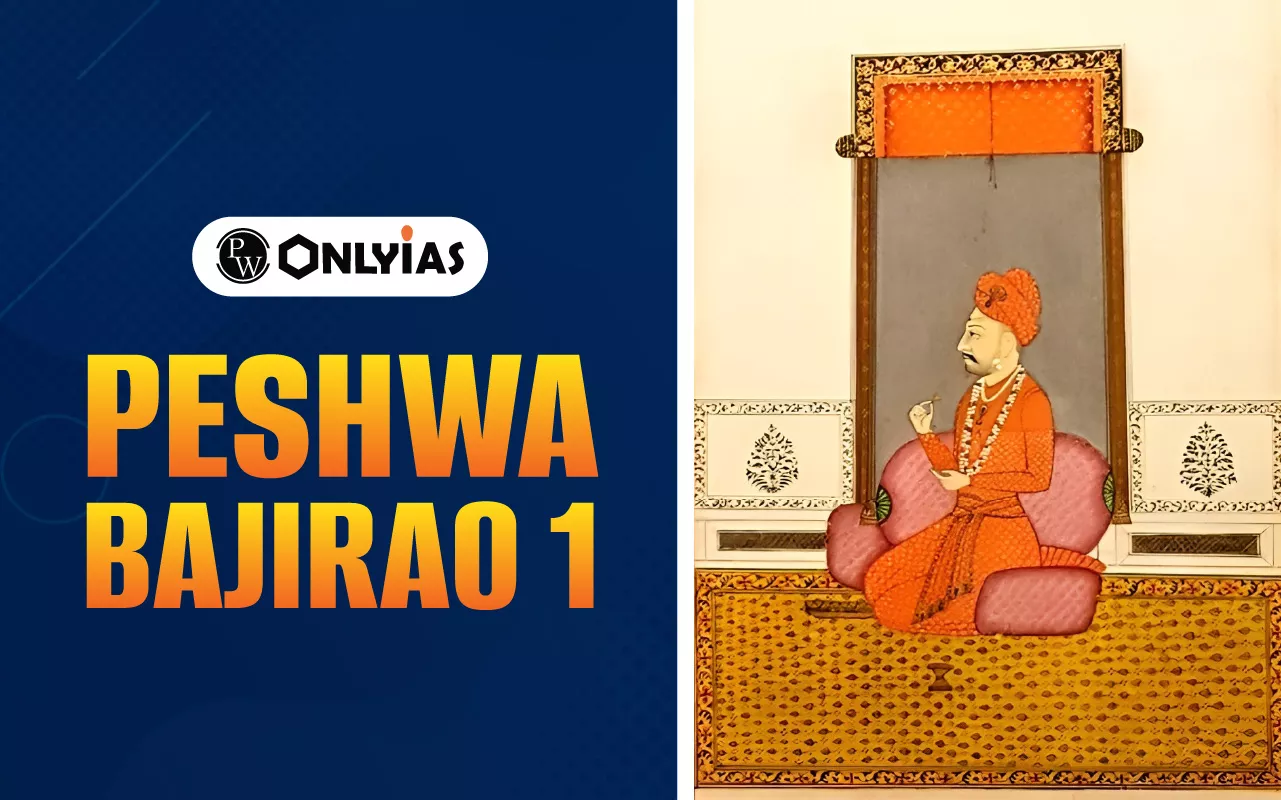
Peshwa Bajirao 1, also known as Peshwa Bajirao I, was the peshwa (prime minister) of the Maratha Empire under Shahu’s rule. He served as the peshwa from 1720 to 1740. As a military genius, Bajirao I expanded the Maratha power in Malwa and Gujarat and also extended it into North India. He was also responsible for the downfall of the Mughal Empire during the reign of Muhammad Shah. Bajirao 1 also played a role in the growth of the Maratha Empire and introduction of the hereditary system of Peshwas.
Peshwa Bajirao 1 was born to the famous Bhat family. Peshwa Bajirao 1 was the son of the then peshwa Balaji Vishvanath Bhat. In 1720, he became the peshwa of the Maratha Empire. In a career spanning two decades, Peshwa Bajirao 1 became one of the most influential military leaders in Indian history.
He was renowned for his battlefield tactics and strategy. He is often described as one of the greatest warriors to have ever fought for India. Bajirao 1 was also known for his strategy of fast cavalry charges and surprise attacks and his ability to win battles with smaller armies. Bajirao 1’s love story with Mastani and his marriage to Kashibai is well known as a part of Maratha folklore.
| Peshwa Bajirao 1 Key Facts | |
| Category | Details |
| Peshwa Bajirao 1 Full Name | Baji Rao Ballal Bhat |
| Peshwa Bajirao 1 Wife | Kashibai Bhat |
| Peshwa Bajirao 1 Son | Balaji Baji Rao (Nanasaheb) |
| Peshwa Bajirao 1 Father | Balaji Vishvanath Bhat |
| Peshwa Bajirao 1 Battles | Battle of Palkhed, Battle of Bhopal, Battle of Malwa, Battle of Delhi (1737), others |
| Bajirao 1 Time Period | 1720 – 1740 |
The Peshwa Bajirao 1 biography begins with his birth in the Bhat family in 1700. Bajirao was groomed in military, administrative, and leadership skills from a young age. Upon his father Balaji Vishvanath’s death, Bajirao was appointed as the peshwa at a young age, injecting vigor and strategic acumen into the administration.
Bajirao expanded the Maratha empire into central and northern India, notably in Malwa and Gujarat. His conquests weakened the Mughal empire and established the Marathas as a dominant force. Bajirao’s leadership style combined strict discipline, battlefield innovation, and administrative expertise, earning him the loyalty of his soldiers and ministers.
A warrior at heart, Bajirao also patronized art, culture, and learning. His court in Pune became a center for scholars, poets, and artists. The Peshwa Bajirao 1 biography delves into his personal life, including his wife Kashibai, his son Balaji Baji Rao, and his relationship with Mastani.
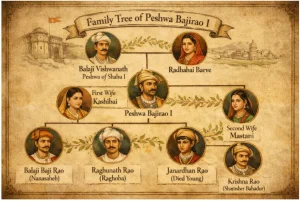
The Bajirao Peshwa family tree reflects the hereditary nature of the peshwa post. Bajirao’s father, Balaji Vishvanath Bhat, was the first hereditary peshwa. Bajirao’s son, Balaji Baji Rao (Nanasaheb), succeeded him after his untimely death in 1740. The family tree also includes Bajirao’s wife Kashibai and his other children with Mastani. The lineage continued to influence the Maratha confederacy for several decades.
Peshwa Bajirao 1 was a brilliant military strategist whose battles expanded the Maratha Empire across India. His victories showcased his use of fast cavalry, smart tactics, and strategic planning, making him one of the most respected warriors of his time. Key Battles of Peshwa Bajirao 1:
This was Bajirao’s first major victory against the Nizam of Hyderabad. He used rapid cavalry movements and encirclement tactics to cut off the Nizam’s supply lines, forcing him to surrender without heavy bloodshed.
In this battle, Bajirao defeated the Mughal forces in Malwa, solidifying Maratha control in central India. His strategic positioning and swift attacks allowed him to overcome a numerically superior enemy.
Bajirao led Maratha forces into Malwa to weaken Mughal authority. By winning key forts and controlling trade routes, he expanded Maratha influence and secured revenue-rich regions.
Bajirao marched towards Delhi, confronting Mughal forces directly. His tactical brilliance forced the Mughals to retreat, signaling the growing strength of the Maratha Empire in northern India.
Bajirao also fought several smaller battles in Gujarat, Bundelkhand, and Khandesh. In each engagement, his use of fast-moving cavalry, intelligence, and strategic surprise ensured consistent victories for the Marathas.
Check Out UPSC CSE Books
Visit PW Store
The reason behind Bajirao Peshwa death was that he was taken by a sudden illness in 1740. At the time, he was 40 years old. This shocked the whole Maratha Empire. His son, Balaji Baji Rao, succeeded him as the peshwa and kept on with his father’s work of fortifying and expanding the Maratha confederacy. He also had a huge impact on Kashibai, who devoted her life to austerity after his death.
Ready to boost your UPSC 2026 preparation? Join PW’s UPSC online courses today!
Explore UPSC Test Series

Peshwa Bajirao 1 was the prime minister and a military chief of the Maratha Empire during 1720 to 1740.
Kashibai continued to live a life of devotion and served the family with great dignity after Bajirao passed away.
After Bajirao’s death, his son Balaji Baji Rao (Nanasaheb) took over as the Peshwa of the Maratha Empire.
His father was Balaji Vishvanath Bhat, who was the first hereditary Peshwa of the Marathas.
His son was Balaji Baji Rao, also known as Nanasaheb, who succeeded him as Peshwa.
Peshwa Bajirao 1 battles include Palkhed, Malwa, Bhopal, Delhi, and many more, where he proved his military brilliance.



Explore SRIJAN Prelims Crash Course


Connect with our experts to get free counselling & start preparing
Books
Udaan (Prelims Wallah)
Prahaar (Mains Wallah)
Q&A Bank (Prelims & Mains)
Budget & Economic Survey
NCERT Wallah
Marks Booster
हिंदी माध्यम विशेष शृंखला
 Current Affairs
Monthly Current Wallah
Subject Wise Current Affairs
Editorial Analysis
Editorial PDFs
News of The Day
Download Our App



Download Our App
<div class="new-fform">
</div>

 GS Foundation
 Optional Course
 Combo Courses
 Degree Program