Udaan, Prahaar, Q&A Bank etc.
CA Magazines & Editorials
Political parties are essential to India's democracy, connecting citizens with the government and shaping public policies. India follows a multi-party system with National, State, and Unrecognised Parties. The Election Commission of India (ECI) grants recognition based on electoral performance. National and regional parties play a crucial role in governance, coalition politics, and democratic representation.
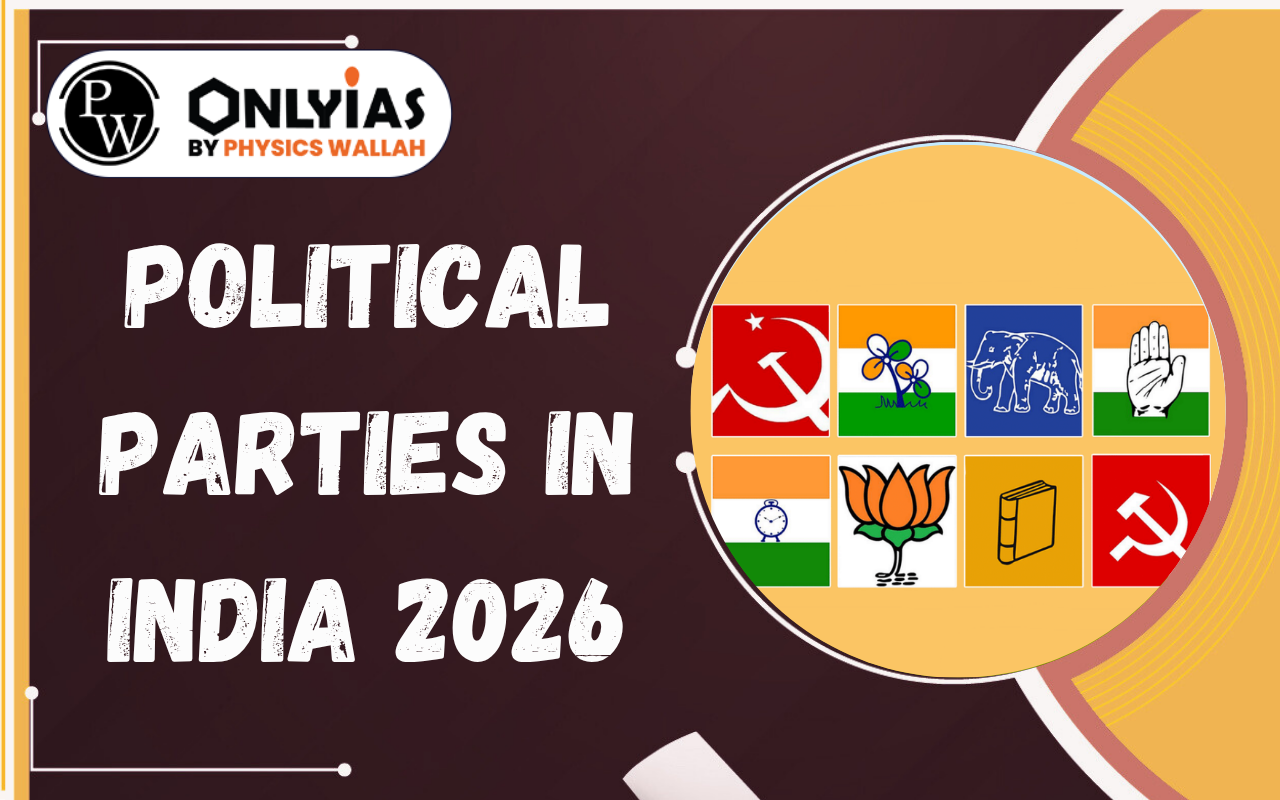
Political parties are organised groups that contest elections, form governments, and represent public interests. They play a crucial role in democracy by promoting political participation, formulating policies, providing opposition, and ensuring government accountability. The Election Commission of India classifies parties as National, State, or Unrecognised based on their electoral performance.
India follows a multi-party system that has evolved from Congress dominance to coalition politics and the rise of regional parties. As of 2025, India has 6 recognised National Parties and several recognised State Parties. The ECI’s structured interaction initiative with political parties in 2025 further strengthened electoral dialogue and democratic participation.
Political parties are organised groups of people who share a common ideology and work together to contest elections, gain political power, and govern according to their policies and objectives.
In India, political parties act as a link between citizens and the government by representing public interests, encouraging political participation, and ensuring government accountability. Unlike pressure groups, political parties aim to directly form and control the government through elections.
Political parties are essential for the smooth functioning of a democracy. They represent the interests of different sections of society, contest elections, form governments, and provide constructive opposition. They also promote political awareness, formulate public policies, and ensure stability and continuity in governance through organized political participation.
The Election Commission of India (ECI) classifies political parties into three categories based on their electoral performance:
A party is recognised as a National Party if it meets ECI criteria related to vote share, Lok Sabha seats, or recognition in multiple states. National parties can use a reserved election symbol across India and receive other electoral benefits.
A party is recognised as a State Party if it satisfies ECI criteria related to vote share or seats won within a particular state. These parties mainly represent regional interests and enjoy a reserved symbol in their recognised state(s).
These are registered political parties that have not met the requirements for national or state party status. They do not receive benefits such as reserved symbols or free broadcast time. As of 2025, India has over 2,600 registered unrecognised political parties.
Explore UPSC Foundation Courses

Explore UPSC Foundation Courses

India follows a multi-party system, where several national and regional parties compete in elections. This diversity reflects India’s social, cultural, and regional diversity and makes its political system one of the world’s most vibrant democracies.
The Indian party system has evolved through distinct phases since Independence:
As of 2025, the Election Commission of India recognises 6 political parties as National Parties. The ECI, under Chief Election Commissioner Shri Gyanesh Kumar, conducted structured interactions with all recognised national parties in May 2025 as part of a new initiative to strengthen electoral dialogue.
| Sl. No. | Name of the Political Party | Representative / Status of Meeting | Date of Meeting |
| 1 | Bahujan Samaj Party (BSP) | Km. Mayawati (National President) | May 06, 2025 |
| 2 | Bharatiya Janata Party (BJP) | Shri Jagat Prakash Nadda (National President) | May 08, 2025 |
| 3 | Communist Party of India (Marxist) – CPI(M) | Shri M.A. Baby (General Secretary) | May 10, 2025 |
| 4 | National People’s Party (NPP) | Shri Conrad K. Sangma (National President) | May 13, 2025 |
| 5 | Aam Aadmi Party (AAP) | Shri Arvind Kejriwal (National Convenor) | May 15, 2025 |
| 6 | Indian National Congress (INC) | Party requested deferral and did not reply to subsequent ECI communications for rescheduling | Invited: May 15, 2025 |
In addition to National Parties, the ECI interacted with 17 recognised State Parties during July and August 2025. Altogether, 23 parties (6 national + 17 state) participated in this structured interaction initiative. The full list of recognised state parties that met with the Commission is given below:
| Sl. No. | Name of the Political Party | Authorised Representative | Date of Meeting |
| 1 | All India Trinamool Congress (AITC) | Ms. Chandrima Bhattacharya (Authorised Representative) | July 1, 2025 |
| 2 | Yuvajana Sramika Rythu Congress Party (YSRCP) | Shri Y.V. Subba Reddy | July 3, 2025 |
| 3 | Samajwadi Party (SP) | Shri Ramgopal Yadav (Secretary General) | July 3, 2025 |
| 4 | All India Majlis-e-Ittehadul Muslimeen (AIMIM) | Shri Asaduddin Owaisi (National President) | July 7, 2025 |
| 5 | Telugu Desam Party (TDP) | Shri Palla Srinivasa Rao (State President) | July 15, 2025 |
| 6 | Dravida Munnetra Kazhagam (DMK) | Shri N.R. Elango | July 17, 2025 |
| 7 | Communist Party of India (ML) Liberation | Shri Sanjay Sharma (Authorised Representative) | July 22, 2025 |
| 8 | Tipra Motha Party | Shri Brishaketu Debbarma (General Secretary) | July 23, 2025 |
| 9 | All India Anna Dravida Munnetra Kazhagam (AIADMK) | Shri Shanmugam (Authorised Representative) | July 24, 2025 |
| 10 | Shiv Sena | Shri Uday Samant | July 29, 2025 |
| 11 | Janata Dal (United) [JD(U)] | Mr. Afaque Ahmad Khan (Authorised Representative) | July 31, 2025 |
| 12 | Indigenous People’s Front of Tripura (IPFT) | Shri Prem Kumar Reang (Party President) | August 1, 2025 |
| 13 | Bharat Rashtra Samithi (BRS) | Shri K.T. Rama Rao (Working President) | August 5, 2025 |
| 14 | Lok Janshakti Party (Ram Vilas) [LJP(RV)] | Shri A.K. Bajpayee (Vice President) | August 7, 2025 |
| 15 | Nationalist Congress Party (NCP) | Shri Brijmohan Shrivastav (Authorised Representative) | August 12, 2025 |
| 16 | Biju Janata Dal (BJD) | Shri Debi Prasad Mishra (Sr. Vice-President) | August 19, 2025 |
| 17 | Janata Dal (Secular) [JD(S)] | Shri K.R. Shivakumar (National General Secretary) | August 21, 2025 |
Explore Prarambh Course

Explore Prarambh Course

National and State Parties differ in their geographical reach, recognition criteria, electoral influence, and role in India’s political system.
| Parameter | National Political Parties | State Political Parties |
| Geographical Scope | Contest elections across multiple states | Limited to one or a few recognised states |
| Reserved Symbol | Exclusive throughout India | Exclusive within recognised state(s) |
| Electoral Criterion | Recognition based on ECI’s national party criteria | Recognition based on ECI’s state party criteria |
| Free Broadcast Time | Available on national Doordarshan and AIR | Available on state-level Doordarshan and AIR |
| Star Campaigners | Up to 40 star campaigners | Up to 20 star campaigners |
| Coalition Role | Often lead national alliances | Often act as coalition partners or kingmakers |
| Policy Focus | National governance and policy issues | Regional concerns and state-specific development |
| Examples (2025) | BJP, INC, BSP, CPI(M), AAP, NPP | DMK, SP, AITC, TDP, NCP, JD(U), Shiv Sena |
In a landmark new initiative, the Election Commission of India, under the leadership of Chief Election Commissioner Shri Gyanesh Kumar and Election Commissioners Dr. Sukhbir Singh Sandhu and Dr. Vivek Joshi, launched structured interaction meetings with all recognised political parties at multiple levels — a significant departure from the earlier reactive mode of interaction that was prompted solely by representations from parties.
This initiative was conceptualised at the Conference of Chief Election Officers (CEOs) held in March 2025. The key highlights of this initiative are:
This initiative reflects the ECI’s broader vision of proactively strengthening the electoral process and fostering constructive dialogue with all political stakeholders in accordance with the existing legal framework.
Political parties in India is a high-frequency topic in the UPSC Civil Services Examination (Mains). The following questions have appeared in recent years:
Check Out UPSC CSE Books
Visit PW Store
Political parties are organised groups of people with a common ideology who contest elections, seek political power, and govern according to their policies.
As of 2025, the Election Commission of India recognises 6 National Parties: BJP, INC, BSP, CPI(M), AAP, and NPP.
Political parties in India are classified into three categories: National Parties, State (Regional) Parties, and Unrecognised Parties based on ECI recognition criteria.




Connect with our experts to get free counselling & start preparing
Join India’s trusted platform for expert guidance, quality content, proven success.
Learn anytime, anywhere.



India's leading UPSC coaching platform helping aspirants prepare for IAS, IPS, IFS and other Civil Services examinations with the best faculty and proven strategies.
<div class="new-fform">
</div>