Udaan, Prahaar, Q&A Bank etc.
CA Magazines & Editorials
Rajeshwari Suve M UPSC Rank 2 Mock Interview highlights her practice session for the Civil Services personality test. The panel asked questions on water scarcity in Tamil Nadu, social indicators, climate change, UN relevance, yoga benefits, reservation policy, and social change, while advising deeper, evidence-based answers.
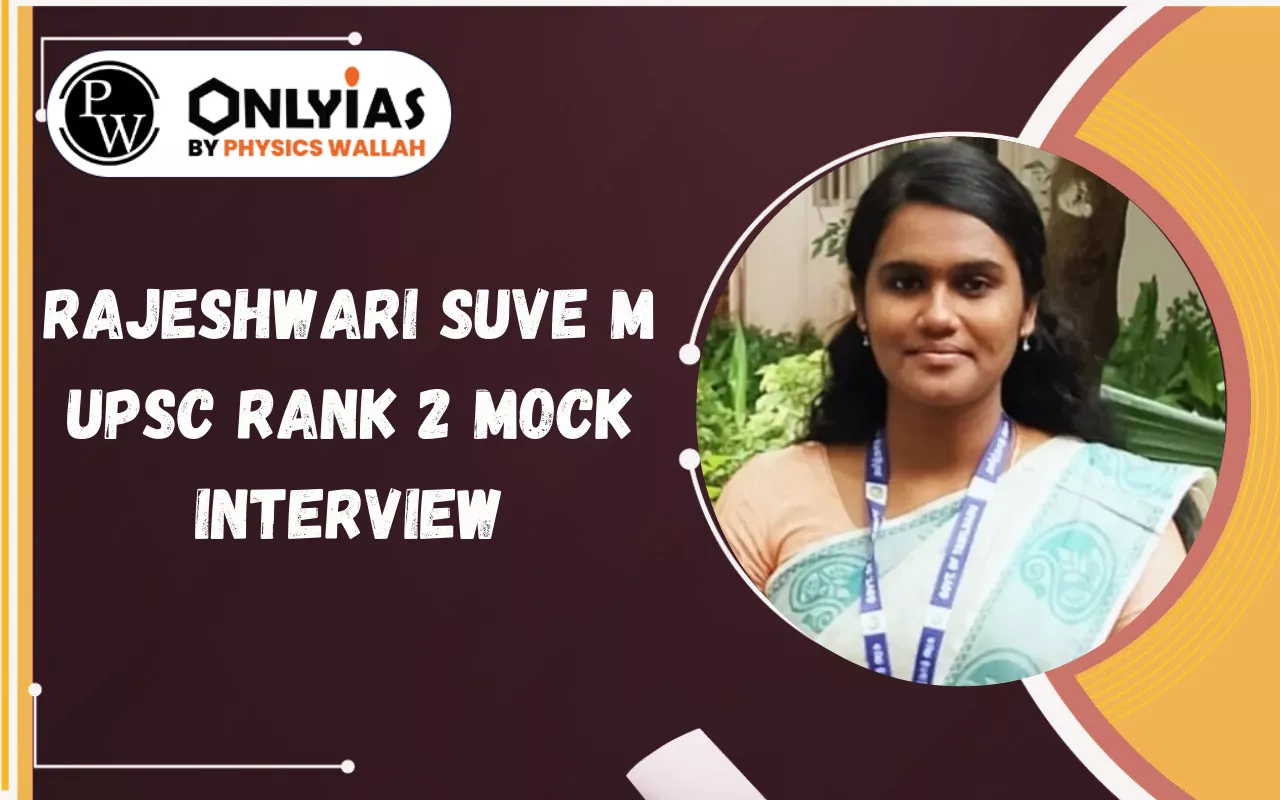
Rajeshwari Suve M UPSC Rank 2 Mock Interview: The mock interview stage is an important part of preparation for the Civil Services personality test conducted by the Union Public Service Commission. Many aspirants practice through mock interviews to improve confidence, clarity of thought, and answer presentation.
One such session involved Rajeshwari Suve M, who later secured Rank 2 in the Civil Services Examination. The mock interview focused on different topics such as water scarcity, social development, international relations, climate change, governance, and social issues.
The panel asked questions from many fields to test her awareness and analytical ability. Rajeshwari answered most questions correctly, but the panel also advised her to provide deeper explanations and examples.
Rajeshwari Suve M All India Rank 2 in the UPSC 2025 securing a final total of 1067 marks, which includes 865 marks in the written total and 202 marks in the personality test.
Rajeshwari Suve M, who secured All India Rank 2 in the UPSC Civil Services Examination 2025, participated in the Interview Guidance Programme (IGP) conducted by PW OnlyIAS as part of her preparation for the Personality Test stage. She attended the mock interview session at the PW OnlyIAS centre in offline mode, where she interacted with an experienced panel of mentors.
During the session, the panel evaluated her responses, communication style, and overall personality, while also providing detailed feedback to help refine her interview performance. The mock interview environment allowed her to practice answering questions confidently and develop a structured approach to the Personality Test.
The Interview Guidance Programme offered by PW OnlyIAS is designed to support aspirants preparing for the final stage of the UPSC selection process. Through structured mock interviews, expert assessment, and individualized feedback, the programme aims to help candidates enhance confidence, clarity in expressing their views, and their overall presentation during the interview stage.
Rajeshwari Suve M’s exceptional performance in both the written and interview stages is detailed below:
The interviewers asked Rajeshwari about several important subjects. These topics help test a candidate’s awareness and analytical thinking.
The interview began with a question about water scarcity in the state of Tamil Nadu.
Rajeshwari explained that water shortage occurs due to several reasons. One important factor is geography. Tamil Nadu lies on the leeward side of the southwest monsoon. Because of this location, the state receives limited rainfall during the main monsoon season.
Another reason is the lack of large perennial rivers. Many regions depend heavily on groundwater. Over-extraction of groundwater for agriculture and industries has increased the problem.
Urban growth also puts pressure on water resources. Cities require large amounts of water for domestic and industrial use.
The panel suggested that answers on such topics should include solutions. Some possible solutions include:
Providing both causes and solutions can make an answer more balanced.
The panel then asked about the strong social indicators in Tamil Nadu.
Rajeshwari mentioned that the state has made consistent efforts in public health and education. Government programs have expanded access to schools and hospitals across rural and urban areas.
She also referred to the role of the Public Distribution System. The distribution of essential food items has supported many families and improved nutrition.
The interviewer agreed with her points but suggested adding specific examples, such as:
Including such examples helps explain how policies improve human development.
The discussion then moved to international relations. The panel asked about the role of the United Nations in the modern world.
Rajeshwari stated that the United Nations continues to play an important role in global cooperation. It provides a platform where countries can discuss issues related to peace, security, and development.
She also mentioned the involvement of the organization in climate discussions and humanitarian assistance.
However, the panel noted that the answer could include both strengths and challenges. For example:
Such points show a balanced understanding of global institutions.
Another question focused on climate change and how leaders can be convinced to accept scientific evidence.
Rajeshwari explained that climate change should be discussed using scientific data and real examples. Rising sea levels, extreme weather events, and forest fires are clear signs of environmental change.
The panel advised that answers should also highlight the impact on vulnerable countries. Island nations and coastal regions face serious risks from rising sea levels and stronger storms.
Using facts, examples, and global reports can make arguments more convincing.
The interview panel asked why cyclones are more common on the eastern coast of India.
Rajeshwari explained that the Bay of Bengal creates favorable conditions for cyclone formation. The region has warm sea surface temperatures, which help storms develop.
The interviewer added that the wide geographical area of the Bay of Bengal and freshwater inflow from rivers also contribute to cyclone development.
States along the eastern coast often face strong cyclones because of these natural conditions. Understanding such geographical factors is important for disaster management planning.
The discussion also included a question about the importance of yoga in daily life.
Rajeshwari said that she practiced yoga during the pandemic period. According to her, yoga helped reduce stress and improved mental health.
The interviewer appreciated this personal example. However, the panel suggested including scientific evidence in the response.
Research studies show that yoga helps reduce cortisol levels, which is a hormone related to stress. Regular practice can improve mental focus and emotional balance.
The topic of yoga is often connected with the global promotion of the International Day of Yoga, which encourages healthy lifestyles.
Rajeshwari explained that many social changes have taken place in recent years. Education levels have increased and people often marry later in life. Exposure to different cultures through media and social networks has also influenced social attitudes.
These factors have changed how people view relationships and family life.
The interviewer pointed out that answers should recognize both sides of the issue. While some social trends are changing, family institutions continue to remain important in many parts of the country.
Rajeshwari explained that the creamy layer rule applies to Other Backward Classes. It excludes individuals from reservation benefits if their parents fall above certain income or status levels.
The discussion also considered whether similar criteria should apply to other categories. Rajeshwari stated that such changes require careful policy debate.
Reservation policies aim to promote social justice. At the same time, policymakers must ensure that benefits reach the communities that need them most.
The panel asked about the connection between cinema and politics in the state. Rajeshwari mentioned that several film personalities have entered politics and gained strong public support.
One prominent example is M. G. Ramachandran, who moved from cinema into politics and later served as the Chief Minister. Another well-known leader is J. Jayalalithaa, who also had a background in the film industry before becoming Chief Minister.
The popularity of cinema personalities has influenced political culture in the state for many decades.
Check Out UPSC CSE Books
Visit PW Store
Rajeshwari showed a good personality and clear communication. Her answers were generally correct. However, the experts noted that her responses were sometimes a bit superficial.
The interviewers gave her constructive feedback. They advised her to add more depth to her answers. They suggested using more facts, data, and real-life examples. For instance, when talking about social change, she should mention specific policies or recent studies.
Ready to boost your UPSC 2026 preparation? Join PW’s UPSC online courses today!
Explore SRIJAN Courses

Rajeshwari Suve M secured Rank 2 in the Civil Services Examination conducted by the Union Public Service Commission.
The mock interview covered water scarcity, social indicators, climate change, United Nations relevance, yoga, reservation policy, and social changes.
Mock interviews help aspirants improve confidence, communication skills, and the ability to present balanced answers in the personality test.
The panel advised her to add more depth, examples, and factual support to make her answers stronger.
Aspirants should prepare structured answers, support their views with facts and examples, and develop clarity while speaking during the interview.






Connect with our experts to get free counselling & start preparing
Join India’s trusted platform for expert guidance, quality content, proven success.
Learn anytime, anywhere.



India's leading UPSC coaching platform helping aspirants prepare for IAS, IPS, IFS and other Civil Services examinations with the best faculty and proven strategies.
<div class="new-fform">
</div>