Books

Shaksgam Valley is a disputed territory in the Karakoram Range, claimed by India but controlled by China since 1963. Pakistan illegally ceded this area to China, a move India consistently rejects. Its strategic location near the Siachen Glacier and its connection to the China-Pakistan Economic Corridor (CPEC) highlight the geopolitical complexities surrounding the Shaksgam Valley.
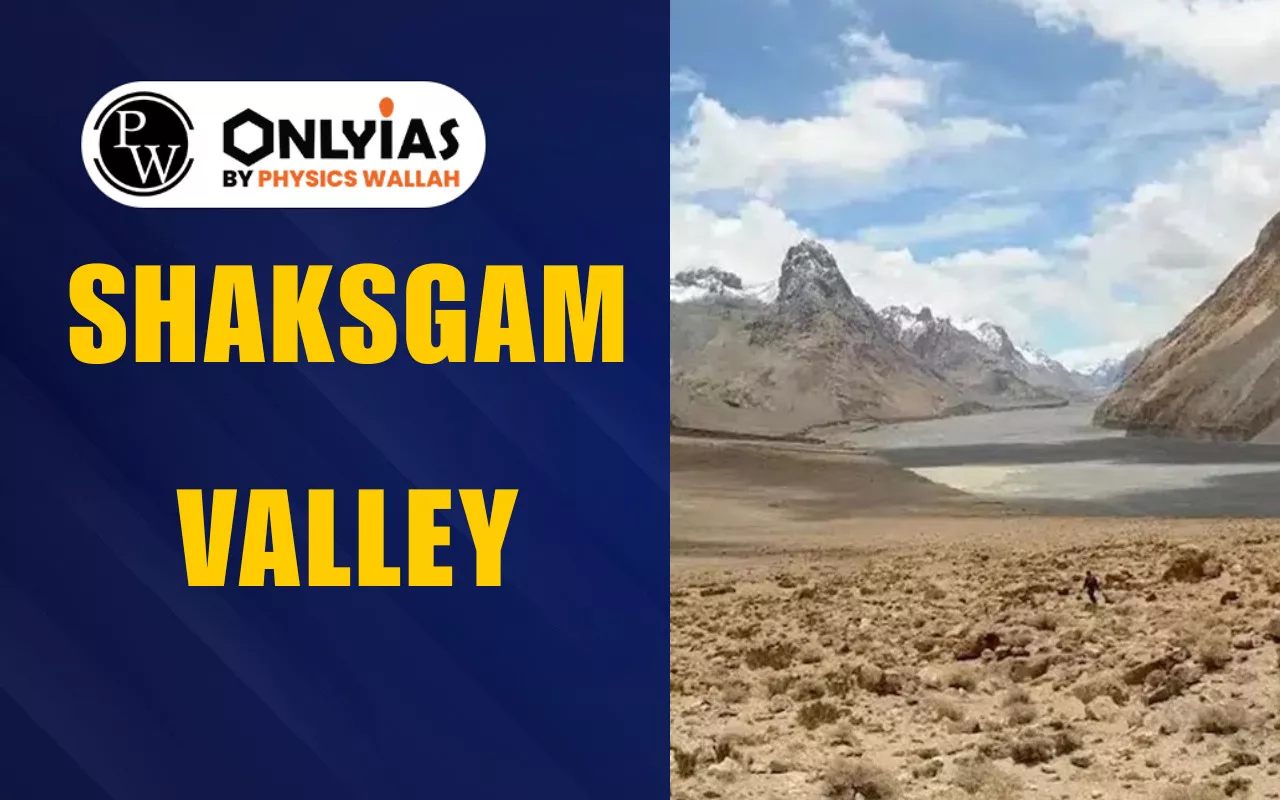
Shaksgam Valley is a cold and remote region in the Karakoram Range and forms part of the Trans Karakoram Tract. It is controlled by China but claimed by India, making it a major point of dispute in South Asia.
The valley is important due to its strategic location near the Siachen Glacier and its link to China–Pakistan connectivity projects. Its harsh geography, glaciers, and border history make the Shaksgam Valley a key topic in geography and international relations.
Explore UPSC Foundation Courses

Explore UPSC Foundation Courses
Shaksgam Valley is a large, cold, and remote valley located in the northern part of the Indian subcontinent. The Shaksgam Valley is also known as part of the Trans Karakoram Tract. It is mostly uninhabited and covered with glaciers, mountains, and rivers.
The Shaksgam Valley became important because of long-standing border and political issues involving India and China.
Shaksgam Valley is in a remote and mountainous region. It lies north of the Siachen Glacier and is part of the broader Karakoram Range. The valley borders China’s Xinjiang Province to the north. To its south and west are the Northern Areas of Pakistan-Occupied Kashmir (POK).
The Shaksgam River valley is a crucial feature within this area. The rugged Shaksgam Valley geography makes it challenging to access.
Below are official-style reference images and Shaksgam Valley maps used for educational understanding and navigation.
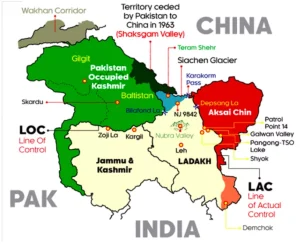
The Shaksgam Valley geography is very harsh and challenging. The land is made up of:
The climate of Shaksgam Valley is extremely cold. Snow covers the region for most of the year. Because of this, there are no permanent settlements in the Shaksgam Valley.
The Shaksgam Valley in Karakoram Range lies among one of the world’s highest mountain systems. The Karakoram Range is known for strong glaciers and steep peaks.
This location makes Shaksgam Valley difficult to access but very important from a defense point of view. Mountain passes and river routes here have been used in history for movement across borders.
Explore UPSC Prarambh Course

Explore UPSC Prarambh Course
The Shaksgam River valley is formed by the Shaksgam River, which flows through the region and later joins the Yarkand River in China. This river shapes the land and supports glaciers.
The Shaksgam River valley also helps experts understand glacier movement and water flow in the Karakoram region.
Before understanding the dispute, students should know what the Trans Karakoram Tract is.
The Trans Karakoram Tract refers to the area north of the Karakoram Range, including Shaksgam Valley. Historically, India considers this area part of the former princely state of Jammu and Kashmir.
| Feature | Details |
| Region Name | Trans Karakoram Tract |
| Key Area | Shaksgam Valley |
| Terrain | Mountains, glaciers |
| Strategic Value | Border security |
| Climate | Extremely cold |
Before 1947, the Shaksgam Valley was part of the princely state of Jammu and Kashmir. Following the 1947-48 Indo-Pak conflict, Pakistan occupied parts of this territory. In 1963, Pakistan unilaterally ceded the Shaksgam Valley to China through a boundary agreement. India maintains that this 1963 agreement is illegal. India asserts that Pakistan had no authority to transfer territory belonging to Jammu and Kashmir and Ladakh.
The Shaksgam Valley border dispute is closely linked with the Shaksgam Valley India China issue. China controls the area today, but India continues to claim it as its own.
This issue is often discussed during India-China talks because:
The Shaksgam Valley India China issue remains unresolved and is an important topic in current affairs.
Explore Degree Courses

Explore Degree Courses
Pakistan and China signed a boundary agreement in 1963. This agreement aimed to settle their border differences. However, Article 6 of this agreement stated that after the resolution of the Kashmir dispute between Pakistan and India, the sovereign authority concerned would reopen negotiations with China regarding the boundary. This would lead to a formal Boundary Treaty replacing the 1963 agreement. This agreement also laid the groundwork for the Karakoram Highway. Chinese and Pakistani engineers jointly built this highway in the 1970s.
The Shaksgam Valley location holds significant strategic value. Its proximity to the Siachen Glacier allows for observation of Pakistani positions. Access to the Karakoram Pass enables monitoring of Chinese military movements. China currently administers the valley as part of the Xinjiang Uyghur Autonomous Region. China has developed infrastructure there, including roads linked to the China-Pakistan Economic Corridor (CPEC). CPEC aims to connect Gwadar Port (Pakistan) with Kashgar (Xinjiang, China). This provides China an alternative energy route, bypassing the Malacca Strait. The Shaksgam Valley border dispute is thus vital for regional security and connectivity.
India consistently objects to China’s presence and activities in the Shaksgam Valley. India views the valley as an integral part of its Union Territory of Ladakh. India has protested against any infrastructure development in the region. This includes projects under CPEC. India considers these activities illegal and invalid, reaffirming its territorial claims.
The 1963 Sino-Pakistan Boundary Agreement outlined specific rules for the Shaksgam Valley. It defined the boundary between the two countries in this region. A key rule is Article 6, which emphasizes the provisional nature of the agreement. It states that final border negotiations would occur after settling the Kashmir dispute. This article is central to the ongoing Shaksgam Valley dispute.
The Shaksgam Valley is important for learning:
Students preparing for exams benefit from understanding the Shaksgam Valley dispute, its location, and its role in Asian geopolitics.
Check Out UPSC CSE Books
Visit PW Store
Key Points to Remember About Shaksgam Valley are given below:
Ready to boost your UPSC preparation? Join PW’s UPSC online courses today!
Explore UPSC Test Series

The Shaksgam Valley is located in the Karakoram Range, north of the Siachen Glacier, bordering China's Xinjiang province and Pakistan-Occupied Kashmir.
India claims the Shaksgam Valley as part of Jammu and Kashmir, but Pakistan ceded it to China in 1963, a move India considers illegal.
Article 6 states that the boundary agreement is provisional. Final negotiations will occur after the Kashmir dispute between India and Pakistan is resolved.
China has built infrastructure, including roads, in the Shaksgam Valley. These are linked to CPEC, which aims to enhance connectivity between China and Pakistan.



Explore SRIJAN Prelims Crash Course


Connect with our experts to get free counselling & start preparing
Books
Udaan (Prelims Wallah)
Prahaar (Mains Wallah)
Q&A Bank (Prelims & Mains)
Budget & Economic Survey
NCERT Wallah
Marks Booster
हिंदी माध्यम विशेष शृंखला
 Current Affairs
Monthly Current Wallah
Subject Wise Current Affairs
Editorial Analysis
Editorial PDFs
News of The Day
Download Our App



Download Our App
<div class="new-fform">
</div>

 GS Foundation
 Optional Course
 Combo Courses
 Degree Program