Books

A Solar Eclipse is a natural phenomenon that occurs when the Moon passes between the Sun and Earth, partially or completely blocking the Sun’s light. This alignment causes the Moon’s shadow to fall on Earth. Solar Eclipses happen only during a New Moon and are significant for studying the Sun’s atmosphere.
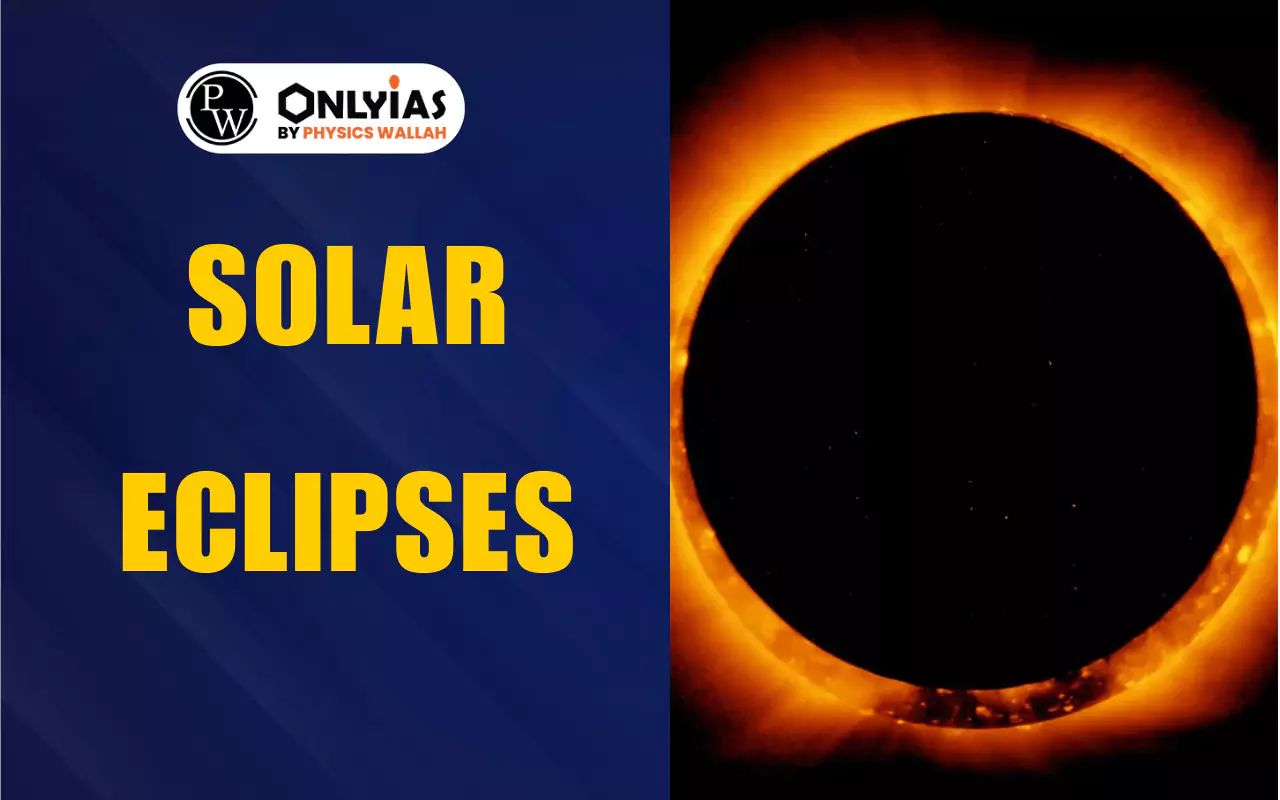
A solar eclipse is an astronomical phenomenon that happens when the Moon moves between the Earth and the Sun, temporarily blocking sunlight from reaching certain parts of the Earth. This event only takes place during the New Moon phase, when the Sun, Moon, and Earth align in a straight or nearly straight line.
Solar eclipses are classified into four main types: Total, Annular, Partial, and Hybrid. The specific type depends on the Moon’s distance from Earth and how precisely the three celestial bodies are aligned. These factors determine how the Moon’s shadow falls on Earth and what observers experience. Studying solar eclipses is important for competitive exams like UPSC.
A Solar Eclipse is a natural astronomical event. It occurs when the Moon aligns directly between the Earth and the Sun. During this alignment, the Moon’s shadow falls on Earth, causing noticeable changes in sunlight and the brightness of the sky.
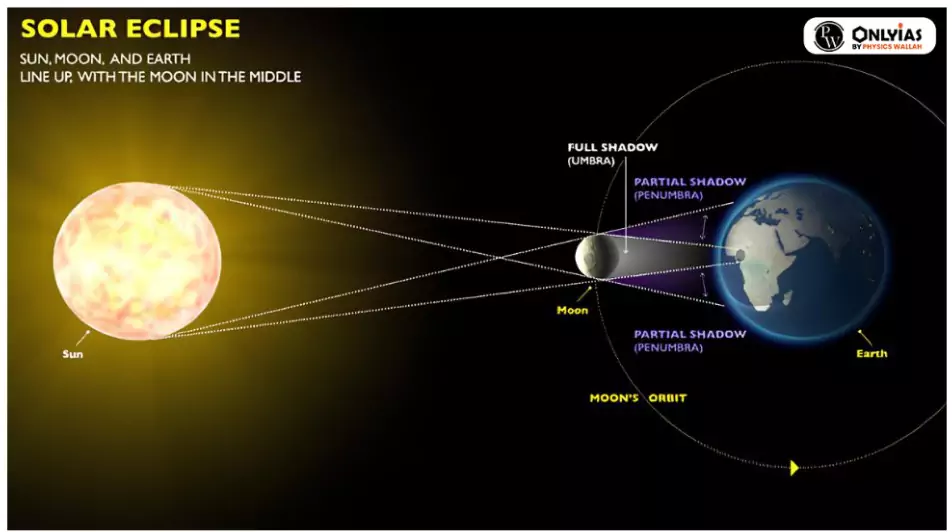
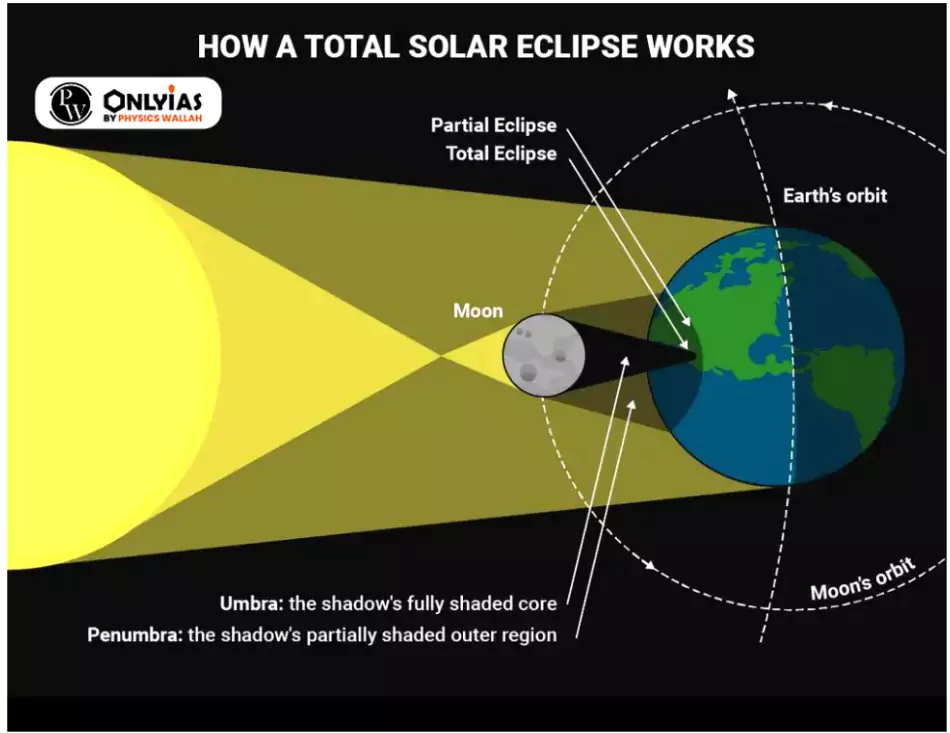
The occurrence of Solar Eclipses depends on precise astronomical alignment and orbital mechanics:
Explore UPSC Foundation Courses Explore UPSC Foundation Courses
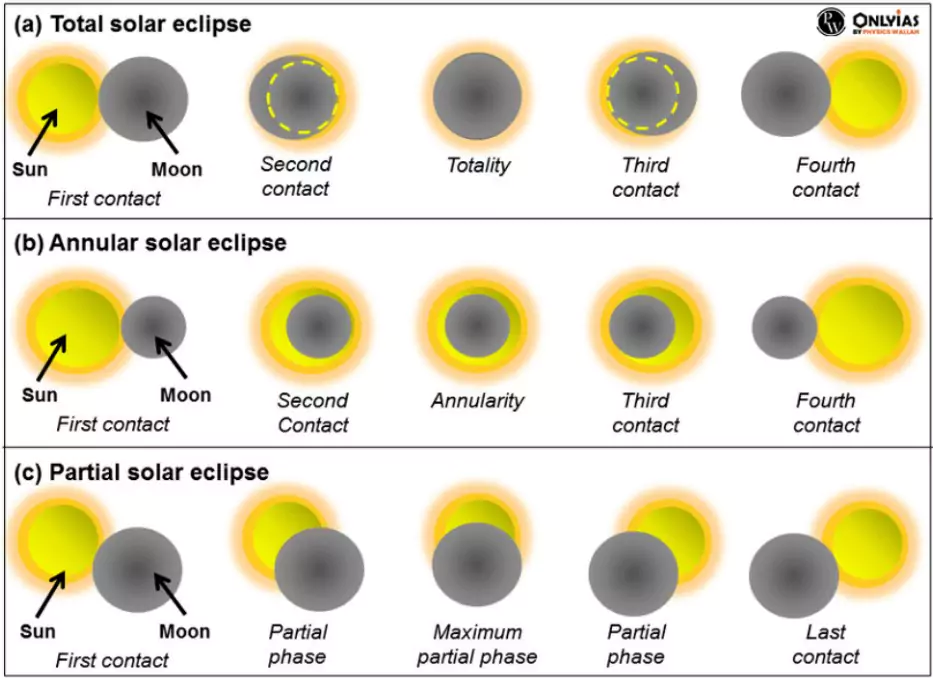
A Solar Eclipse has five main phases:
| Phase | Description | What Observers See |
| First Contact | The Moon begins to move across the Sun’s disk. | A small “bite” appears on the Sun, marking the start of the partial eclipse. |
| Second Contact | The Moon nearly covers the entire Sun. | Baily’s Beads and the Diamond Ring effect may be visible just before totality begins. |
| Totality | The Moon completely blocks the Sun. | The Sun’s corona becomes visible, stars may appear, and daylight briefly turns dim like twilight. |
| Third Contact | The Moon starts moving away from the Sun’s center. | The Diamond Ring effect appears again as sunlight re-emerges, ending totality. |
| Fourth Contact | The Moon fully clears the Sun’s disk. | The partial eclipse ends and normal daylight is fully restored. |
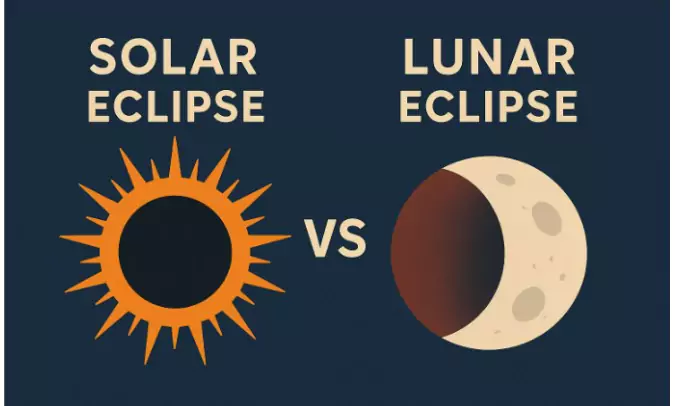
While both solar and lunar eclipses involve the alignment of the Sun, Earth, and Moon, they differ in occurrence and visibility:
| Solar Eclipse vs Lunar Eclipse | ||
| Feature | Solar Eclipse | Lunar Eclipse |
| Occurrence | Moon passes between the Earth and the Sun | Earth passes between the Sun and the Moon |
| Visibility | Visible only from specific areas on Earth within the Moon’s shadow | Visible from anywhere on the night side of the Earth |
| Effect on Sun/Moon | Sun appears partially or fully obscured | Moon appears darkened or reddish |
| Frequency | Happens 2–5 times a year | Happens 2–4 times a year |
| Time of Day | Occurs during the day | Occurs at night |
| Types | Total, Partial, Annular, Hybrid | Total, Partial, Penumbral |
| Shadow Involved | Umbra and Penumbra | Umbra and Penumbra |
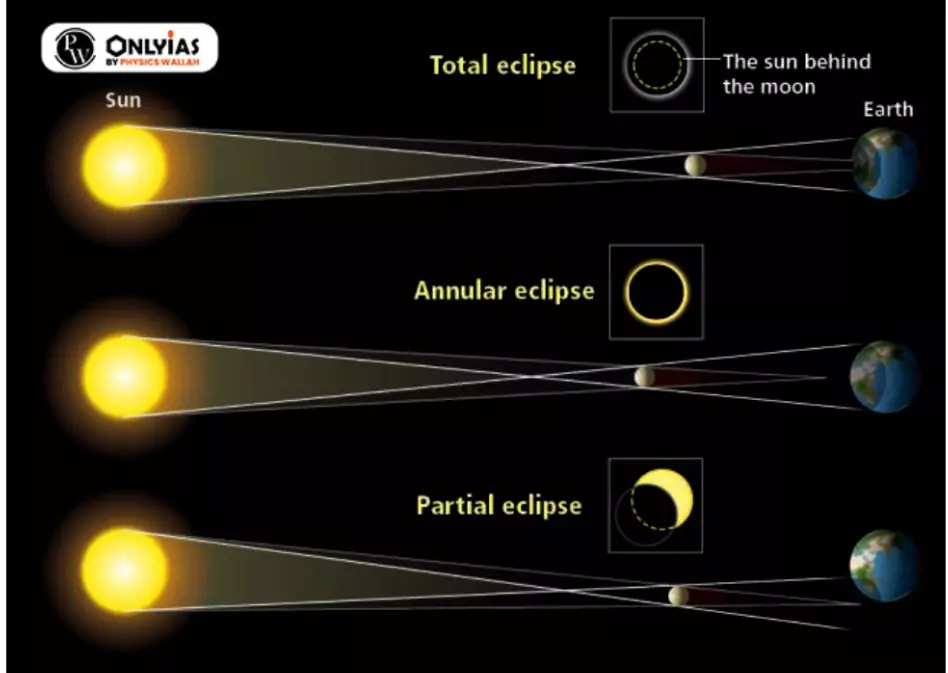
Three distinct shadow zones are created during a Solar Eclipse, depending on the extent to which the Moon blocks sunlight.
Solar Eclipses are sorted by their alignment and the Moon’s distance from Earth.
A Total Solar Eclipse completely hides the Sun. This allows unique observations of the Sun’s atmosphere.
Explore UPSC Prarambh Course Explore UPSC Prarambh Course
An Annular Solar Eclipse occurs when the Moon is too far away. It cannot completely cover the Sun.
A Partial Solar Eclipse covers only part of the Sun. The Sun, Moon, and Earth are not perfectly centered.
A Hybrid Solar Eclipse shifts its appearance along its path. This is due to Earth’s curved surface.
Solar Eclipses have distinct characteristics shaped by celestial alignment and shadow dynamics.
Astronomers can forecast Solar Eclipses with remarkable precision using advanced calculations based on orbital motion and shadow geometry.
The years 2026 and 2027 will include multiple Solar Eclipses, creating valuable opportunities for observation, scientific research, and public interest worldwide. Here is the list of upcoming solar eclipses:
| Date | Key Visibility Regions | Type of Solar Eclipse |
| February 17, 2026 | Antarctica (annular path); partial views in parts of Africa, South America, and the Indian Ocean | Ring-shaped eclipse visible mainly in Antarctica |
| August 12, 2026 | Greenland, Iceland, Spain, Russia, and parts of Portugal | Total Eclipse |
| February 6, 2027 | Several regions in the Southern Hemisphere | Annular Phase |
| August 2, 2027 | North Africa and parts of Europe | Expected to be one of the longest Total Solar Eclipses |
Solar Eclipses reveal remarkable solar features that are normally hidden by the Sun’s intense brightness. During totality, the Sun’s outer atmosphere, known as the corona, becomes visible as a glowing halo around the darkened disk. A thin reddish layer called the chromosphere can also be seen briefly.
Bright pink prominences may extend thousands of kilometers from the Sun’s surface. Just before and after totality, small flashes of light called Baily’s Beads appear as sunlight shines through the Moon’s uneven surface, creating the stunning Diamond Ring effect.
Check Out UPSC CSE Books
Solar eclipses (Surya Grahan) are astronomical events that have both scientific and cultural significance. They can impact Earth’s atmosphere, temperature, and wildlife. They have also shaped celestial understanding and influenced art, literature, and religion across cultures.
Check Out UPSC CSE Books
Explore UPSC Test Series

The solar eclipses in 2025 will be visible across Europe, Africa, the Americas, eastern Australia, New Zealand, and Antarctica.
Surya Grahana in English is called a Solar Eclipse, when the Moon passes between the Earth and the Sun.
The Surya Grahan in 2025 will occur on March 29 and September 21.
The next solar eclipse after 2025 will occur according to the astronomical calendar, typically within six months of the previous eclipse.
Solar eclipse (Surya Grahan) is an astronomical event where the Moon passes between Earth and the Sun, obscuring the view of the Sun from a small part of the Earth, either completely or partially.
The annular solar eclipse is also called the ‘ring of fire’ because the moon will not cover the sun completely, thereby leaving a thin ring of sunlight called 'ring of fire” effect.
For a solar eclipse (Surya Grahan) to occur, the moon must pass between the Earth and the Sun. Despite the moon being much smaller than the Sun, it can block the sunlight due to its position away from Earth.
Total solar eclipse, annular solar eclipse, hybrid solar eclipse and partial solar eclipse are different types of solar eclipses.
During a Solar eclipse, the moon passes between Sun and the Earth while during a lunar eclipse, the Earth passes between the Sun and the Moon.




Explore SRIJAN Prelims Crash Course


Connect with our experts to get free counselling & start preparing
Books
Udaan (Prelims Wallah)
Prahaar (Mains Wallah)
Q&A Bank (Prelims & Mains)
Budget & Economic Survey
NCERT Wallah
Marks Booster
हिंदी माध्यम विशेष शृंखला
 Current Affairs
Monthly Current Wallah
Subject Wise Current Affairs
Editorial Analysis
Editorial PDFs
News of The Day
Download Our App



Download Our App
<div class="new-fform">
</div>

 GS Foundation
 Optional Course
 Combo Courses
 Degree Program