Udaan, Prahaar, Q&A Bank etc.
CA Magazines & Editorials
Master the UPSC Mains 2026 with the comprehensive SRIJAN 2026 Plus Program. Designed for immediate, high-yield action, it features daily answer-writing practice, specialised test series for essay and ethics, topper-led mentorship, fast-track evaluation, and an organised study planner. Maximise your scores to secure a top rank with essential, paper-neutral support for all general studies papers and key optionals.
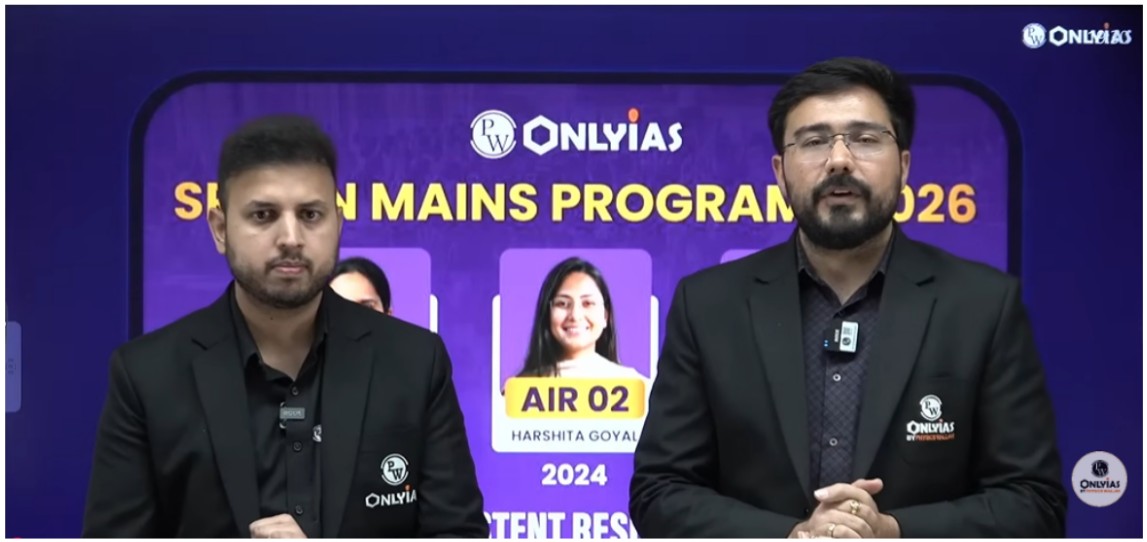
The Civil Services Mains exam is the most important stage to get a top rank. It carries 1,750 marks out of the total selection score. To help you prepare well, SRIJAN 2026 by PW Only IAS offers a complete program made just for UPSC Mains 2026. It includes test series, quick evaluations, and guidance from experts and toppers. Every part of this program is built to help you succeed. With full dedication, you can turn your hard work into a top-100 rank.
For candidates scoring 75+ marks in this year’s UPSC Prelims, it is important to immediately start preparing for the Mains examination. With the Mains starting on August 21st, approximately 80 days are available (as of May 27th). Delaying preparation by even 10-12 days to await Prelims results would leave only 65 days, causing panic and difficulty in managing GS Papers (1, 2, 3), Ethics, Essay, Optional, and Answer Writing practice.
The Mains stage is important for achieving a rank, as it accounts for 1750 marks. No leniency can be afforded. Regardless of Prelims cutoff proximity, the upcoming months must be dedicated purely to Mains preparation. Diligent Mains preparation now is highly beneficial, even for those with slightly lower Prelims scores.
The Srijan Program is PW Only IAS’s flagship Mains program, known for producing numerous toppers and successful candidates, including those achieving single-digit ranks. The program features have been developed through extensive discussions with students, previous toppers, and faculty, expecting candidates to put in complete effort.
Answer writing is an art in the Mains, requiring regular practice to master. Key aspects to focus on include identifying mistakes, structuring the introduction, body, and conclusion, and using relevant keywords.
To excel in answer writing, follow this three-stage plan:
The programme includes:
Essay and ethics papers show the highest score variance (e.g., 70-130 in ethics and 60-110 in essay). Answer writing for the essay and ethics is highly specialised and differs from GS papers. Optional answer writing also requires a distinct approach.
Teachers provide time for live writing sessions. These are followed by immediate discussions on:
Pakshal Sekhri (AIR 8) highlights that, unlike Prelims, UPSC Mains exhibits high predictability. The more effort one puts in and the more answers one writes, the higher their scores will be. Daily tests provide practice and build muscle memory, enabling candidates to write two pages for a 10-mark question in 10 minutes. The ‘Likho Live’ feature offers live evaluation and discussion, revealing multiple approaches to introductions and broadening thought processes. Full-Length Tests are essential for comprehensive performance evaluation after a revision cycle, assessing overall preparation, while daily tests focus on foundational skills.
These classes address weaknesses in any subject across GS1 (History, Society, and Geography), GS2 (Polity), and other areas, maximising learning from specific lectures.
This feature helps candidates understand the approach taken by high-scoring candidates (e.g., 110 in GS1). Toppers themselves will be part of this program for direct interaction. The faculty speaker will be involved with the essay, and Atul Garg sir with ethics.
To address lingering doubts after the test evaluation, faculty will personally sit with students to explain and guide them on how to improve.
These provide one-page summaries covering guaranteed annual topics (e.g., poverty, landmark constitutional cases expanding fundamental rights, and significant environmental cases like the MC Mehta cases). Students are advised to revise these 100-200 times for better performance in tests and the final UPSC exam.
It is mandatory to score well in the essay and ethics. Maximise scores in GS1 and GS2, as GS3 scores tend to be lower in UPSC. The top strategy is to focus entirely on subjects or areas that yield higher marks.
These offer mains-orientated and paper-neutral content, which is beneficial as UPSC questions often span across GS papers (e.g., GS3 questions in GS1, GS1 questions in GS2). They help consolidate data points and introductions, simplifying answer writing.
Authored by toppers who achieved high scores (e.g., Shruti Ma’am scored 140 marks in Ethics three times), these booklets present solutions in a proper format with significant value-added content.
Addressing concerns about long evaluation times, the programme ensures the following:
This initiative addresses any doubt, any time, preventing anxiety and saving crucial time and energy. Students are advised to consult mentors promptly.
After evaluations, thorough discussions are conducted, providing personalised feedback. Direct interaction with faculty is also arranged if required.
Even if Prelims are not cleared this year, approaching preparation as if you are writing Mains is important. This ensures Mains readiness for the next year, leading to minimal difficulty when Prelims are cleared.
The planner offers comprehensive coverage of essays, ethics, all GS papers, and optionals. Starting June 4th with an essay, initial sessions will cover basic essay writing, with the difficulty increasing to include philosophical essay questions, emphasising effective introductions and conclusions.
GS subjects begin with Polity and the Constitution (GS2), followed by Governance, International Relations (IR), and other GS2 topics. Then comes GS1 (Modern History, Geography, etc.), followed by Ethics. GS3 is strategically placed last due to its reliance on current affairs, allowing thorough analysis of recent events. The planner is designed for completion by July 31st or August 1st. The last 20 days (before August 21st Mains) are purely for revision and full-length tests, with no new content. This blueprint is a realistic guide, with students able to customise 5-15% based on their individual needs.
The Srijan programme covers PSIR, anthropology, public administration, geography, history, sociology, Hindi literature, and mathematics. A crash course in English medium is provided for all optionals except Hindi Literature, with faculty support for PSIR, Geography, History, Sociology, and Literature in the Hindi medium. Each option includes 4 sectional tests and 2 full-length tests, along with mentorship. The role of optionals in Mains is significant, comprising two papers, similar to the essay and ethics. Strong performance leads to better outcomes, aiming for a score sufficient for selection.
The Srijan Plus Programme aims to ensure that Mains preparation does not falter and to help students achieve a top 100 rank. Aspirants are urged not to waste any time and start preparation immediately, dedicating 100% effort from the beginning, especially during the first 60 days. The last 20 days should be purely for revision and tests to manage pre-exam anxiety. Students should fill out the Google Form for mentorship team connection and support. Early answer writing sessions will also be provided to understand the Mains answer writing before the first test. This comprehensive effort from the PW team requires students to utilise it correctly and contribute 100% effort.
Check Out UPSC CSE Books
Visit PW Store
Immediate Mains preparation is crucial because the examination is just 80 days away (from May 27th) and it accounts for 1750 marks, determining an aspirant's rank. Delaying preparation significantly reduces the available time, making it challenging to cover all GS papers, ethics, essay, optional, and extensive answer writing practice.
The Srijan Program's test series includes 39 daily tests, 4 sectional tests, and 8 full-length tests. It also features 'Likho Live' sessions for live writing and discussion and emphasises specialised answer writing for essays and ethics papers due to their high score variance.
The program provides dedicated mentors for each student and super mentors (successful exam crackers) who offer guidance on strategies and clarity. Mentorship is available via audio and highly emphasised video calls. Additionally, a 24/7 Doubt Solving Room initiated by Piyush Sir addresses any queries promptly, saving valuable time and energy.
The planner starts with the essay, followed by polity and the constitution (GS2), then other GS2 topics, GS1 (modern history, geography, etc.), and ethics. GS3 is strategically placed last due to its heavy reliance on current affairs, allowing students to analyse recent events thoroughly. The last 20 days are reserved purely for revision and full-length tests.
The Srijan Program covers several optional subjects,, including PSIR, Anthropology, Public Administration, Geography, History, Sociology, Hindi Literature, and Mathematics. It offers a crash course in English medium for most optional subjects and faculty support for select subjects in Hindi medium, along with sectional and full-length tests and mentorship.


Connect with our experts to get free counselling & start preparing
Join India’s trusted platform for expert guidance, quality content, proven success.
Learn anytime, anywhere.



India's leading UPSC coaching platform helping aspirants prepare for IAS, IPS, IFS and other Civil Services examinations with the best faculty and proven strategies.
<div class="new-fform">
</div>