Introduction
Early humans, like cave dwellers, used painting to express their aesthetic sensibility, creativity and to make their shelters more colorful and beautiful or to keep a visual record of their day-to-day life with prehistoric rock paintings.
Description of Early Paintings
- The initial finding of rock paintings in India occurred in 1867-68 in Sohagighat, in the Mirzapur district by Archaeologist Archibold Carlleyle.
- The earliest paintings have been reported from Upper Palaeolithic times in India.
- The initial prehistoric paintings were found in the Bhimbetka caves of Madhya Pradesh.
- The caves were discovered in 1957–58 by eminent archaeologist V.S. Wakankar
- It was declared a UNESCO World Heritage Site in 2003.
- These prehistoric rock paintings can be categorized into three primary phases
Enroll now for UPSC Online Course
| Upper Palaeolithic Period (40,000- 10,000 BC) |
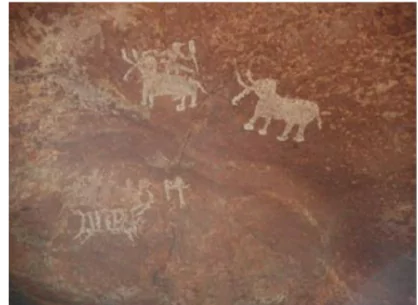
- Quartzite walls in rock shelter caves were utilised for prehistoric paintings.
- Primary pigments: Ochre or geru (from haematite), mixed with lime and water; Green from the chalcedony stone; White from Lime
- The paintings of the Upper Palaeolithic phase are linear representations, in green and dark red, of huge animal figures, such as bisons, elephants, tigers, rhinos and boars besides stick-like human figures
- Human figures are represented with red for hunters and green for dancers.
|
| Mesolithic Period (10,000- 4000 BC) |
- Predominant use of red pigment during this era.
- Generally smaller size paintings compared to the Upper Paleolithic Period.
- Frequent themes include group hunting, grazing scenes, and depictions of riding activities. Community dances provide a common theme.
- Animals were painted in a naturalistic style, and humans were depicted only in a stylistic manner.
|
| Chalcolithic Period |
- Notable rise in the number of paintings using green and yellow pigments.
- Prominent subject: battle scenes; Numerous depictions of men on horseback and elephants, some armed with bows and arrows, suggesting readiness for conflicts.
|
- Ancient rock art, typically executed on rocks, is referred to as petroglyphs.
|
Other Primitive Paintings
- Cave painting in the Kaimur Range of Central India, the Vindhya Hills, with locations like Bhimbetka, Mirzapur, Pachmarhi, and
- Indus Valley pottery (Painted Earthen Jar: Discovered in Mohenjodaro was painted in black and adorned with motifs of plants and geometric patterns).
- These prehistoric rock paintings depict primitive scenes like wild animals, war processions, and hunting.
Enroll now for UPSC Online Classes
Conclusion
- Prehistoric rock paintings serve as invaluable records of humanity’s artistic and cultural evolution, bridging the gap between modern civilizations and our distant ancestors, fostering a deeper appreciation for our shared human heritage.


 April 12, 2024






 GS Foundation
 Crash Course
 Combo
Combo Optional Courses
 Degree Program