Top Wildlife Sanctuaries of India 2026 State-wise List

India has a vast network of wildlife sanctuaries (570+), created under the Wildlife Protection Act 1972 to protect biodiversity and natural habitats. These sanctuaries differ from national parks and biosphere reserves in terms of scope, ownership, and protection level. From high-altitude regions like Ladakh to coastal ecosystems in Odisha, each sanctuary plays a unique role in conserving species such as tigers, elephants, rhinos, and migratory birds, making them crucial for ecological balance and UPSC preparation.
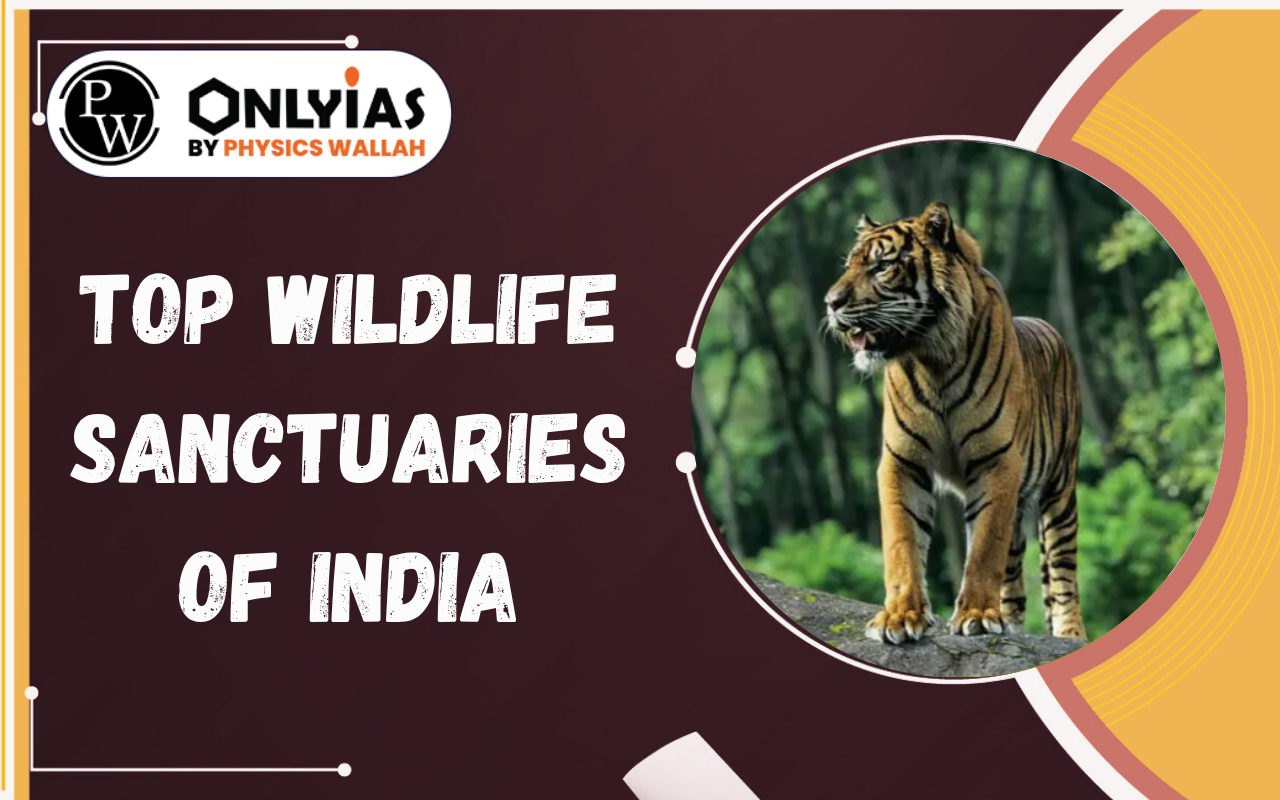
Top Wildlife Sanctuaries of India 2026 State-wise List

India is home to a rich network of wildlife sanctuaries that play a vital role in conserving the country’s diverse flora and fauna. Spread across different ecosystems from the Himalayan regions to coastal wetlands these protected areas are established under the Wildlife Protection Act 1972 to safeguard endangered species and maintain ecological balance. Exploring the top wildlife sanctuaries of India not only highlights their environmental significance but also helps aspirants understand important conservation topics for exams like UPSC.

Wildlife Sanctuaries in India

Wildlife Sanctuaries are vital protected areas in India, defined by their rich flora and biodiversity, dedicated to the protection, promotion, and expansion of wildlife. India currently hosts 573 Wildlife Sanctuaries, with the Andaman & Nicobar Islands having the highest number. These sanctuaries are established under the Wildlife Protection Act 1972 by both State and Central Governments

UPSC Online Courses

Establishment of Wildlife Sanctuaries

Wildlife Sanctuaries are designated regions characterized by rich flora and biodiversity, serving as ideal places for the protection, promotion, and expansion of wildlife. They are established under the provisions of the Wildlife Protection Act 1972, granting authority to both State and Central Governments to declare a suitable region as a sanctuary.

Wildlife Sanctuaries, National Parks, and Biosphere Reserves Comparison

Understanding the distinctions between India’s protected areas is crucial for conservation.

Wildlife Sanctuaries, National Parks, and Biosphere Reserves Comparison
Wildlife Sanctuary (WLS) Feature National Park (NP) Biosphere Reserve (BR) 
Primarily for animals only. Primary Protection Protects animals and plants. Protects plants, animals, and the entire biodiversity.
Can be established on private lands. Land Ownership Always on government-owned land. (Implied broader scope, includes both)
Boundaries are not as clearly defined. Boundary Definition Boundaries are more clearly defined. Divided into three zones: Core, Buffer, and Outer Zone.

Wildlife Sanctuaries by State/UT

Check the state and Union Territory-wise list of wildlife sanctuaries across India, helping aspirants understand their regional distribution and unique ecological features. These sanctuaries, established under the Wildlife Protection Act 1972, highlight the country’s diverse habitats from forests and wetlands to deserts and coastal ecosystems making them important for both conservation awareness and exam preparation.

Wildlife Sanctuaries in Jammu & Kashmir (UT)

Jammu & Kashmir features notable wildlife sanctuaries, many identified by the suffix “Sar” indicating a lake 

  1. Hokersar Wildlife Sanctuary: Kashmir’s largest bird reserve, a wetland in the Jhelum River basin, and a Ramsar Wetland famous for migratory birds.
  2. Jasrota Wildlife Sanctuary: Located on the banks of the Ujh River, known for bamboo plantations and Chital.
  3. Surinsar-Mansar Wildlife Sanctuary: Named after two Ramsar Sites (Surinsar and Mansar lakes), important for endangered Nilgai.
  4. Lachhipora Wildlife Sanctuary: A high-altitude sanctuary established for Markhor conservation, also home to the vulnerable Western Tragopan.

Wildlife Sanctuaries in Ladakh

Ladakh’s high-altitude terrain hosts distinct sanctuaries.

  1. Changthang Wildlife Sanctuary: A high-altitude sanctuary on the Changthang Plateau, home to the endangered Tibetan Wild Ass (Kiang). It encompasses Lake Tso Moriri and Korzok village, the world’s highest village.
  2. Karakoram Wildlife Sanctuary: In the Karakoram Range, established in 1987, famous for the Tibetan Antelope (Chiru) in its sparse, cold desert climate.

Wildlife Sanctuaries in Himachal Pradesh

Himachal Pradesh showcases diverse Himalayan ecosystems.

  1. Daranghati Wildlife Sanctuary: In Shimla District, conserving Musk Deer, Goral, and Thar in the Dhauladhar Range.
  2. Kanwar Wildlife Sanctuary: One of the oldest protected areas, home to rare bird species like the Western Tragopan.
  3. Chail Wildlife Sanctuary: Near Shimla, with dense Oak and Pine vegetation.
  4. Churdhar Wildlife Sanctuary: In Sirmaur District, known for rich biodiversity and religious importance around Churdhar Peak.

Wildlife Sanctuaries in Uttarakhand

Uttarakhand’s sanctuaries reflect its mountainous and avian wealth.

  1. Binsar Wildlife Sanctuary: Historically the capital of Chand rulers, now famous for various bird species.
  2. Pangot & Kilbury Bird Wildlife Sanctuary: A paradise for bird watchers, comprising two distinct sanctuaries.
  3. Benog Wildlife Sanctuary: Part of Rajaji National Park, also known as Vino Mountain Quail Sanctuary, though the Mountain Quail is now extinct here.
  4. Askot Wildlife Sanctuary: Also known as Askot Musk Deer Sanctuary, primarily for Musk Deer conservation. The Kali River forms its eastern border.

Wildlife Sanctuaries in Haryana

Haryana’s sanctuaries often serve as critical bird habitats.

  1. Kalesar Wildlife Sanctuary: Part of Kalesar National Park, in the lower Shivalik Hills. Historically home to tigers, now extinct here.
  2. Chhilchila Wildlife Sanctuary: In Kurukshetra, a bird sanctuary and wetland attracting migratory birds for breeding.
  3. Sultanpur Bird Sanctuary: In Gurugram District, a paradise for bird watchers known for rare bird species.
  4. Khol Hi Raitan Wildlife Sanctuary: In Panchkula District, near Kalesar National Park.

Wildlife Sanctuaries in Punjab

Punjab’s sanctuaries are crucial for specific species and migratory birds.

  1. Abohar Wildlife Sanctuary: Established in 1975 for Blackbuck and Nilgai conservation; Blackbucks are sacred to the Bishnoi community.
  2. Harike Wildlife Sanctuary: A bird sanctuary adjacent to Harike Wetlands, at the confluence of the Beas and Sutlej rivers. It attracts migratory birds from Siberia and the Arctic.
  3. Nangal Wildlife Sanctuary: In the Shivalik Range, part of the Bhakra Nangal reservoir, famous for Pangolin conservation.

UPSC Online Coaching

Wildlife Sanctuaries in Uttar Pradesh

Uttar Pradesh, despite its size, has important protected areas.

  1. Suhelwa Wildlife Sanctuary: One of the oldest forest regions in Uttar Pradesh, spread across three districts.
  2. Mahavir Swami Wildlife Sanctuary: In Jhansi District, known as the “Gateway of Bundelkhand”. (Memory Tip / Caution: Do not confuse this with Bhagwan Mahavir Wildlife Sanctuary in Goa.)
  3. Sandi Wildlife Sanctuary: A bird sanctuary in Hardoi District, declared an Important Bird Area.
  4. National Chambal Wildlife Sanctuary: Primarily for Gharials and Gangetic Dolphins, located at the tri-junction of Madhya Pradesh, Rajasthan, and Uttar Pradesh.

Wildlife Sanctuaries in Bihar

Bihar’s sanctuaries are known for their unique ecological and mythological significance.

  1. Bhimband Wildlife Sanctuary: In Munger District, known for warm water springs and a mythological origin related to Bhim.
  2. Kanwar Lake Bird Wildlife Sanctuary: Asia’s largest freshwater oxbow lake bird sanctuary, located at the confluence of three rivers.

Wildlife Sanctuaries in Jharkhand

Jharkhand’s sanctuaries are significant for elephant and bird conservation.

  1. Dalma Wildlife Sanctuary: In East Singhbhum District, mainly for elephant conservation.
  2. Udhwa Lake Bird Wildlife Sanctuary: A bird sanctuary in Sahibganj District, the only district in Jharkhand through which the River Ganga flows.

Wildlife Sanctuaries in West Bengal

West Bengal’s sanctuaries boast diverse landscapes, from hills to plains.

  1. Senchel Wildlife Sanctuary: One of the oldest wildlife sanctuaries in India, established in 1915 near Darjeeling, known for Barking Deer and Wild Boar.
  2. Chapramari Wildlife Sanctuary: In Jalpaiguri District, known for its significant elephant population and named after a local fish.
  3. Buxa Wildlife Sanctuary: A Wildlife Sanctuary, Tiger Reserve, and National Park that serves as an international corridor for East Elephant migration between India and Bhutan. It shares a border with Bhutan’s Phibsoo Wildlife Sanctuary.

Wildlife Sanctuaries in Assam

Assam is rich in wildlife, with several significant sanctuaries.

  1. Garampani Wildlife Sanctuary: One of the oldest sanctuaries in Assam, notified in 1952, famous for hot springs and Hoolock Gibbons and Golden Langurs.
  2. Pobitora Wildlife Sanctuary: Near Guwahati, holds the highest density of One-horned Rhinos.
  3. Chakrashila Wildlife Sanctuary: In Kokrajhar District, famous for Golden Langur protection.
  4. Amchang Wildlife Sanctuary: In Guwahati City, with an isolated elephant population and Gaur.
  5. Borail Wildlife Sanctuary: Houses species like Slow Loris, Hoolock Gibbon, and various vultures.

Wildlife Sanctuaries in Sikkim

Sikkim’s high-altitude sanctuaries are ideal for birds and alpine flora.

  1. Kitam Wildlife Sanctuary: A bird sanctuary, considered a paradise for bird watchers.
  2. Kyongnosla Alpine Wildlife Sanctuary: In Eastern Sikkim, known for its rich alpine vegetation and Sikkim’s famous Tsomgo Lake.

Wildlife Sanctuaries in Meghalaya

Meghalaya’s sanctuaries protect unique plants and biodiversity.

  1. Nongkhyllem Wildlife Sanctuary: Considered the best protected area in the entire North East, with Lake Barapani.
  2. Baghmara Pitcher Plant Wildlife Sanctuary: Primarily for Pitcher Plant protection, locally known as “Ghost Basket“.

Wildlife Sanctuaries in Arunachal Pradesh

Arunachal Pradesh features high-altitude sanctuaries and diverse big cat habitats.

  1. Talle Wildlife Sanctuary: Home to several endangered species, including the Clouded Leopard.
  2. Eaglenest Wildlife Sanctuary: A high-altitude sanctuary, part of the Kameng Elephant Reserve, and at the confluence of Pakke Tiger Reserve.
  3. Pakke (Pakhui) Wildlife Sanctuary: Declared a Tiger Reserve under Project Tiger, bounded by the Kameng River.
  4. Kamlang Wildlife Sanctuary: Home to all four species of Big Cats found in India: Tiger, Leopard, Clouded Leopard, and Snow Leopard.

Wildlife Sanctuaries in Manipur

Manipur’s sanctuaries protect its unique forest types and riverine ecosystems.

  1. Buning Wildlife Sanctuary: In the Barail Range, with the Barak River flowing alongside.
  2. Jiri-Makru Wildlife Sanctuary: Located between the Jiri and Makru Rivers, featuring Tropical Wet Evergreen Forests.
  3. Jalad Wildlife Sanctuary: Named after the Jalad Lake, known for rich biodiversity.

Wildlife Sanctuaries in Nagaland

Nagaland’s sanctuaries are noted for their unique geography and birdlife.

  1. Fakim Wildlife Sanctuary: On the India-Myanmar border, featuring Moist Evergreen Forests and diverse wildlife including Tiger and Hoolock Gibbon.
  2. Singphan Wildlife Sanctuary: In Mon District, declared an Elephant Reserve in 2018.
  3. Ghosu Bird Wildlife Sanctuary: In Zunheboto District, known for rare bird species and large quantities of salt licks along the Laki River. (Memory Tip: Remember the unusual name “Ghosu” for Nagaland’s bird sanctuary.)

Click to Know UPSC Coaching Centres in India

Wildlife Sanctuaries in Mizoram

Mizoram protects its alpine forests and tropical ecosystems.

  1. Lengteng Wildlife Sanctuary: An alpine forest, Mizoram’s second highest peak, established for bird conservation.
  2. Tawi Wildlife Sanctuary: One of Mizoram’s first Wildlife Sanctuaries, featuring Tropical Evergreen and Semi-Evergreen Forests.

Wildlife Sanctuaries in Tripura

Tripura’s sanctuaries are vital for Indian Gaurs and migratory birds.

  1. Trishna Wildlife Sanctuary: Established for Indian Gaur conservation, adjacent to Rajbari National Park.
  2. Gumti Wildlife Sanctuary: Contains the famous Dumboor Lake, an important breeding point for migratory birds, named after the Gumti River.

Wildlife Sanctuaries in Maharashtra

Maharashtra’s diverse sanctuaries span Western Ghats and Satpura ranges.

  1. Melghat Wildlife Sanctuary: Part of the Melghat Tiger Reserve, with the Tapi River flowing along its northern boundary.
  2. Gautala Wildlife Sanctuary: In the Western Ghats on the Ajanta Hills, named after Gautama Rishi.
  3. Bhamragarh Wildlife Sanctuary: An urban sanctuary popular for its avian population and attracting migratory birds in winters.
  4. Koyna Wildlife Sanctuary: A Natural World Heritage Site and Important Bird Area, forms the northern border of the Sahyadri Tiger Reserve.
  5. Bhimashankar Wildlife Sanctuary: A biodiversity hotspot in the Western Ghats, established for conservation of sacred groves.

Wildlife Sanctuaries in Gujarat

Gujarat’s sanctuaries are crucial for marine life, wild asses, and unique desert ecosystems.

  1. Nalsarovar Bird Sanctuary: A large lake and marshes attracting thousands of migratory bird species, declared a Ramsar Site in 2012.
  2. Barda Wildlife Sanctuary: West of Gir Forest, historically home to Asiatic Lions and supporting Maldhari families.
  3. Wild Ass Wildlife Sanctuary (Little Rann of Kutch): One of the few places globally where the endangered Indian Wild Ass is found, listed in UNESCO’s tentative MAB list.
  4. Narayan Sarovar Wildlife Sanctuary: A unique ecosystem, one of the last remaining habitats for Cheetahs in India.
  5. Shoolpaneshwar Wildlife Sanctuary: In the Western Satpura Range, initially for Sloth Bear conservation, also features Zarwani Waterfalls.

Wildlife Sanctuaries in Rajasthan

Rajasthan’s sanctuaries are known for their desert and mountain wildlife.

  1. Kumbhalgarh Wildlife Sanctuary: In the Aravalli Mountain Range, an Ecologically Sensitive meeting point of four mountain ranges.
  2. Darrah Wildlife Sanctuary: Part of Mukundra Hills National Park, historically a hunting ground for the Maharaja of Kota.
  3. Kaila Devi Wildlife Sanctuary: Named after the Kaila Devi Shrine, situated in the buffer zone of Ranthambore National Park.
  4. National Chambal Wildlife Sanctuary: Spans Rajasthan, Uttar Pradesh, and Madhya Pradesh, primarily for Gharials and Dolphins of the Chambal River.

Wildlife Sanctuaries in Madhya Pradesh

Madhya Pradesh hosts several large and ecologically significant sanctuaries.

  1. Noradehi Wildlife Sanctuary: The largest Wildlife Sanctuary in Madhya Pradesh, an important potential site for Cheetah reintroduction.
  2. Ratapani Wildlife Sanctuary: A Tiger Reserve containing the Bhimbetka rock paintings (World Heritage Status), famous for dense Teak forests and endangered Chinkara.
  3. Bori Wildlife Sanctuary: Part of the Satpura Tiger Reserve and Pachmarhi Biosphere Reserve. (Memory Tip / Caution: Not to be confused with ‘Bori Valley’ in Maharashtra.)
  4. Sanjay-Dubri Wildlife Sanctuary: Functions as a Wildlife Sanctuary, National Park, and Tiger Reserve, with Evergreen Sal Forests.
  5. Kuno-Palpur Wildlife Sanctuary: Recently declared a National Park, identified for translocation of Asiatic Lions.
  6. Pachmarhi Wildlife Sanctuary: In the Satpura Range, part of the Pachmarhi Biosphere Reserve, known as the “Queen of Satpura” and named for “Five Caves“.

Wildlife Sanctuaries in Chhattisgarh

Chhattisgarh protects its forests and unique riverine wildlife.

  1. Pamed Wildlife Sanctuary: On the Andhra Pradesh-Chhattisgarh border, established in 1983 for Wild Bison conservation, with mixed deciduous forests.
  2. Sita Nadi Wildlife Sanctuary: Established in 1974, named after the Sita Nadi River, a tributary of the Mahanadi River.

Wildlife Sanctuaries in Odisha

Odisha is home to a unique marine sanctuary and important tiger reserves.

  1. Gahirmatha Marine Wildlife Sanctuary: Odisha’s only marine sanctuary, very famous for Olive Ridley Turtles. The mass nesting is called Arribada.
  2. Debrigarh Wildlife Sanctuary: Odisha’s Third Tiger Reserve, located close to Hirakud Dam.
  3. Sunabeda Wildlife Sanctuary: Also a Tiger Reserve on the Odisha-Chhattisgarh border, famous for Swamp Deer and Wild Water Buffalo.

Wildlife Sanctuaries in Telangana

Telangana’s sanctuaries are crucial for tiger and crocodile conservation.

  1. Kawal Wildlife Sanctuary: Declared a Tiger Reserve in 2012, containing some of India’s richest Teak Forests.
  2. Manjira Wildlife Sanctuary: Originally for Mugger crocodile conservation, with a reservoir supplying water to Hyderabad.

Wildlife Sanctuaries in Andhra Pradesh

Andhra Pradesh hosts India’s Largest Tiger Reserve and mangrove ecosystems.

  1. Coringa Wildlife Sanctuary: A Mangrove Forest on the Kakinada coast, famous for Estuarine Crocodiles.
  2. Nagarjunasagar Srisailam Wildlife Sanctuary: India’s Largest Tiger Reserve, located on the Nallamala Hills Range.
  3. Rollapadu Wildlife Sanctuary: A conservation center for the Great Indian Bustard, though its population is declining due to an increase in Blackbucks.

Wildlife Sanctuaries in Karnataka

Karnataka’s sanctuaries offer diverse landscapes and rich birdlife.

  1. Dandeli Wildlife Sanctuary: A paradise for birdwatchers, declared Anshi Dandeli Tiger Reserve and an Elephant Reserve, known for its crocodiles.
  2. Gudavi Bird Wildlife Sanctuary: Located near Gudavi Lake in the Shivamogga District, abundant in greenery.
  3. Brahmagiri Wildlife Sanctuary: In Kodagu District, named after Brahmagiri Peak, featuring Shola forests on peaks.
  4. Melkote Wildlife Sanctuary: Established for Wolf conservation, with distinct religious significance.
  5. Pushpagiri Wildlife Sanctuary: One of India’s major bird sanctuaries, named after the Pushpagiri Peak, proposed for World Heritage Site status.

Click to Explore UPSC Offline Coaching

Wildlife Sanctuaries in Tamil Nadu

Tamil Nadu’s sanctuaries are significant for Blackbucks, tigers, and avian populations.

  1. Point Calimere Wildlife Sanctuary: A biodiversity-rich Ramsar Site and Important Bird Area, established for Blackbuck conservation.
  2. Mudumalai Wildlife Sanctuary: A National Park and Tiger Reserve in the Nilgiri Mountains, acting as a biological corridor within the Nilgiri Biosphere Reserve.
  3. Avalanche Lake Wildlife Sanctuary: Named after Lake Avalanche, home to several waterfalls, and important for biodiversity in the Nilgiri Region.
  4. Vedanthangal Wildlife Sanctuary: India’s Oldest Bird Sanctuary, established in 1936, and declared a Ramsar Site in 2022.

Wildlife Sanctuaries in Kerala

Kerala’s sanctuaries are known for unique ecosystems and tiger conservation.

  1. Periyar Wildlife Sanctuary: In the Pamba River Valley, includes Periyar National Park and Periyar Tiger Reserve, falling within a highly vulnerable eco-sensitive zone.
  2. Chinnar Wildlife Sanctuary: Part of Eravikulam National Park, known for beautiful landscapes and its location on the Kerala-Tamil Nadu border.
  3. Thattekad Wildlife Sanctuary: Primarily a bird sanctuary, famous for Indian Pitta and Cuckoo species, earning it the nickname “Cuckoo Paradise“.
  4. Karimpuzha Wildlife Sanctuary: A relatively new sanctuary (2020) and part of the Nilgiri Biosphere Reserve. It is the only sanctuary in Kerala to feature all seven types of vegetation.
  5. Neyyar Wildlife Sanctuary: Part of the Agasthyamalai Biosphere Reserve, with a Crocodile Farm and Neyyar Elephant Rehabilitation Center.

Wildlife Sanctuaries in Goa

Goa’s sanctuaries protect its dense forests and unique wildlife.

  1. Cotigao Wildlife Sanctuary: Goa’s second largest and most accessible sanctuary, famous for its dense forests suitable for hiking.
  2. Bhagwan Mahaveer Wildlife Sanctuary: In Mollem, covered with lush green vegetation, supporting a significant population of Gaur, Sambar, and various other mammals and reptiles.

Check Out UPSC CSE Books

Visit PW Store

online store 1

Frequently Asked Questions

What is a Wildlife Sanctuary and how is it established in India?

A Wildlife Sanctuary is a region with rich flora and biodiversity dedicated to protecting and promoting wildlife. It is established under the Wildlife Protection Act 1972 by either State or Central Governments.

How do Wildlife Sanctuaries differ from National Parks and Biosphere Reserves?

Wildlife Sanctuaries primarily protect animals, can be on private lands, and have less clearly defined boundaries. National Parks protect animals and plants on government land with clearer boundaries. Biosphere Reserves protect entire biodiversity across three distinct zones (Core, Buffer, Outer).

Which Indian state/UT has the highest number of Wildlife Sanctuaries?

Andaman & Nicobar Islands has the highest number of Wildlife Sanctuaries, with 96 sanctuaries.

Which Wildlife Sanctuary in India is famous for Olive Ridley Turtles, and what is their mass nesting called?

Gahirmatha Marine Wildlife Sanctuary in Odisha is very famous for Olive Ridley Turtles. Their mass nesting phenomenon is known as Arribada.

Which Wildlife Sanctuary in Kerala is unique for having all seven types of vegetation?

Karimpuzha Wildlife Sanctuary in Kerala, declared in 2020, is unique as it is the only sanctuary in Kerala to feature all seven types of vegetation, including semi-evergreen, evergreen, and moist deciduous forests.


Top Wildlife Sanctuaries of India 2026 State-wise List

Explore UPSC Foundation Course

Need help preparing for UPSC or State PSCs?

Connect with our experts to get free counselling & start preparing

Aiming for UPSC?

Download Our App

      
Quick Revise Now !
AVAILABLE FOR DOWNLOAD SOON
UDAAN PRELIMS WALLAH
Comprehensive coverage with a concise format
Integration of PYQ within the booklet
Designed as per recent trends of Prelims questions
हिंदी में भी उपलब्ध
Quick Revise Now !
UDAAN PRELIMS WALLAH
Comprehensive coverage with a concise format
Integration of PYQ within the booklet
Designed as per recent trends of Prelims questions
हिंदी में भी उपलब्ध

<div class="new-fform">


    </div>

    Subscribe our Newsletter
    Sign up now for our exclusive newsletter and be the first to know about our latest Initiatives, Quality Content, and much more.
    *Promise! We won't spam you.
    Yes! I want to Subscribe.