Udaan, Prahaar, Q&A Bank etc.
CA Magazines & Editorials
UPSC NSAT 2026 date has been extended, giving UPSC aspirants additional time to register for the national scholarship test conducted by PW OnlyIAS. The exam will now be held till 17th May 2026 in both online and offline modes. This is an excellent opportunity for aspirants to get up to 100% scholarship on UPSC courses while evaluating their preparation through a structured assessment based on the actual UPSC exam pattern.
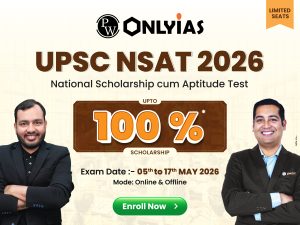
Candidates who get selected under UPSC NSAT will be eligible for discounts on our flagship courses and will also receive all the help required to excel in the UPSC CSE exam.
So, register yourself for NSAT and stand a chance to realize your dream of becoming an IAS Officer!
Click Here for Registration UPSC NSAT 2026
UPSC NSAT 2026 (National Scholarship Cum Admission Test) is a perfect opportunity for candidates to become eligible for a 100% scholarship as well as gain experience of the UPSC exam. The following table provides an overview:
Name of the Exam
UPSC NSAT 2026 (National Scholarship Cum Admission Test) by PW OnlyIAS
Objective
Identify talented UPSC aspirants
Reward
Win up to 100% scholarship on select courses
Mode of Examination
Online and Offline mode
Registration Link
Registration Fee
Free
UPSC NSAT Registration Start Date
1 May 2026
UPSC NSAT Registration End Date
17 May 2026
NSAT Result Date
22nd May
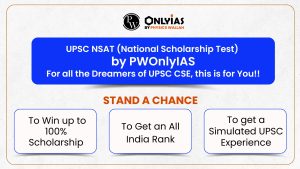
UPSC NSAT 2026 (National Scholarship Cum Admission Test) is a scholarship-based exam conducted by PW OnlyIAS for aspirants preparing for the UPSC Civil Services Examination. It is designed to identify serious candidates and provide them with financial support for their preparation. Candidate appearing for the UPSC NSAT will stand a chance of receiving following benefits:
Explore UPSC Foundation Courses

Explore UPSC Foundation Courses

Candidates, here are the important dates for you to remember, if you are planning to register for UPSC NSAT;
Registration Start Date
1st May
Registration End Date
17th May
NSAT Exam Date
5th May to 17th May 2026
Result Date of NSAT Exam
22nd May 2026
Live Solution Discussion Date
To be Updated
Scholarship Validity
To be Updated
PW OnlyIAS has adopted a liberal criteria to decide eligibility for UPSC NSAT 2026. If you satisfy any one of the conditions mentioned below, you can be eligible for UPSC NSAT;
Explore Prarambh Course

Explore Prarambh Course

Duration of Exam
90 minutes
Total marks
100
Medium of Examination
English
Marking Scheme
No Negative Marking
UPSC NSAT 2026 syllabus will consist of questions from subjects such as polity, geography, history etc. The breakdown of topics and the respective marks weightage is given in the table below:
Subject
Number of Questions
Marks
Geography and Environment
9
18
History and Culture
9
18
Indian Polity
6
12
Economy
6
12
Science and Technology
3
6
Current Affairs and IR
7
14
CSAT
10
20
Total:
50
100
Candidates have to remember certain additional details regarding UPSC NSAT before appearing for the exam. These details have been mentioned in the table below:
Anytime 6:00 PM – 7:30 PM at your nearest PWONLYIAS Offline Centres
Examination Time
For Online Participants:
For Offline participants
System Requirements
Windows Desktop/Windows Laptop/Android Phones ( iOS Device users can access through Safari browser)
Here is a list of offline centres where the UPSC NSAT 2026 offline exam will be held (All PWONLYIAS Offline Centres, 5th May to 17th May);
Candidates can register for UPSC NSAT 2026 offline here and stand a chance to win 100% scholarship on selected courses!
Check Out UPSC CSE Books
Visit PW Store
UPSC NSAT 2026 is a national scholarship test by PW OnlyIAS to help UPSC aspirants get scholarships on preparation courses.
The registration starts on 1 May 2026 and ends on 17 May 2026.
No, the UPSC NSAT 2026 registration is completely free.
The exam is conducted in both online and offline modes.
Aspirants preparing for upcoming UPSC attempts or those who have appeared earlier can apply.




Connect with our experts to get free counselling & start preparing
Join India’s trusted platform for expert guidance, quality content, proven success.
Learn anytime, anywhere.



India's leading UPSC coaching platform helping aspirants prepare for IAS, IPS, IFS and other Civil Services examinations with the best faculty and proven strategies.
<div class="new-fform">
</div>