Colombo Security Conclave (CSC)

3 Dec 2025

Colombo Security Conclave (CSC)

Recently, India hosted the 7th National Security Advisor-level summit of the Colombo Security Conclave (CSC).

About 7th Colombo Security Conclave

  • Host: India’s National Security Adviser Ajit Doval.
  • Participants:
    • Member States: India, Sri Lanka, Maldives, Mauritius, Bangladesh.
    • New Full Member: Seychelles.
    • Observer/Guest: Seychelles (earlier observer), Malaysia (guest participant).
  • Purpose: Strengthening cooperative mechanisms for security in the Indian Ocean Region.

Key Outcomes of the 7th Colombo Security Conclave Summit

  • Expansion of Group Membership: Seychelles formally joined as a full member, signalling stronger regional commitment.
  • Strengthening India’s Maritime Engagement: India deepened cooperation with maritime neighbours amid rising geopolitical competition, particularly involving China.
  • Greater Emphasis on Maritime Security: Highlighted the increasing importance of security cooperation for stability in the Indian Ocean Region (IOR).
  • Possible Future Expansion: Malaysia’s participation as a guest could signal broader Indo-Pacific engagement.

About Colombo Security Conclave (CSC)

  • Refers: The CSC is a regional security cooperation platform focused on enhancing maritime and transnational security among Indian Ocean Region (IOR) countries.
  • Origin and Evolution:
    • Establishment as Trilateral Framework (2011): Launched in 2011 as a trilateral maritime security mechanism between India, Sri Lanka, and the Maldives, focusing on coordinated responses to regional maritime threats.
    • Revival and Expansion (2020): Revitalised in 2020 with Mauritius joining as a full member, while Bangladesh and Seychelles were inducted as Observers, widening the Conclave’s regional scope.
    • Bangladesh Becomes Full Member (2024): Bangladesh elevated its status to full membership in 2024, significantly enhancing the Conclave’s strategic depth and cooperative mechanisms.
    • Institutionalisation Through Founding Documents (August 2024): The Founding Documents of the CSC were formally signed in Sri Lanka in August 2024, giving the grouping a streamlined institutional and operational structure.
    • Broadened Engagement at CSC Summit (2025): At the 2025 CSC Summit, Seychelles participated as an Observer and Malaysia as a Guest State, signalling growing regional interest in the CSC framework.
    • Pathway for Seychelles’ Membership (2025): CSC members welcomed Seychelles’ decision to accede as a full member, marking the next step in the Conclave’s phased and consensus-driven expansion.
  • CSC Secretariat: Colombo, Sri Lanka
  • Objectives:
    • Enhanced Maritime & Security Cooperation: Strengthen collaboration on maritime security, counterterrorism, cybersecurity, and humanitarian assistance and disaster relief (HADR) across Indian Ocean littoral states.
    • Improved Intelligence Sharing: Promote real-time information exchange, joint threat assessments, and coordinated responses to evolving regional security challenges.
    • Capacity-Building & Joint Preparedness: Enhance collective capabilities through joint exercises, specialised training programmes, and strong institutional frameworks for long-term operational cooperation.
  • Core Mandate: The Conclave focuses on Five Core Pillars of Cooperation plus a distinct area for environmental security (Marine Pollution Response).
    • Maritime Safety & Security
    • Countering Terrorism & Radicalisation
    • Combating Trafficking & Transnational Crime
    • Cyber Security & Critical Infrastructure Protection
    • Humanitarian Assistance & Disaster Relief (HADR)
    • Marine Pollution Response
      • The Conclave focuses on Five Core Pillars of Cooperation plus a distinct area for environmental security (Marine Pollution Response).

Key Achievements of the Colombo Security Conclave (CSC)

  • Institutional Strengthening: India-led appointment of the first CSC Secretary-General and progress on a dedicated CSC Training Academy have established greater administrative continuity and long-term skill institutionalisation.
  • Operational & Capacity Enhancement: Regular table-top exercises, simulation drills, and capacity-building workshops, combined with training for Mauritius Coast Guard/Police and deployment of Indian hydrographers, have sharply improved operational readiness across member states.
  • Stronger Maritime Domain Awareness (MDA): Deep integration with the Information Fusion Centre–Indian Ocean Region (IFC–IOR) has boosted real-time intelligence, coordinated surveillance, and joint maritime responses.
  • Blue Economy Cooperation: Creation of the Virtual Centre of Excellence on Blue Economy (2025) supports sustainable marine resource governance and climate resilience for littoral and island nations.
  • Rising Regional Cohesion: Seychelles’ accession as a full member and Malaysia’s participation as a guest reflect growing regional trust and widening acceptance of the CSC platform.
  • Effective Policy Coordination: Issue-specific Working Groups continue to drive steady progress, harmonise national approaches, and enable ongoing knowledge exchange among members.

Indian Ocean Region & Role of Colombo Security Conclave (CSC)

About Indian Ocean Region
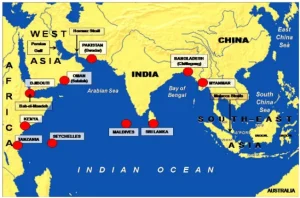
Colombo Security Conclave

  • Extent: It extends from the eastern coast of Africa to the western coast of Australia including the Arab Gulf, East Africa, South Asia, East Asia to the Straits of Malacca and Southern Ocean Islands encompassing nearly 38 countries within it.
  • Connectivity: It serves as an important transit route bridging  the gap between  East and the West through important choke points, such as the Straits of Malacca, Straits of Hormuz, Bab el Mandeb, and Ombai and Wetar Straits.

Its Significance

  • Global Scale: The Indian Ocean is the third-largest ocean basin, shaping major maritime activity.
  • Population Hub: Nearly one-third of the world’s population lives in its surrounding coastal and island states.
  • Energy Artery: Over two-thirds of global oil shipments pass through its vital sea lanes.
  • India’s Trade Lifeline: Nearly 90% of India’s trade by volume and almost all oil imports transit its waters.
  • Maritime Jurisdiction: India holds a vast 2.4 million sq. km Exclusive Economic Zone (EEZ) in the Indian Ocean Region.

India’s Strategy in the Indian Ocean

  • Strong Policy Framework: India’s maritime engagement is shaped by Neighbourhood First and SAGAR (Security and Growth for All in the Region).
    • In March 2025, India introduced the MAHASAGAR doctrine (Mutual and Holistic Advancement for Security and Growth Across Regions), expanding SAGAR into a broader regional vision.
  • India as a Net Security Provider: India is recognised as a Net Security Provider in the IOR.
    • It participates in counter-piracy patrols, fights Illegal, Unreported and Unregulated (IUU) fishing, and cooperates against maritime terrorism and organised crime.
    • India also carries out joint EEZ surveillance and shares real-time maritime information through the Information Fusion Centre – Indian Ocean Region (IFC–IOR).
  • Close Engagement with Littoral States: India maintains strong partnerships with Mauritius, Maldives, Sri Lanka, and Seychelles.
    • Cooperation focuses on development assistance, capacity building, Humanitarian Assistance and Disaster Relief (HADR), and maritime security.
  • Regional Leadership: India plays a major role in several platforms including the Indian Ocean Rim Association (IORA) and the Indian Ocean Commission (IOC).
    • These forums promote economic cooperation, maritime safety, and environmental protection.
  • Building Strategic Infrastructure: India is investing in key regional ports such as Chabahar (Iran), and expanding port development in Sri Lanka, Mauritius, and Seychelles.
    • Through Sagarmala 2.0, India aims to upgrade port connectivity, expand inland waterways, and support industrial development to boost maritime competitiveness.
  • Reliable First Responder in Crises: India consistently provides HADR support in the IOR.
    • Recent Success (Cyclone Ditwah, Late 2025): Launched ‘Operation Sagar Bandhu’ to provide urgent Search & Rescue and HADR support to Sri Lanka following devastating floods and landslides.
    • Also, after the Typhoon Yagi floods, India launched Operation Sadbhav, delivering relief supplies and medical aid to Myanmar, Laos, and Vietnam.

Major Multilateral Platforms in the Indian Ocean Region

  • Indian Ocean Rim Association (IORA): A 23-member grouping focused on economic cooperation, maritime safety, and environmental protection. India is a founding member.
  • Indian Ocean Naval Symposium (IONS): Created by India in 2008 to enhance naval cooperation among Indian Ocean littoral states.
  • Indo-Pacific Oceans Initiative (IPOI): Launched in 2019 to promote an open, inclusive, and sustainable Indo-Pacific maritime space.
  • Quadrilateral Security Dialogue (QUAD): Works on maritime security, HADR, environment, supply chains, and cybersecurity.
  • Bay of Bengal Initiative for Multi-Sectoral Technical and Economic Cooperation (BIMSTEC): India leads its Security pillar, covering counterterrorism, transnational crime, disaster management, and energy security.
  • Indian Ocean Commission (IOC): Focuses on economic and environmental cooperation; India is an observer.

Significance of the Colombo Security Conclave (CSC) for the Indian Ocean Region

  • Fills the Gap Left by a Paralysed SAARC: Unlike SAARC, which is stuck because of India–Pakistan tensions, the CSC brings together only willing coastal and island countries. It works as a practical and cooperative platform where decisions and coordination are easier.
  • Strengthens India’s Role as a “First Responder” and Net Security Provider: India supports members by giving patrol vessels, aircraft, training, and maritime equipment
    • It also leads quick diplomatic and security responses (e.g., against unauthorised Chinese research vessels), showing that India is the most trusted security partner for many IOR states.
  • Balances China’s “String of Pearls” Strategy Without Direct Conflict: By building strong security ties with Sri Lanka, Maldives, Mauritius, and Seychelles, the CSC reduces their dependence on China’s ports, loans, and military facilities (such as Hambantota and Djibouti). 
    • This acts as a quiet but effective counterbalance to China.
  • Addresses Key Non-Traditional Threats Faced by Small Island States: Problems like Illegal, Unreported and Unregulated (IUU) fishing, drug trafficking, human smuggling, marine pollution, and climate disasters hit island nations the hardest. 
    • CSC’s six security pillars and the Virtual Centre of Excellence on Blue Economy (2025) help these countries deal with their most urgent risks.
  • Creates a Like-Minded “Inner Ring” Around India’s Maritime Neighbourhood: While the Quad works at a wider Indo-Pacific level, the CSC forms a tighter, more operational group of countries directly linked to India’s coastline and Exclusive Economic Zone (EEZ)
    • This builds faster coordination and stronger trust.
  • Promotes Collective Rules and Norms in the Western Indian Ocean: Members increasingly take joint positions on freedom of navigation, UNCLOS, overflight rights, and EEZ monitoring
    • This turns the CSC into a rule-making forum that prevents outside powers from shaping the IOR on their own terms.
  • Uses a Slow and Inclusive Expansion Model: Beginning with three members in 2011, the CSC expanded carefully—bringing in Mauritius (2021), Bangladesh and Seychelles (2024 as observers), and moving toward Seychelles as a full member soon. 
    • This step-by-step approach keeps the grouping stable and cohesive.

Major Challenges Before the Colombo Security Conclave (CSC)

  • Divergent Threat Perceptions on China: India views China’s maritime push as a strategic challenge, while several members rely heavily on Chinese loans, infrastructure, and trade, making risk alignment difficult.
  • Institutional and Structural Weaknesses: CSC still functions largely at the National Security Advisor (NSA) level without ministerial backing, a pooled budget and joint operational mechanisms (e.g., coordinated patrols).
  • Domestic Political Volatility:  The group will be vulnerable to domestic political changes unless it can better institutionalise itself within the participant’s systems. 
    • For example, Political shifts in Bangladesh and Maldives (e.g., the “India Out” campaign) may disrupt continuity.
  • Lack of Coordination: The CSC countries are all members of the two region-wide Indian Ocean groupings, the Indian Ocean Rim Association (IORA), and the Indian Ocean Naval Symposium (IONS). However, the lack of coordination between the IORA and the IONS has hindered the effective functioning of these institutions. 
  • Fragmentation with Other Regional Platforms: Overlaps with Indian Ocean Rim Association (IORA), Indian Ocean Naval Symposium (IONS) and Bay of Bengal Initiative for Multi-Sectoral Technical and Economic Cooperation (BIMSTEC) reduce focus and efficiency.

Check Out UPSC CSE Books

Visit PW Store
online store 1

Way Forward

  • Strengthen Legal and Institutional Frameworks: Elevate the CSC to Foreign Minister or Deputy Minister-level meetings to provide stronger political ownership, clearer mandate-setting, and sustained policy coherence.
  • Create a Dedicated CSC Security Cooperation Fund: Establish a pooled financial mechanism to support joint projects, maritime patrols, training programs, and Maritime Domain Awareness (MDA) infrastructure across member-states.
  • Establish Cross-Pillar Joint Task Forces: Form permanent, multi-country task forces under each CSC security pillar to ensure continuous coordination, faster decision-making, and operational follow-through.
  • Scale Up Collaborative Maritime Operations: Transition from limited exercises to joint naval patrols, anti–Illegal, Unreported and Unregulated (IUU) fishing missions, and multi-nation Humanitarian Assistance and Disaster Relief (HADR) drills to strengthen real-world interoperability.
  • Integrate Advanced Maritime Technologies: Expand the use of satellite-based surveillance, AI-enabled maritime tracking, and shared access to the Information Fusion Centre–Indian Ocean Region (IFC–IOR) systems for real-time situational awareness.
  • Address the China Factor with Strategic Sensitivity: Keep CSC agendas focused on non-traditional security threats to maintain cohesion, while offering transparent, sustainable, capacity-building alternatives to counter China’s debt-heavy infrastructure model.
  • Deepen Development–Security Synergy: Promote joint initiatives in the Blue Economy, coastal climate adaptation, early warning systems, fisheries governance, and launch a MAHASAGAR framework integrating security, climate, and economic resilience.
  • Adopt a Phased and Structured Expansion Model: Allow potential members—such as Malaysia and Thailand—to join first as Observers and then transition to Full Membership, protecting institutional stability and operational efficiency.

Conclusion

The Colombo Security Conclave uniquely positions India as the undisputed security anchor of its neighbourhood, enabling faster coordination, stronger trust, and effective counterbalance to China, making CSC India’s most reliable and impactful platform for shaping Indian Ocean security.

PWOnlyIAS Extra Edge:

CSC vs Other Regional Groupings:

Mechanism Geographical Scope Core Focus Area Hard Power Component India’s Role
Colombo Security Conclave (CSC) Immediate Indian Ocean littorals (sub-regional) Non-traditional security (cyber, HADR, trafficking, maritime safety) Low (mainly table-top exercises) Unambiguous Leader & Agenda-Setter (driven by SAGAR)
Quad Wider Indo-Pacific Strategic balance, global goods, technology, infrastructure High (Malabar, joint naval sails) First among Equals (shared leadership with US, Japan, Australia)
Indian Ocean Rim Association (IORA) Broad Indian Ocean Region (23 members) Economic cooperation, trade, sustainable development None (civilian platform) Founding Member & Influential, but not security-focused
Indian Ocean Naval Symposium (IONS) 36 littoral state navies Dialogue, professional naval cooperation None (dialogue forum) Founder, important but non-dominant
Milan Exercise Multinational naval exercise Interoperability, naval diplomacy High (major naval manoeuvres) Host Nation, but not a permanent grouping
  • The Colombo Security Conclave (CSC) is the only platform where India is the clear leader in its immediate maritime neighbourhood.
  • The CSC gives India a unique route to institutionalise its role as the region’s preferred “Net Security Provider”, strengthen SAGAR, and manage China’s growing influence in the Indian Ocean.

Need help preparing for UPSC or State PSCs?

Connect with our experts to get free counselling & start preparing

Aiming for UPSC?

Download Our App

      
Quick Revise Now !
AVAILABLE FOR DOWNLOAD SOON
UDAAN PRELIMS WALLAH
Comprehensive coverage with a concise format
Integration of PYQ within the booklet
Designed as per recent trends of Prelims questions
हिंदी में भी उपलब्ध
Quick Revise Now !
UDAAN PRELIMS WALLAH
Comprehensive coverage with a concise format
Integration of PYQ within the booklet
Designed as per recent trends of Prelims questions
हिंदी में भी उपलब्ध

<div class="new-fform">


    </div>

    Subscribe our Newsletter
    Sign up now for our exclusive newsletter and be the first to know about our latest Initiatives, Quality Content, and much more.
    *Promise! We won't spam you.
    Yes! I want to Subscribe.