PWOnly IAS Extra Edge:
About India–European Union Relationship
- The India-EU relationship is a comprehensive strategic partnership rooted in shared values like democracy, rule of law, multilateralism, and a rules-based international order.
- It has grown into a multifaceted engagement spanning trade, investment, security, technology, climate action, and more.
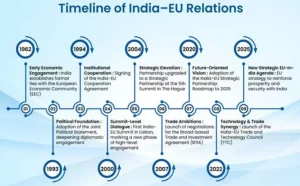
- Historical Background: India established diplomatic relations with the European Economic Community (predecessor to the EU) in 1962, one of the earliest such ties.
- 1993: Joint Political Statement signed.
- 2000: First India-EU Summit in Lisbon, launching regular summit-level dialogue.
- 2004: Upgraded to Strategic Partnership at The Hague Summit.
- Since 2004, 15 summits have been held prior to the landmark 16th EU-India Summit in New Delhi in January 2026.
- The relationship has deepened significantly after 2020 due to geopolitical shifts, supply-chain diversification, and Indo-Pacific focus.
- Key Institutional Mechanisms:
-
- India-EU Trade and Technology Council (TTC): Launched February 2023 (announced April 2022); coordinates on trade, trusted technology, digital, green tech, and security.
- Connectivity Partnership: Launched 2021; covers transport, digital, energy, and people-to-people ties.
- India-Middle East-Europe Economic Corridor (IMEC): Announced September 2023 with partners.

Economic and Trade Ties

- Bilateral trade volume reached approximately, making the EU India’s largest goods trading partner.
- The EU is one of India’s largest trading partners, with bilateral trade in goods with the EU worth $136.53 billion in 2024-25 (exports worth $75.85 billion and imports at $60.68 billion).
- The EU market accounts for about 17% of India’s total exports, and EU’s exports to India constitute 9% of its total overseas shipments.
- Growth: Nearly 90% increase over the past decade.
- Investment: EU is the leading foreign investor in India (FDI stock €140.1 billion in 2023, up from €82.3 billion in 2019); more than 6,000 European companies are currently operating in India.
About the European Union (EU)
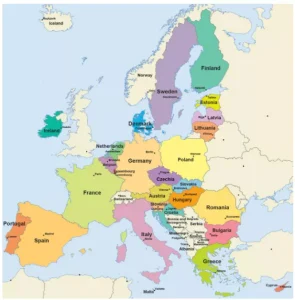
- The European Union is an economic and political union of 27 European countries.
- They work together to promote peace, stability, prosperity, and shared values.
- Founded: Began in 1951 (as the European Coal and Steel Community) with 6 founding members; evolved into the modern EU through treaties like the Treaty of Rome (1957) and Lisbon Treaty (2009).
- Member States: 27 countries (United Kingdom left in 2020 via Brexit).
- Currency: The euro (€) is used by 21 member states of the Eurozone (recent addition: Bulgaria adopted the euro on January 1, 2026).
- Key Institutions: The EU has a unique transnational structure with shared decision-making.
- European Commission: Acts as the executive; proposes laws, enforces EU rules, manages the budget.
- European Parliament: Directly elected by citizens; co-legislates and approves the budget.
- European Council: Heads of state/government set overall political direction and priorities.
- Court of Justice of the European Union: Ensures uniform application of EU law.
- European Central Bank: Manages the euro and monetary policy for the eurozone.
|