UPSC PYQs

Prelims, Mains & Optional PYQs

UPSC Notes

Comprehensive & Short Notes

India–New Zealand FTA 2026: Trade, Tariffs, Investment & Market Access

22 Sep 2026

India–New Zealand FTA 2026: Trade, Tariffs, Investment & Market Access

Subject: GS 02: International Relations

Context: India and New Zealand have completed their respective domestic legal processes for the India–New Zealand Free Trade Agreement (FTA), which will come into force on October 20, 2026

UPSC Course Fees Online

Key Highlights of India – New Zealand Free Trade Agreement

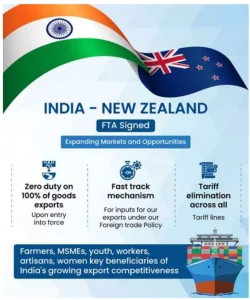
India–New Zealand FTA 2026

  • Tariff-Free Access: New Zealand will eliminate import levies on all Indian goods exported to its market.
  • Access to Indian Market: Around 95% of New Zealand’s exports to India will receive either tariff-free access or significantly reduced tariffs.
  • Trade Target: India aims to double bilateral trade to ₹35,000 crore over the next four to five years.
  • Sensitive Sectors Protected: India has retained protection for dairy and sensitive agricultural products, including onions, almonds, chickpeas, peas, artificial honey and sugar.
  • Investment Commitment: New Zealand has committed to facilitate $20 billion in foreign direct investment (FDI) into India.

About Free Trade Agreement (FTA)

  • Definition: An FTA is a bilateral or plurilateral arrangement through which participating countries reduce or eliminate tariffs and other trade barriers on goods and, in many cases, services and investment.
  • Market Access: FTAs provide businesses with preferential access to partner-country markets compared with countries without such agreements.
  • Tariff Concessions: Countries negotiate tariff reductions based on the sensitivity of domestic sectors, allowing certain products to remain protected.
  • Rules of Origin: FTAs generally establish rules determining whether a product qualifies for preferential tariff treatment based on its country of origin and value addition.
  • Broader Cooperation: Modern FTAs increasingly cover areas such as services, investment, intellectual property, digital trade, standards and dispute settlement.

Status of Bilateral Trade

  • Trade Volume: India–New Zealand bilateral trade stood at around $1.3 billion in FY 2024–25.
  • India’s Position: India is among New Zealand’s significant export markets.
  • Trade Partnership: New Zealand is India’s second-largest trading partner in Oceania. Bilateral merchandise trade increased from USD 855 million in 2015–16 to USD 1.298 billion in 2024–25, while trade rose by nearly 49% in 2024–25 over the previous year.
  • Export Performance: India’s merchandise exports to New Zealand reached USD 711 million in 2024–25, registering 32% growth. Over the decade, Indian exports grew substantially faster than imports, enabling India to maintain a trade surplus with New Zealand.
  • Services Trade: India’s services exports to New Zealand reached USD 634 million in 2024, growing by 13%, with travel, IT and business services among the major sectors.
  • Investment & Economic Potential: New Zealand had USD 422.6 billion in overseas investment as of March 2025. Under the FTA, it has committed to USD 20 billion investment in India over 15 years, strengthening the scope for investment and technology cooperation.

IAS coaching

Significance of the India–New Zealand FTA

  • Export Expansion: Duty-free access to the New Zealand market can improve the competitiveness of Indian exports and support diversification of India’s export destinations.
  • MSME Opportunities: Preferential access can help MSMEs, artisans, handloom producers and labour-intensive sectors integrate with international markets.
  • Investment and Technology: New Zealand investment and technological capabilities can contribute to manufacturing, agricultural innovation and productivity enhancement.
  • Global Value Chains: India can emerge as a manufacturing base for New Zealand companies seeking access to India’s domestic market as well as other markets where India enjoys preferential access.
  • Economic Resilience: Stronger trade partnerships can help India diversify its economic relationships amid rising tariffs, protectionism and geopolitical uncertainty.
  • Sensitive-Sector Protection: Excluding key agricultural and dairy products from concessions reflects an attempt to balance trade liberalisation with domestic producer interests.

India’s FTA with Other Countries

India has progressively expanded its network of trade agreements with major economies and regional groupings.

  • United Arab Emirates: The India–UAE Comprehensive Economic Partnership Agreement (CEPA) provides preferential market access and covers goods, services and investment.
  • Australia: The India–Australia Economic Cooperation and Trade Agreement (ECTA) provides tariff concessions and greater market access between the two countries.
  • European Free Trade Association: India signed a Trade and Economic Partnership Agreement (TEPA) with EFTA, covering Switzerland, Norway, Iceland and Liechtenstein.
  • United Kingdom: India and the UK concluded a Free Trade Agreement aimed at expanding bilateral trade and investment.
  • Ongoing Negotiations: India continues to engage in trade negotiations with partners such as the European Union, Canada and other economies to expand market access.

Key Challenges in FTA Implementation

  • Trade Diversion: Greater imports from partner countries can create competitive pressure on domestic producers, particularly in vulnerable sectors.
  • Non-Tariff Barriers: Tariff reductions alone may not ensure market access because exporters can face technical standards, certification requirements and sanitary and phytosanitary measures.
  • Rules of Origin: Complex compliance requirements can reduce the ability of smaller firms to effectively utilise preferential tariffs.
  • FTA Utilisation: Indian exporters, particularly MSMEs, may lack adequate awareness regarding tariff preferences, documentation and partner-market standards.
  • Trade Imbalances: Differences in the scale and structure of the two economies can affect the distribution of benefits from tariff liberalisation.

Way Forward

  • Improve FTA Awareness: Strengthen exporter awareness through digital platforms, trade facilitation centres and simplified documentation to improve utilisation of preferential tariffs.
  • Build MSME Export Capacity: Help MSMEs meet international quality, certification and compliance standards required in partner markets.
  • Address Non-Tariff Barriers: Establish stronger institutional mechanisms to identify and resolve technical, regulatory and sanitary barriers faced by Indian exporters.
  • Deepen Investment Partnerships: Complement tariff liberalisation with investment and technology partnerships to promote manufacturing, innovation and productivity.
  • Strengthen FTA Monitoring: Periodically review trade agreements to assess whether negotiated market-access commitments are translating into actual export growth.
  • Protect Sensitive Sectors: Retain appropriate safeguards for strategically important agricultural and manufacturing sectors while pursuing greater trade liberalisation.

Click to Know UPSC Coaching Centres in India

Conclusion

The India–New Zealand FTA marks a further step in India’s strategy of expanding preferential market access, investment partnerships and global value-chain integration. Its long-term effectiveness will depend on effective utilisation by Indian exporters, resolution of non-tariff barriers and a balanced approach to domestic-sector protection.

News Source: The Hindu

Check Out UPSC CSE Books

Visit PW Store

online store 1

India–New Zealand FTA 2026: Trade, Tariffs, Investment & Market Access

Need help preparing for UPSC or State PSCs?

Connect with our experts to get free counselling & start preparing

Free Counselling for UPSC Aspirants

Connect with our experts and take the right next step.

Expert Guidance
Personalized Strategy
100% Free

Book Your Free Session

NEED ASSISTANCE?

Request a Callback

Our counsellor will connect with you and help you choose the right course and centre.

  • Expert Guidance
  • Course & Fee Information
  • Quick Callback Support

Request a Callback

Books
UPSC PYQs
UPSC Notes
Current Affairs
Quick Revise Now !
AVAILABLE FOR DOWNLOAD SOON
UDAAN PRELIMS WALLAH
Comprehensive coverage with a concise format
Integration of PYQ within the booklet
Designed as per recent trends of Prelims questions
हिंदी में भी उपलब्ध
Quick Revise Now !
UDAAN PRELIMS WALLAH
Comprehensive coverage with a concise format
Integration of PYQ within the booklet
Designed as per recent trends of Prelims questions
हिंदी में भी उपलब्ध

<div class="new-fform">


    </div>

    Subscribe our Newsletter
    Sign up now for our exclusive newsletter and be the first to know about our latest Initiatives, Quality Content, and much more.
    *Promise! We won't spam you.
    Yes! I want to Subscribe.