UPSC PYQs

Prelims, Mains & Optional PYQs

UPSC Notes

Comprehensive & Short Notes

Indus Waters Treaty: PCA Ruling, Ratle Project & India’s Stand

1 Sep 2026

Indus Waters Treaty: PCA Ruling, Ratle Project & India’s Stand

Subject: GS Paper 2: International Relations

Context: Recently, the Permanent Court of Arbitration (PCA) at The Hague ruled that the Indus Waters Treaty (IWT), 1960, remains in force, while issuing interim measures concerning the Ratle Hydroelectric Plant. 
UPSC Course Fees Online

About the Indus Water Treaty

Indus Waters Treaty

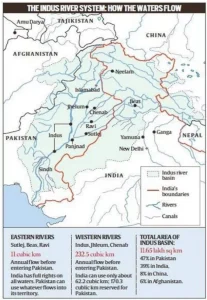
  • Indus Waters Treaty, 1960: Signed between India and Pakistan with World Bank assistance to govern the utilisation of the waters of the Indus River system.
  • Water allocation:
    • Eastern Rivers: Ravi, Beas, and Sutlej, which are primarily allocated to India.
    • Western Rivers: Indus, Jhelum and Chenab, which are primarily allocated to Pakistan, while India retains specified rights, including limited domestic, agricultural and run-of-the-river hydropower projects.
  • Dispute Resolution Mechanism: The Treaty provides a graded mechanism for resolving disputes.
    • Permanent Indus Commission: Deals with questions concerning the interpretation and implementation of the Treaty.
    • Neutral Expert: Deals primarily with differences relating to technical issues.
    • Court of Arbitration: Deals with disputes falling within its jurisdiction under the Treaty.
  • Status of the Treaty: India placed the Indus Waters Treaty in abeyance following the Pahalgam terror attack of 22 April 2025, until Pakistan “credibly and irrevocably” ends its support for cross-border terrorism.
    • India has reiterated that the decision to keep the Treaty in abeyance remains in force.

Permanent Court of Arbitration (PCA)

  • Established: 1899 during the First Hague Peace Conference.
  • Founding treaty: 1899 Convention for the Pacific Settlement of International Disputes, revised in 1907.
  • Purpose: Provides arbitration and other dispute-resolution services involving States, State entities, international organisations and private parties.
  • UN status: Granted Permanent Observer status at the UN General Assembly in 1993.
  • Headquarters: Peace Palace, The Hague, Netherlands.

Background to the Current Dispute

  • Dispute over Hydroelectric Projects: Pakistan has raised objections to the design features of India’s Kishenganga and Ratle hydroelectric projects on the Western Rivers.
  • Divergence over Dispute Resolution: Pakistan sought adjudication through a Court of Arbitration, while India preferred resolution through the Neutral Expert mechanism.
  • World Bank’s Role: The World Bank initially paused both processes in 2016 because simultaneous proceedings could create legal and procedural complications.
    • After efforts to find an amicable solution failed, the World Bank resumed the process in 2022, with a Neutral Expert and a Court of Arbitration being constituted.
  • India’s Objection: India has consistently objected to the Court’s competence and has not participated in its proceedings. The PCA itself records India’s repeated objections to the Court’s competence.

Ratle–Kishenganga Dispute

  • Kishenganga Project: A 330 MW run-of-the-river hydroelectric project on the Kishenganga River (a tributary of the Jhelum) in Jammu and Kashmir.
  • Ratle Project: An 850 MW hydroelectric project on the Chenab River in Jammu and Kashmir.
  • Core Dispute: Pakistan has challenged the design features of the Ratle and Kishenganga hydroelectric projects, alleging violations of IWT restrictions on India’s use of the Western Rivers.
  • Technical Issues: The disputes involve reservoir storage, pondage, dam design and operational parameters.
  • Neutral Expert: At India’s request, the World Bank mechanism appointed a Neutral Expert to examine these technical issues.
  • India’s Stand: India considers the Neutral Expert mechanism treaty-consistent, while viewing the parallel Court of Arbitration process as impermissible under the IWT.

Recent Ruling of the Court of Arbitration

  • Treaty remains in force: The Court held that the Indus Waters Treaty (IWT) remains fully operative and rejected the grounds for its suspension or termination.
  • India’s obligations: India must follow the Treaty’s provisions on the design and operation of hydroelectric projects on the Western Rivers.
  • Ratle Hydroelectric Project: The Court issued interim measures concerning the Ratle Hydroelectric Project (RHEP) on the Chenab.
    • India was barred from concreting certain portions of the dam wall and power intake structure above specified levels until 90 days after the Neutral Expert’s final decision, expected in July 2027.

IAS coaching

India’s Response to the Hague Court Ruling

  • Rejection of the Court’s Legitimacy: India maintains that the Court of Arbitration was constituted in patent breach of the Indus Waters Treaty.
  • Non-recognition: India has never recognised the legal existence of the Court and therefore categorically rejects its award.
  • Rejection of the Court’s Jurisdiction: India maintains that the Court has no jurisdiction over India’s sovereign decisions, including its decision to place the Treaty in abeyance.
  • No Effect on Projects: India has stated that the Court’s pronouncements, present or future, will not affect India’s actions regarding its hydroelectric projects.
  • Non-Participation in Proceedings: India has never appeared before the Court of Arbitration and has consistently refused to take cognisance of its pronouncements.
    • India’s non-participation stems from its fundamental objection to the constitution and jurisdiction of the Court itself.

Challenges in Managing the Indus Waters Treaty

  • Jurisdictional Conflict: India’s rejection of the PCA’s jurisdiction creates uncertainty over the Treaty’s dispute-settlement framework.
  • Parallel Proceedings: Overlapping proceedings before the Court of Arbitration and Neutral Expert complicate effective dispute resolution.
  • Water Security: Pakistan’s heavy dependence on the Indus system makes any alteration of the Treaty highly sensitive for food and water security.
  • Bilateral Tensions: Linking the Treaty with cross-border terrorism has further weakened prospects for sustained cooperation.
  • Hydropower Disputes: Disagreements over projects on the Western Rivers can delay India’s hydropower development.
  • Climate Change: Changing rainfall patterns, glacier dynamics and rising water demand are increasing uncertainty over future water availability.

Click to Know UPSC Coaching Centres in India

Way Forward

  • Strengthen Institutions: Preserve engagement through the Permanent Indus Commission, focusing on technical dialogue, data sharing and hydrological assessments.
  • Resolve Procedural Ambiguity: Clarify the roles of the Neutral Expert and the Court of Arbitration to prevent parallel proceedings and jurisdictional conflicts.
  • Protect Developmental Interests: Continue legitimate hydropower development on the Western Rivers with sound engineering, environmental safeguards and Treaty compliance.
  • Balance Security and Water Diplomacy: Address cross-border terrorism through appropriate diplomatic channels while maintaining technical cooperation on water wherever feasible.
  • Build Climate Resilience: Promote water conservation, storage, efficient irrigation, and integrated basin management to address changing rainfall patterns, glacier dynamics, and rising demand.

Check Out UPSC CSE Books

Visit PW Store

online store 1

Indus Waters Treaty: PCA Ruling, Ratle Project & India’s Stand

Need help preparing for UPSC or State PSCs?

Connect with our experts to get free counselling & start preparing

Free Counselling for UPSC Aspirants

Connect with our experts and take the right next step.

Expert Guidance
Personalized Strategy
100% Free

Book Your Free Session

NEED ASSISTANCE?

Request a Callback

Our counsellor will connect with you and help you choose the right course and centre.

  • Expert Guidance
  • Course & Fee Information
  • Quick Callback Support

Request a Callback

Books
UPSC PYQs
UPSC Notes
Current Affairs
Quick Revise Now !
AVAILABLE FOR DOWNLOAD SOON
UDAAN PRELIMS WALLAH
Comprehensive coverage with a concise format
Integration of PYQ within the booklet
Designed as per recent trends of Prelims questions
हिंदी में भी उपलब्ध
Quick Revise Now !
UDAAN PRELIMS WALLAH
Comprehensive coverage with a concise format
Integration of PYQ within the booklet
Designed as per recent trends of Prelims questions
हिंदी में भी उपलब्ध

<div class="new-fform">


    </div>

    Subscribe our Newsletter
    Sign up now for our exclusive newsletter and be the first to know about our latest Initiatives, Quality Content, and much more.
    *Promise! We won't spam you.
    Yes! I want to Subscribe.