Subject: GS 2: International Relations
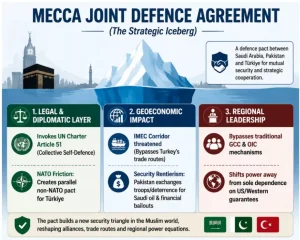
Context: Recently, Pakistan, Saudi Arabia and Türkiye signed the Mecca Joint Defence Agreement, pledging collective defence and deterrence; an attack on one would be treated as an attack on all.
IAS coaching
Background
- In September 2025, Saudi Arabia and Pakistan signed a Strategic Mutual Defence Agreement, under which aggression against one country was to be treated as aggression against both.
- The 2026 Mecca agreement therefore represents an expansion from bilateral to trilateral security cooperation through the inclusion of Türkiye.
About the Mecca Joint Defence Agreement
- It is a trilateral defence framework intended to strengthen collective security, defence cooperation and deterrence among Pakistan, Saudi Arabia and Türkiye.
- The agreement was signed at the Mecca Al-Mukarramah Summit for Joint Defence, attended by Saudi Crown Prince Mohammed bin Salman, Turkish President Recep Tayyip Erdoğan and Pakistani Prime Minister Shehbaz Sharif.
- The pact is described as defence-oriented and not directed against any particular country, with emphasis on regional peace, stability, burden-sharing and collective security.
Why Now?
- Escalating West Asian Insecurity: The agreement comes amid a prolonged regional security crisis involving Iran, Israel, the United States and Iran-aligned non-state actors.
- Threats to Saudi Arabia: Saudi Arabia has faced repeated security threats, including Houthi attacks near its border and against energy infrastructure, increasing the importance of collective deterrence.
- Red Sea Insecurity and Strait of Hormuz: Houthi attacks and disruption of maritime activity around the Red Sea have increased concerns over the security of critical trade and energy routes.
- Changing Regional Alignments: The pact reflects the growing willingness of major regional powers to develop alternative and complementary security arrangements amid uncertainty over the existing regional security architecture.
What Strengths Do the Three Countries Bring?
- Saudi Arabia: Financial power and energy dominance.
- Türkiye: Defense technology/drone manufacturing and NATO operational experience.
- Pakistan: Large conventional army, manpower, and nuclear power status
|
Implications for India’s Strategic Environment
- Energy Security: Instability affecting the Strait of Hormuz and wider Gulf region has direct implications for India because of its dependence on West Asian energy supplies and the importance of these maritime routes for India’s external trade.
- West Asian Strategic Architecture: The emergence of a new trilateral defence framework could influence the evolving balance of power in India’s extended neighbourhood.
- India–Saudi Arabia Relations: The development needs careful monitoring because India has substantial energy, trade, investment and diaspora linkages with Saudi Arabia.
- However, stronger Saudi–Pakistan defence ties do not necessarily imply a deterioration in India–Saudi relations.
- India–Türkiye–Pakistan Triangle: Türkiye’s growing defence and strategic cooperation with Pakistan remains relevant to India, particularly because of Ankara’s positions on issues concerning India and Pakistan.
- Maritime Security: The agreement has implications for the wider security environment encompassing the Arabian Sea, Gulf of Oman and Red Sea, which are important for India’s energy imports and external trade.
- Strategic Autonomy: The development reinforces the importance of India’s policy of strategic autonomy and multi-alignment, allowing it to maintain functional partnerships with different regional powers despite their competing interests.
Broader Geopolitical Significance
- Rise of Regional Security Arrangements: The pact demonstrates how states are increasingly pursuing minilateral security frameworks to address regional threats rather than relying exclusively on larger alliance structures.
- Shift towards Burden-Sharing: Collective security arrangements allow participating countries to share military capabilities, intelligence, financial resources and strategic responsibilities.
- Muslim-majority Strategic Cooperation: The participation of three influential Muslim-majority states indicates growing strategic convergence on regional security issues, although their interests remain differentiated.
- Complementarity rather than Formal Alliance: The agreement is better understood as a regional defence-cooperation framework rather than an established military alliance comparable to NATO.
Challenges and Limitations
- Different Strategic Interests: Saudi Arabia, Pakistan and Türkiye have overlapping but not identical interests. Differences over Iran, Israel, Syria and relations with Western powers could complicate collective decision-making.
- Ambiguous Military Obligations: The phrase “attack on one is an attack on all” does not by itself establish the precise military response expected from the other members.
- Credibility of Collective Defence: The experience of the 2025 Saudi–Pakistan agreement demonstrates that mutual-defence commitments may not necessarily translate into automatic military intervention.
- Risk of Regional Bloc Politics: Excessive militarisation and competing security blocs could deepen strategic fragmentation in an already unstable West Asian environment.
- Divergent threat Perceptions: The three countries do not necessarily share identical positions on Iran, Israel, the United States and other regional conflicts, which could make coordinated action difficult during a major crisis.
- Implementation Gap: The absence of clearly defined operational obligations may create a gap between the political commitment to collective defence and the actual military response.
Click to Know UPSC Offline Courses
Way Forward
- Deepen Gulf Partnerships: India should continue strengthening its strategic engagement with Saudi Arabia and other Gulf countries through defence, energy, trade and investment cooperation.
- Strengthen Maritime Preparedness: Greater attention should be given to maritime security in the Arabian Sea, Gulf of Oman and Red Sea, including protection of India’s commercial shipping and energy supply chains.
- Maintain Strategic Autonomy: India should avoid being drawn into competing regional blocs and instead pursue issue-based partnerships with Saudi Arabia, Türkiye, Iran and other regional actors.
- Expand Diplomatic Engagement: India can leverage its relations across the region to support dialogue, de-escalation and regional stability, consistent with its broader approach to West Asian diplomacy.
Conclusion
The Mecca Joint Defence Agreement signals a more multi-layered security architecture in West Asia, strengthening defence cooperation among Pakistan, Saudi Arabia and Türkiye. For India, it underscores the need for strategic autonomy, diversified partnerships, and stronger maritime and diplomatic capabilities in its extended neighbourhood.
 8 Aug 2026