Subject: GS 2: International Relations
Context: Recently, U.S. has announced a phased tariff structure on generic pharmaceutical imports, effective August 1, 2026
- The proposed tariff regime on imported generic medicines is 0% till August 2028, 100% for one year thereafter, and 200% subsequently—to encourage pharmaceutical companies to establish manufacturing facilities in the U.S.
IAS coaching
About Generic Medicines

- Generic medicines are drugs containing the same Active Pharmaceutical Ingredient (API), dosage, strength, safety, quality, route of administration, and therapeutic efficacy as the corresponding branded (innovator) medicine.
- They are manufactured after the expiry of the patent of the original drug.
- They are approved based on bioequivalence, ensuring that they produce the same therapeutic effect as the branded medicine.
Key Features of Generic Medicines
- Therapeutically Equivalent: Provide the same efficacy and safety as branded medicines.
- Cost-effective: Significantly cheaper as manufacturers do not bear the costs of drug discovery and extensive clinical trials.
- Quality Assured: Manufactured under the same Good Manufacturing Practices (GMP) and regulatory standards.
- Improves Healthcare Access: Enhances affordability and availability of essential medicines.
Why India Is Exposed?
| Metric |
Figure |
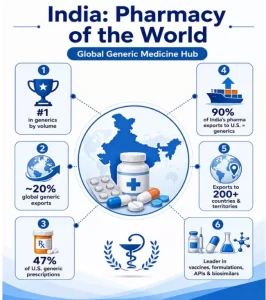
| India’s total pharma exports (2025) |
$25.8 billion |
| Exports to the U.S. |
$9.7 billion (37.7%) — India’s largest overseas pharma market |
| India’s share of U.S. generic prescriptions dispensed |
~47% (largest supplier) |
| India’s share of the value of U.S. generic imports |
~30% (lower, due to low unit pricing) |
| Total U.S. pharma imports (2025) |
$213 billion, including $94.1 billion of finished retail-pack medicines |
| India’s FY26 pharma export growth |
+2%, crossing $31 billion, despite a sharp March decline |
Implications for India
- Reduced Export Competitiveness: High tariffs could diminish the price advantage of Indian generic medicines in the U.S. market.
- Pressure on Profitability: Thin operating margins in the generic medicine industry may make it difficult to absorb additional tariff costs.
- Acceleration of Overseas Investments: Indian pharmaceutical companies are increasingly investing in manufacturing facilities in the U.S.
- Shift towards Local Production: Companies may adopt a “produce where you sell” strategy to retain market access.
- Growing Outbound Investments: India’s outbound investment to the U.S. reached $4.08 billion in FY26, the highest in recent years.
- Rise of Trade Protectionism: Reflects the growing use of trade policy as an instrument of industrial policy.
- Need for Export Diversification: Highlights the risks associated with excessive dependence on a single export destination.
- Greater Emphasis on API Security: Reinforces the need to strengthen India’s domestic Active Pharmaceutical Ingredient (API) ecosystem.
- India continues to rely heavily on China for the import of Active Pharmaceutical Ingredients (APIs) and bulk drugs, exposing vulnerabilities in its pharmaceutical supply chain.
Click to Know UPSC Offline Courses