UPSC PYQs

Prelims, Mains & Optional PYQs

UPSC Notes

Comprehensive & Short Notes

News in Shorts 25 July 2026: UNCITRAL, Black Sea, BHAVYA & FTCs

25 Jul 2026

News in Shorts 25 July 2026: UNCITRAL, Black Sea, BHAVYA & FTCs

UNCITRAL: 60th Anniversary Conference

Context: India hosted UNCITRAL’s 60th anniversary conference, where External Affairs Minister S. Jaishankar called for inclusive and predictable global trade laws reflecting Global South priorities.

UPSC Online Courses

About The United Nations Commission on International Trade Law (UNCITRAL) 

  • It is the core legal body of the UN system dealing with international trade law.
  • Establishment: UNCITRAL was established by the UN General Assembly in 1966 to promote the progressive harmonisation and unification of international trade law.
  • Key Role: It develops model laws, conventions, legislative guides and legal standards to modernise and harmonise international trade law.
  • Membership: The Commission comprises 60 Member States elected by the UN General Assembly for six-year terms, with half of the membership renewed every three years.
  • Regional Representation: Its membership includes 14 African, 14 Asian, 8 Eastern European, 10 Latin American and Caribbean, and 14 Western European and other States.
  • Significance: UNCITRAL promotes predictable legal frameworks, cross-border commercial cooperation and efficient dispute resolution, facilitating international trade and investment.

India and UNCITRAL

  • Long-standing Engagement: India is among the countries with continuous membership of UNCITRAL and has actively contributed to the development of international trade law.
    • India joined UNCITRAL as a founding member in 1968.
  • Legal Reforms: India’s reforms in arbitration, commercial dispute resolution and insolvency reflect its efforts to create a modern, transparent and internationally compatible legal environment.
  • Global South: India advocates greater representation of developing countries in shaping international legal norms and calls for trade laws that address the developmental priorities of the Global South.
  • Viksit Bharat 2047: India views predictable and harmonised international legal frameworks as essential for strengthening manufacturing, technological innovation, global integration and a resilient economy.


Black Sea

Context: Recently, an Indian sailor was killed after commercial vessel MV Omorfi was attacked in Russian territorial waters in the Black Sea.
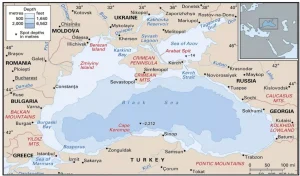
About the Black Sea

Black Sea

  • Introduction: The Black Sea is a large inland sea located between southeastern Europe and western Asia, serving as an important maritime corridor connecting the region with global trade routes.
  • Bordering Nations: The Black Sea is bordered by Türkiye, Bulgaria, Romania, Ukraine, Russia and Georgia.
  • Key Geographical Features
    • Surface Area: The Black Sea covers approximately 436,000 sq. km, making it one of the world’s major inland seas.
    • Anoxic Deep Waters: Its deep waters are largely oxygen-deficient, creating conditions that can preserve ancient shipwrecks and organic remains exceptionally well.
    • Major Rivers: Important rivers draining into the Black Sea include the Danube, Dnieper and Dniester, which contribute significantly to its freshwater inflow.
    • Surrounding Mountains: The sea is bordered by the Pontic Mountains to the south, Caucasus Mountains to the east and Crimean Mountains towards the north.
  • Straits and Sea Routes
    • Bosporus Strait: Connects the Black Sea with the Sea of Marmara and serves as a crucial maritime passage.
    • Dardanelles Strait: Connects the Sea of Marmara with the Aegean Sea, providing access to the Mediterranean Sea and the Atlantic Ocean.
    • Kerch Strait: Connects the Black Sea with the Sea of Azov to the northeast.
  • Strategic Importance
    • Maritime Trade: The Black Sea is strategically important for the transportation of energy resources, agricultural commodities and other goods between Eastern Europe, the Caucasus and global markets.
    • Geopolitical Significance: Its location and access through the Turkish Straits make it a critical region for European security, maritime trade and regional geopolitics

BHAVYA Rasayan Scheme

Context: The Cabinet Committee on Economic Affairs (CCEA) has approved Bharat Audyogik Vikas Yojana Rasayan or BHAVYA – Rasayan Scheme.
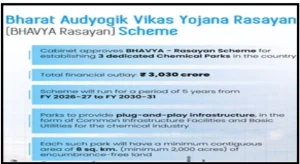
About the Scheme

BHAVYA Rasayan Scheme

  • It is a Central Sector scheme to develop three world-class chemical and petrochemical industrial parks in the country.
    • The Scheme was announced in the Union Budget of 2026-27.
  • Implemented by: Department of Chemicals and Petrochemicals, Ministry of Chemicals and Fertilisers.
  • Implementation period: FY 2026–27 to FY 2030–31 (5 years).
  • Aim: Build an integrated, eco-friendly, and globally competitive chemical manufacturing ecosystem.
    • Reduce logistics costs and import dependence.
    • Attract domestic and foreign direct investment (FDI).
    • Strengthen India’s participation in Global Value Chains (GVCs).

Key Features of the Scheme

  • Financial Outlay: ₹3,030 crore total allocation:
    • ₹3,000 crore for common infrastructure and basic utilities.
    • ₹30 crore for administrative expenditure.
  • Central–State Funding Pattern: Central assistance of up to ₹1,000 crore per park.
    • States must provide a minimum matching grant of ₹500 crore.
  • Land Requirement: States must provide at least 8 sq. km. (2,000 acres) of contiguous, encumbrance-free land for each park.
  • Plug-and-Play Infrastructure: Parks will provide shared industrial infrastructure, including:
    • Common Effluent Treatment Plants (CETPs).
    • Treatment, Storage and Disposal Facilities (TSDFs) for hazardous waste.
    • Solvent recovery and distillation plants.
    • Steam generation and distribution systems.
    • Industrial pipeline networks, logistics, and warehousing facilities.

UPSC Online Classes

Fast-Track Courts (FTCs)

Context: Prime Minister Narendra Modi announced the proposal to establish fast-track courts (FTCs) for paper leak cases amid protests over examination paper leaks.
About Fast-Track Courts

Fast-Track Courts

  • They are Special courts established to expedite the trial of specific categories of cases and reduce judicial delays.
  • Legal Status: There is no single central law governing FTCs.
  • Mode of Establishment: They are created through government schemes, judicial directions, or state initiatives.

Evolution

  • 14th Finance Commission (2015–20): Recommended setting up 1,800 FTCs for heinous crimes, long-pending property disputes, and cases involving vulnerable groups.
  • 2019: The Union Government launched the Fast-Track Special Courts (FTSCs) Scheme, partly funded through the Nirbhaya Fund, for speedy trial of rape and POCSO cases.

Timeframe for Disposal of Cases by Fast-Track Courts (FTCs)

  • No Statutory Time Limit: Litigants do not have a statutory right to a fixed deadline for completion of trials.
  • BNSS Recommendation: The Bharatiya Nagrik Suraksha Sanhita (BNSS) recommends:
    • Criminal trials: Ideally completed within 2 years.
    • Sexual offence trials: Ideally completed within 2 months.
  • Disposal Target under FTSC Scheme: Under the Centrally Sponsored Fast-Track Special Courts (FTSC) Scheme, each FTSC is expected to dispose of 41–42 cases per quarter (around 165 cases annually).

Constitutional Safeguards for Fast-Track Courts

  • Equality Before Law: Special courts must comply with Article 14 of the Constitution, ensuring equality before the law.
  • Reasonable Classification Principle: In State of West Bengal v. Anwar Ali Sarkar (1952), the Supreme Court held that “object of speedier trial” alone cannot justify creating a special court
    • To survive constitutional scrutiny, the classification of cases chosen for fast-tracking must have a rational, objective basis – such as the specific nature of the offence or the vulnerability of the victims.
  • Special Courts for Exceptional Cases: Special courts have subsequently been constituted for major public-interest cases, such as the 2G Spectrum Scam and the Satyam Scam, to ensure expeditious trials.

Click to Know UPSC Coaching Centres in India

Performance of FTC

  • As of January 2026:
    • 862 regular FTCs functioning across 21 States/UTs.
    • 774 FTSCs, including 398 exclusive POCSO courts, operational across 29 States/UTs.
  • 2024: FTSCs received 88,902 new cases and disposed of 85,595 cases.
  • Average disposal: 9.5 cases per month, compared to 3.3 cases by regular trial courts.
    • Despite high disposal rates, over 2.4 lakh cases remained pending by the end of 2023.

Check Out UPSC CSE Books

Visit PW Store

online store 1

News in Shorts 25 July 2026: UNCITRAL, Black Sea, BHAVYA & FTCs

Explore UPSC Foundation Batches

Need help preparing for UPSC or State PSCs?

Connect with our experts to get free counselling & start preparing

Free Counselling for UPSC Aspirants

Connect with our experts and take the right next step.

Expert Guidance
Personalized Strategy
100% Free

Book Your Free Session

NEED ASSISTANCE?

Request a Callback

Our counsellor will connect with you and help you choose the right course and centre.

  • Expert Guidance
  • Course & Fee Information
  • Quick Callback Support

Request a Callback

Books
UPSC PYQs
UPSC Notes
Current Affairs
Quick Revise Now !
AVAILABLE FOR DOWNLOAD SOON
UDAAN PRELIMS WALLAH
Comprehensive coverage with a concise format
Integration of PYQ within the booklet
Designed as per recent trends of Prelims questions
हिंदी में भी उपलब्ध
Quick Revise Now !
UDAAN PRELIMS WALLAH
Comprehensive coverage with a concise format
Integration of PYQ within the booklet
Designed as per recent trends of Prelims questions
हिंदी में भी उपलब्ध

<div class="new-fform">


    </div>

    Subscribe our Newsletter
    Sign up now for our exclusive newsletter and be the first to know about our latest Initiatives, Quality Content, and much more.
    *Promise! We won't spam you.
    Yes! I want to Subscribe.