UPSC PYQs

Prelims, Mains & Optional PYQs

UPSC Notes

Comprehensive & Short Notes

News in Shorts 24 September 2026: Climate Impact Lab Report, Cyclone Arnab, Poompuhar & OIC

24 Sep 2026

News in Shorts 24 September 2026: Climate Impact Lab Report, Cyclone Arnab, Poompuhar & OIC

Climate Impact Lab Report

Context: The Climate Impact Lab projects 15,800 additional heat-related deaths in India between September 2026 and February 2027 amid an exceptionally Super El Niño event.

UPSC Coaching Classes

Key Findings of Climate Impact Lab Report

  • Global Mortality: The report projects approximately 451,000 additional heat-related deaths globally during the first six months of the El Niño event.
  • India’s Heat Mortality: India could experience an estimated 15,800 additional heat-related deaths, with an uncertainty range of ±1,600, compared with average conditions during 1996–2025.
  • Impact on Energy demand: The heat is also increasing the demand for electricity, with nearly 40% of India’s coal-fired power plants reporting critically low fuel stocks.

About Climate Impact Lab

  • The Climate Impact Lab is a multidisciplinary research collaboration that uses climate modelling, economics and data science to measure localized socioeconomic impacts of climate change.
  • The organization operates out of two primary hubs:
    • The University of Chicago working closely with the Energy Policy Institute at Chicago (EPIC).
    • Oakland, California Climate Impact Lab partnered with researchers at the Rhodium Group and the University of California, Berkeley
  • Reports: Its research provides quantitative estimates of climate-related impacts to support adaptation planning, policy decisions and risk assessment.

About Super El Niño

  • Super El Niño is an informal term for an exceptionally strong El Niño, involving unusually high sea-surface temperatures in the central and eastern tropical Pacific.
  • Key Features
    • Trade winds weaken, allowing warm surface waters to shift eastward.
    • Walker circulation is disrupted, altering global atmospheric circulation.
    • Eastern equatorial Pacific temperatures can rise more than 3°C above normal during an extreme event.
  • Impacts
    • Super El Niño can suppress the Indian southwest monsoon, intensify heat, increase drought and wildfire risks, disrupt marine ecosystems through weaker upwelling, and alter rainfall patterns globally


Cyclone Arnab: A Misnomer

Context: A Deep Depression over the Bay of Bengal crossed the North Andhra Pradesh–South Odisha coast near Kalingapatnam in the early hours of 24 September 2026, bringing heavy rainfall to parts of Odisha and Andhra Pradesh. 
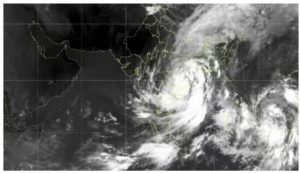
Key Facts

  • Status: The system remained a Deep Depression and was not classified as a Cyclonic Storm before landfall.
  • Monitoring: The system was monitored by the India Meteorological Department (IMD), including observations from the Doppler Weather Radar at Visakhapatnam.

UPSC Online Classes

Why Is It Called “Arnab”?

Cyclone Arnab

  • Official Status: The depression was not officially named Arnab because it did not reach Cyclonic Storm intensity.
  • Name In The Regional List: Arnab is one of the names in the North Indian Ocean tropical cyclone naming list.
  • Contributor: The name Arnab was contributed by Bangladesh.
  • Future Use Of Name: The name is available for use when a future system reaches the required cyclonic-storm intensity and comes next in the naming sequence.

Depression Vs Cyclone

  • Depression: A system with maximum sustained wind speed of 17–27 knots (31–49 km/h).
  • Deep Depression: A system with maximum sustained wind speed of 28–33 knots (50–61 km/h).
  • Cyclonic Storm: A system with maximum sustained wind speed of 34–47 knots (63–87 km/h).
  • Key Difference: A system is classified as a Cyclonic Storm when its maximum sustained wind speed reaches 34 knots (63 km/h).

North Indian Ocean Cyclone Naming Mechanism

  • Regional Framework: Cyclone names are assigned under the World Meteorological Organization and the Economic and Social Commission for Asia and the Pacific  (WMO/ESCAP) Panel on Tropical Cyclones.
  • Participating Countries: 13 countries contribute names to the regional list — Bangladesh, India, Maldives, Myanmar, Oman, Pakistan, Sri Lanka, Thailand, Iran, Qatar, Saudi Arabia, UAE and Yemen.
  • Name Pool: Each country contributes 13 names, creating a total of 169 names.
  • Alphabetical Order: The participating countries are arranged alphabetically, and their contributed names are used sequentially in this order.
  • Sequential Naming: The next available name is assigned when a system reaches Cyclonic Storm intensity (34 knots or more).
  • One-Time Use: Once a name is assigned to a cyclone, it is not reused.


OECD Raises India’s FY2026–27 Growth Forecast

Context: The OECD raised India’s FY2026–27 growth forecast to 7.1% from 6.3%, citing resilient domestic demand and supportive government policies.

Key Highlights of India’s Growth Projection

  • Factors Supporting Growth: The OECD attributes India’s resilience to strong domestic demand and government policies that have cushioned households and firms from higher energy prices amid global shocks.
  • Emerging Risks: The OECD expects growth to moderate during the second half of FY2026–27 because reduced purchasing power may weaken domestic demand, while energy, inflation and weather-related risks remain relevant.

UPSC Online Courses

About OECD

  • The Organisation for Economic Co-operation and Development (OECD) is an intergovernmental organisation that promotes better economic and social policies through data, research and policy cooperation.
  • Origin: Established in 1961, the OECD succeeded the Organisation for European Economic Co-operation (OEEC), established in 1948 to administer the Marshall Plan.
  • Membership: The OECD has 38 member countries. India is not a member, but has been an OECD Key Partner since 2007.
  • Key Role: It provides economic analysis, comparative data, international standards and policy recommendations covering taxation, trade, employment, education, governance and economic growth


Poompuhar: Ancient Maritime Trade Centre

Context: A 2026 underwater exploration at Poompuhar recovered over 200 potsherds and torpedo jars, strengthening evidence of ancient trade with West Asia.

About Poompuhar

  • Poompuhar, also known as Kaveripattinam or Kaveripoompattinam, was an important ancient port city situated at the mouth of the River Kaveri on Tamil Nadu’s Bay of Bengal coast.
  • Period: Parts of Poompuhar date to at least the 3rd century BCE, while the settlement continued to develop as a major maritime centre in subsequent centuries.
  • Rulers Associated: Poompuhar was an important Chola port, particularly associated with the early Chola polity and its maritime activities.
  • Key Features
    • West Asian Trade: The discovery of torpedo jars, glazed Iranian pottery and other artefacts indicates maritime connections between Poompuhar, the Persian Gulf and Iran from around the 3rd century BCE.
    • Inland Trade Networks: Paddle-impressed pottery and other finds indicate connections with the Gangetic plains, showing that Poompuhar was linked to both coastal and inland trade networks.
    • Underwater Structures: An underwater stone structure measuring approximately 40 m × 16 m has been identified several kilometres offshore, providing evidence of the ancient settlement’s submergence.
    • Multi-regional Cultural Links: Limestone potentially associated with Buddhist artefacts from Amaravati and possibly rouletted ware indicate wider cultural and commercial interactions.
  • Historical Significance: Poompuhar is mentioned in Silappadikaram and Manimekalai and in Greco-Roman works such as the Periplus of the Erythraean Sea and Ptolemy’s Geography.
    • Sea erosion and repeated tsunamis over centuries contributed to its submergence.


Organisation of Islamic Cooperation (OIC)

Context: Recently India rejected the OIC Contact Group on Jammu and Kashmir remarks on Kashmir.

Key Objections Raised by India

  • Internal Matter: India stated that the OIC has no locus standi to comment on matters that India considers strictly internal, and reaffirmed the territorial status of Jammu and Kashmir and Ladakh.
  • Politicised Narrative: India rejected the Contact Group’s characterization of the 2025 India-Pakistan conflict and its references to India’s military actions, describing the OIC position as politically motivated.

Click to Know UPSC Coaching Centres in India

About Organisation of Islamic Cooperation (OIC)

  • The Organisation of Islamic Cooperation (OIC) is the second-largest intergovernmental organisation after the United Nations and describes itself as the collective voice of the Muslim world.
  • Origin: The OIC was established on 25 September 1969 at Rabat, Morocco, following the arson attack on Al-Aqsa Mosque in Jerusalem.
  • Members: The OIC has 57 member states spread across four continents , but not all of them are exclusively Islamic states.
    • India is not a member.
  • Headquarters: Its General Secretariat is headquartered in Jeddah, Saudi Arabia.
  • Objectives: The OIC seeks to strengthen Islamic solidarity, economic and social cooperation, peace and security, and support issues concerning Palestine and Al-Quds.
  • Important Summits: The Islamic Summit is the organisation’s highest-level forum and normally brings together heads of state every three years.
    • The 15th Islamic Summit was held in Banjul, The Gambia, in 2024, while the 16th is scheduled for Baku, Azerbaijan, in 2027.

Check Out UPSC CSE Books

Visit PW Store

online store 1

News in Shorts 24 September 2026: Climate Impact Lab Report, Cyclone Arnab, Poompuhar & OIC

Need help preparing for UPSC or State PSCs?

Connect with our experts to get free counselling & start preparing

Free Counselling for UPSC Aspirants

Connect with our experts and take the right next step.

Expert Guidance
Personalized Strategy
100% Free

Book Your Free Session

NEED ASSISTANCE?

Request a Callback

Our counsellor will connect with you and help you choose the right course and centre.

  • Expert Guidance
  • Course & Fee Information
  • Quick Callback Support

Request a Callback

Books
UPSC PYQs
UPSC Notes
Current Affairs
Quick Revise Now !
AVAILABLE FOR DOWNLOAD SOON
UDAAN PRELIMS WALLAH
Comprehensive coverage with a concise format
Integration of PYQ within the booklet
Designed as per recent trends of Prelims questions
हिंदी में भी उपलब्ध
Quick Revise Now !
UDAAN PRELIMS WALLAH
Comprehensive coverage with a concise format
Integration of PYQ within the booklet
Designed as per recent trends of Prelims questions
हिंदी में भी उपलब्ध

<div class="new-fform">


    </div>

    Subscribe our Newsletter
    Sign up now for our exclusive newsletter and be the first to know about our latest Initiatives, Quality Content, and much more.
    *Promise! We won't spam you.
    Yes! I want to Subscribe.