UPSC PYQs

Prelims, Mains & Optional PYQs

UPSC Notes

Comprehensive & Short Notes

Women Farmers in India: Recognition, Challenges and Empowerment Measures

24 Sep 2026

Women Farmers in India: Recognition, Challenges and Empowerment Measures

Subject: GS 01: Society

Context: Maharashtra became the first State to enact the Women Farmers Empowerment Bill, 2026, recognising women as farmers through a Woman Farmer Certificate irrespective of land ownership.
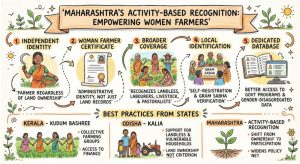
  • The United Nations has designated 2026 as the International Year of the Woman Farmer to highlight women’s vital role in agriculture and rural livelihoods and address their persistent exclusion from land, resources and institutional support.

Best Online Coaching for UPSC

Status of Women in Indian Agriculture

  • Large Agricultural Workforce: According to the Periodic Labour Force Survey (PLFS) 2023–24, more than three-fourths of rural working women are engaged in agriculture and allied activities, making the sector central to rural women’s livelihoods.
  • Mixed Employment Structure: Rural women participate as agricultural labourers, self-employed cultivators, livestock rearers and unpaid family workers, rather than forming a uniform category of farm operators.
  • Persistent Ownership Gap: The Agricultural Census 2015–16 recorded women as holding only about 14% of operational agricultural holdings, while legal ownership or rights over agricultural land remain limited.
  • High Unpaid Work: In 2025, women accounted for roughly 110 million agricultural workers, compared with about 127 million men. However, more than 41% of female agricultural workers were unpaid helpers in family enterprises, compared with around 20% of male workers.
  • Lower Economic Autonomy: Nearly 63% of male agricultural workers were own-account workers, compared with around 39% of women, indicating that women’s participation does not necessarily translate into equivalent control over farm income and assets.

Women Farmers in India

Why Is Agriculture Becoming More Feminised?

  • Economic Drivers:
    • Male Out-Migration: Limited farm incomes and agrarian distress encourage men to seek employment in construction, manufacturing and other urban non-farm sectors, increasing women’s responsibility for family farms.
    • Substitution of Household Labour: Rising input and labour costs encourage small and marginal farm households to replace hired labour with unpaid female family labour, particularly during sowing, weeding, transplanting and harvesting.
    • Wage Differentials: Gender-based wage disparities can make women more likely to be employed as agricultural labourers, particularly in labour-intensive operations.
    • Limited Non-Farm Opportunities: Inadequate rural industrialisation, skill development and vocational opportunities restrict women’s movement into better-paid non-farm employment.
  • Socio-Cultural Drivers:
    • Care Responsibilities: Women’s responsibility for children, elderly family members and livestock limits their geographical mobility and often keeps them within village-based livelihoods.
    • Social Acceptability of Farm Work: Activities such as transplanting, weeding and harvesting are frequently viewed as extensions of traditional domestic responsibilities, reinforcing women’s concentration in labour-intensive agricultural work.
    • Mobility Constraints: Safety concerns, social norms and community restrictions can limit women’s independent migration to urban areas in search of employment.
    • Patriarchal Property Structures: Male-oriented inheritance practices and unequal control over land and assets reduce women’s bargaining power and restrict their transition from agricultural labour to independent farm entrepreneurship.

Why Recognition of Women Farmers Matters ?

  • Strengthening Food Security: The Food and Agriculture Organization (FAO) has estimated that closing the gender gap in access to productive agricultural resources could substantially raise farm productivity and reduce global hunger.
  • Improving Household Outcomes: Greater control over agricultural income can strengthen women’s ability to allocate resources towards nutrition, healthcare and children’s education.
  • Enhancing Climate Resilience: Women possess significant knowledge of traditional seeds, biodiversity, livestock management and local soil and water practices, making their participation important for climate-resilient agriculture.
  • Increasing Economic Agency: Formal farmer status can shift women from being viewed primarily as agricultural labourers to recognised economic actors and decision-makers.
  • Improving Policy Design: Reliable gender-disaggregated farmer databases can help governments identify gaps in credit, insurance, extension, mechanisation and market access.

UPSC Online Preparation

Major Challenges Faced by Women Farmers

  • Land-Linked Exclusion: Farmer databases largely depend on land titles, excluding women cultivating family, leased or jointly managed land from formal recognition.
  • Inheritance Disparity: Patriarchal inheritance practices limit women’s ownership and control over agricultural assets, weakening their economic agency.
  • Credit Constraints: Without land titles or collateral, women face difficulty accessing institutional credit, Kisan Credit Cards (KCCs) and affordable agricultural loans.
  • Welfare Exclusion: Land-based eligibility can restrict access to subsidies, crop insurance, seeds, fertilisers and extension services. Women account for only around 23–25% of PM-KISAN beneficiaries.
  • Technology and Extension Gap: Limited access to women-friendly machinery and agricultural advisory services increases physical drudgery and restricts adoption of modern farming practices.
  • Market Barriers: Restricted mobility, inadequate transport and limited participation in Agricultural Produce Market Committee (APMC) markets weaken women’s ability to negotiate better prices.
  • Data Deficit: Their underrepresentation in official farmer databases creates statistical invisibility, making gender-responsive agricultural planning and targeted interventions more difficult.

Government Initiatives to Empower Women in Agriculture

  • Mahila Kisan Sashaktikaran Pariyojana (MKSP): As a component of the Deendayal Antyodaya Yojana–National Rural Livelihoods Mission (DAY-NRLM), MKSP seeks to strengthen women’s skills, capacities and participation in agriculture.
  • Krishi Sakhi Convergence Programme: Rural women are trained as Community Agriculture Care Service Providers, enabling them to deliver agricultural knowledge and advisory support at the grassroots level.
  • Women-Focused Budgetary Support: The Ministry of Agriculture and Farmers Welfare provides for a minimum 30% allocation for women under various agricultural schemes and programmes.
  • Women Farmer Producer Organisations: Promotion of women-led Farmer Producer Organisations (FPOs) can improve aggregation, collective bargaining, access to inputs and integration with agricultural value chains.
  • Property Ownership Incentives: States such as Uttar Pradesh provide stamp-duty concessions for property or agricultural land registered in a woman’s name, encouraging greater female ownership of productive assets.

Way Forward

  • Separate Farmer Identity from Land Title: States should adopt an activity-based definition of a farmer that recognises cultivation, livestock rearing and other agricultural activities alongside land ownership.
  • Build an Interoperable Farmer Registry: Women Farmer Certificates should be integrated with Agri Stack and Farmer IDs, enabling recognised women to access relevant schemes through a unified digital identity.
  • Expand Collateral-Free Finance: Banks and institutions such as the National Bank for Agriculture and Rural Development (NABARD) should develop mechanisms through which recognised women farmers can access KCCs and collateral-free agricultural credit.
  • Strengthen Grassroots Institutions: Gram Panchayats and Gram Sabhas should play a greater role in identification, awareness generation, certification and incorporation of women’s agricultural priorities into Gram Panchayat Development Plans (GPDPs).
  • Improve Access to Technology: Agricultural extension systems should actively target women farmers, while research and procurement policies should promote ergonomically suitable, affordable and labour-saving machinery.
  • Promote Collective Market Power: Women’s Self-Help Groups (SHGs), FPOs and cooperatives should be connected with procurement, storage, processing, e-commerce and value chains to strengthen their bargaining position.
  • Ensure Gender-Responsive Monitoring: The mandated allocation for women-oriented agricultural programmes should be accompanied by outcome-based audits tracking actual beneficiaries, credit access, asset ownership and income gains.

Click to Explore UPSC Offline Coaching

Conclusion

Recognising women based on their agricultural contribution rather than land ownership can improve access to credit, technology, markets and welfare, while advancing SDG 1, SDG 2 and SDG 5.

News Source: The Hindu

Check Out UPSC CSE Books

Visit PW Store

online store 1

Women Farmers in India: Recognition, Challenges and Empowerment Measures

Need help preparing for UPSC or State PSCs?

Connect with our experts to get free counselling & start preparing

Free Counselling for UPSC Aspirants

Connect with our experts and take the right next step.

Expert Guidance
Personalized Strategy
100% Free

Book Your Free Session

NEED ASSISTANCE?

Request a Callback

Our counsellor will connect with you and help you choose the right course and centre.

  • Expert Guidance
  • Course & Fee Information
  • Quick Callback Support

Request a Callback

Books
UPSC PYQs
UPSC Notes
Current Affairs
Quick Revise Now !
AVAILABLE FOR DOWNLOAD SOON
UDAAN PRELIMS WALLAH
Comprehensive coverage with a concise format
Integration of PYQ within the booklet
Designed as per recent trends of Prelims questions
हिंदी में भी उपलब्ध
Quick Revise Now !
UDAAN PRELIMS WALLAH
Comprehensive coverage with a concise format
Integration of PYQ within the booklet
Designed as per recent trends of Prelims questions
हिंदी में भी उपलब्ध

<div class="new-fform">


    </div>

    Subscribe our Newsletter
    Sign up now for our exclusive newsletter and be the first to know about our latest Initiatives, Quality Content, and much more.
    *Promise! We won't spam you.
    Yes! I want to Subscribe.