Ease of Living in India: Governance Reforms and Inclusive Growth (2014–2026)

16 Jun 2026

Ease of Living in India: Governance Reforms and Inclusive Growth (2014–2026)

Between 2014–2026, India’s governance journey transformed daily life through housing, clean fuel, sanitation, drinking water, electricity, transport connectivity, and financial inclusion, empowering millions with dignity and opportunity.

  • Initiatives like Jan Dhan, MUDRA, AMRUT, Digital India, and MyGov strengthened citizen participation, resilience, and inclusive growth.

Best Online Coaching for UPSC

What is Ease of Living?

  • Ease of Living refers to the extent to which citizens can access basic services, opportunities, and a dignified quality of life with minimum barriers. 
    • In the Indian context, Ease of Living represents a shift from merely providing welfare to creating an empowered, inclusive, and citizen-centric development model where every individual can live with dignity, convenience, and equal opportunities.
  • It is closely linked with the constitutional vision of:
    • Article 21 – Right to life with dignity
    • Article 38 – Promotion of social welfare and reduction of inequalities
    • Article 39 – Ensuring adequate livelihood opportunities
    • Article 47 – Improvement of public health

Ease of Living: Developed vs Developing Nations 

Parameter Developed Nations (Examples) Developing Nations (India Example)
Human Development Norway, Switzerland, and Germany have high HDI due to strong health, education, and income systems. India is improving through health, education, and poverty reduction programmes, but remains in the process of achieving comparable outcomes.
Healthcare Access The United Kingdom provides universal healthcare through National Health Service; Canada has publicly funded healthcare. India expanded health protection through Ayushman Bharat, but faces challenges of doctor availability and out-of-pocket expenditure.
Drinking Water & Sanitation Japan and Singapore have advanced water management and sanitation systems. India improved rural water access through Jal Jeevan Mission and sanitation through Swachh Bharat Mission.
Housing Security Singapore provides large-scale public housing through the Housing and Development Board. India addresses housing needs through Pradhan Mantri Awas Yojana (PMAY) for urban and rural households.
Energy Access Germany and Denmark have reliable electricity and strong renewable energy integration. India achieved near-universal electricity access through programmes like Saubhagya, while promoting renewable energy.
Public Transport & Mobility Japan has high-speed rail networks like Shinkansen; European cities have integrated public transport. India is expanding connectivity through metros, highways, Dedicated Freight Corridors, and UDAN regional air connectivity.
Digital Governance Estonia is a global example of e-governance with digital public services. India’s Digital India, Aadhaar, UPI, and DigiLocker have created large-scale digital public infrastructure.
Employment & Social Security Sweden and Germany provide stronger unemployment benefits and labour protections. India focuses on skill development, MUDRA, social security schemes, and employment generation, but informal employment remains high.
Environmental Sustainability Sweden and Norway use cleaner energy, recycling, and sustainable urban planning. India promotes renewable energy, EV adoption, and climate-resilient infrastructure, while managing development needs.
Governance & Citizen Services Singapore is known for efficient administration and urban management. India is improving citizen-centric governance through MyGov, DBT, digital services, and participatory platforms.

Determinants of Ease of Living

  • Basic Services & Amenities: Access to safe drinking water, sanitation, electricity, clean cooking fuel, and housing ensures dignified living.
  • Healthcare Accessibility: Availability of affordable healthcare, preventive services, and health insurance improves well-being.
  • Quality Education & Skill Development: Access to quality education, digital learning, and employable skills creates opportunities for growth.
  • Employment & Economic Security: Stable livelihoods, financial inclusion, credit access, and social security enhance economic independence.
  • Infrastructure & Connectivity: Roads, public transport, railways, digital connectivity, and urban infrastructure improve mobility and access.
  • Affordable Housing & Urban Planning: Availability of safe, affordable, and sustainable housing supports social stability.
  • Digital Access & Governance Efficiency: Digital public infrastructure, transparent services, and citizen participation improve service delivery.
  • Environmental Sustainability: Clean air, green spaces, climate resilience, and sustainable resource management ensure long-term quality of life.
  • Safety, Security & Social Inclusion: Protection of women, vulnerable groups, and marginalised communities promotes inclusive development.
  • Good Governance & Citizen Participation: Accountability, transparency, and responsive institutions are essential for people-centric development.

Challenges in Achieving Ease of Living

  • Regional Inequality: Uneven development across states, districts, and rural-urban areas creates disparities in access to opportunities and services.
  • Quality of Services: Improving the quality and efficiency of healthcare, education, and public infrastructure remains a key challenge.
  • Employment Generation: Ensuring stable jobs, skill development, and livelihood security is crucial, especially for the growing youth population.
  • Affordable Housing: Providing safe, affordable, and sustainable housing remains challenging due to rapid urbanisation and rising demand.
  • Environmental Sustainability: Climate change, pollution, and resource depletion threaten long-term quality of life and sustainable growth.
  • Digital Divide: Limited digital access, connectivity, and digital literacy restrict the benefits of technology-driven governance.
  • Urbanisation Challenges: Rapid urban growth creates issues of traffic congestion, waste management, pollution, and pressure on infrastructure.
  • Governance & Implementation Gaps: Weak last-mile delivery, coordination issues, and institutional capacity constraints affect effective service delivery.

Government Initiatives Promoting ‘Ease of Living’

  • Housing and Basic Amenities:
    • Pradhan Mantri Awas Yojna Urban (PMAY-U)
      • Launched in 2015 for pucca houses in urban areas covering EWS, LIG, MIG.
      • Since its inception, over 1.25 crore houses have been sanctioned under PMAY-U. Of these, more than 98 lakh houses have been completed. 
    • Atal Mission for Rejuvenation and Urban Transformation (AMRUT):
      • Launched in 2015 for urban services like water supply, sewerage, green spaces, transport.
      • AMRUT 2.0 (2021): Expanded to 4,800 statutory towns with ₹2.99 lakh crore outlay.
      • ₹2.79 lakh crore projects sanctioned under AMRUT & AMRUT 2.0.
  • Universal Access to Essentials:
    • Pradhan Mantri Ujjwala Yojna (PMUY):
      • Launched: May 2016 to provide clean LPG connections and improve rural cooking practices. 
      • LPG coverage increased from 55.9% (2014) to 107.2% (2026).
      • Consumers increased from 14.51 crore (2014) to 33.39 crore (2026) with expanded infrastructure.
    • Jal Jeevan Mission (JJM):
      • Launched in 2019 with the goal of Har Ghar Jal through piped water supply.
      • Rural tap water connections increased from 3.23 crore (16.72%) in 2019 to 15.86 crore (81.94%) by 2026.
  • Power For All: Reliable, Affordable and Clean Energy:
    • Generation Capacity and a Reliable, Cleaner Grid:
      • Total installed power capacity has more than doubled in the last 12 years. It rose from 248 GW in FY 2014 to over 532 GW by March 2026.
      • Renewable sources now make up more than half of this capacity. Renewable Energy capacity reached 274.69 GW in March 2026 compared to 76.38 GW in 2014.
    • SAUBHAGYA: Bringing Power to Every Home: 
      • By March 2022, about 2.86 crore households had received an electricity connection. This marked the closing of the scheme as all the targets were achieved.
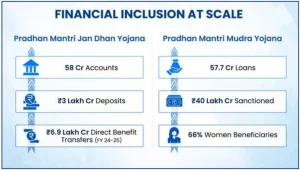
  • Financial Inclusion and Empowerment: 

Ease of Living

  • Transport and Connectivity 
    • India’s road network expanded significantly between 2014 and 2026, reshaping connectivity and daily mobility. 
      • At 63.73 lakh km, it is now the second-largest road network globally. National highways grew nearly 61%, from 91,287 km in FY14 to 1,46,572 km in March 2026.  
    • Recent projects advanced urban and regional mobility:
    • Delhi–Dehradun Economic Corridor (2026) cuts travel time from six hours to 2.5 hours, featuring Asia’s longest elevated wildlife corridor.
    • Ahmedabad–Dholera Expressway (2026) strengthens logistics and reduces travel time.
    • Bridge over River Ganga NH-31 (2025) in Bihar reduces heavy vehicle routes by over 100 km.
    • Urban Extension Road II (2025), Delhi’s third ring road, accelerates freight movement.
  • Citizen‑Facing Platforms:
    • Centralised Public Grievance Redress and Monitoring System (CPGRAMS):  
      • A dedicated feedback portal available for Ministries, Departments, States, and Union Territories to monitor citizen satisfaction regarding grievance resolution. 
        • Between January 2025 and February 2026, approximately 6 lakh grievances were resolved, of which 69.8% were rated as satisfactory by the complainants 
    • MyGov: Launched in 2014, MyGov strengthens citizen participation in governance. With more than 60 million registered users, it acts as a dynamic bridge between citizens and the Government. 
  • Governance Reforms:
    • The Jan Vishwas (Amendment of Provisions) Act, 2026, expanded the scope significantly. It covers 784 provisions across 79 central Acts, decriminalises 717 provisions, and amends 67 provisions directly affecting citizens. 

Click to Know UPSC Offline Courses

Way Forward

  • Shift from Access to Quality: Prioritise better outcomes, service quality, and citizen satisfaction rather than only expanding coverage.
  • Strengthen Local Governance: Empower Panchayats and municipalities with resources and capacity for effective last-mile service delivery.
  • Promote Green & Inclusive Growth: Integrate renewable energy, sustainable transport, and climate-resilient infrastructure for sustainable development.
  • Human Capital First Approach: Increase investment in health, education, and skill development to create a productive workforce.
  • Data-Driven Governance: Promote evidence-based policymaking, digital tools, and real-time monitoring for efficient governance.
  • Bridge Regional Inequalities: Ensure balanced development across states, rural-urban areas, and vulnerable sections through targeted interventions.
  • Enhance Digital Inclusion: Expand digital connectivity, literacy, and affordable access so technology benefits all citizens.
  • Strengthen Public-Private Partnerships: Encourage collaboration, innovation, and investment to improve infrastructure and service delivery.

Check Out UPSC CSE Books

Visit PW Store

online store 1

Ease of Living in India: Governance Reforms and Inclusive Growth (2014–2026)

Explore UPSC Foundation Course

Need help preparing for UPSC or State PSCs?

Connect with our experts to get free counselling & start preparing

Aiming for UPSC?

Download Our App

      
Quick Revise Now !
AVAILABLE FOR DOWNLOAD SOON
UDAAN PRELIMS WALLAH
Comprehensive coverage with a concise format
Integration of PYQ within the booklet
Designed as per recent trends of Prelims questions
हिंदी में भी उपलब्ध
Quick Revise Now !
UDAAN PRELIMS WALLAH
Comprehensive coverage with a concise format
Integration of PYQ within the booklet
Designed as per recent trends of Prelims questions
हिंदी में भी उपलब्ध

<div class="new-fform">


    </div>

    Subscribe our Newsletter
    Sign up now for our exclusive newsletter and be the first to know about our latest Initiatives, Quality Content, and much more.
    *Promise! We won't spam you.
    Yes! I want to Subscribe.