Subject: GS 2: Polity & Governance
Context: Recently, the Lok Sabha passed the Bankers’ Books Evidence Bill, 2026.
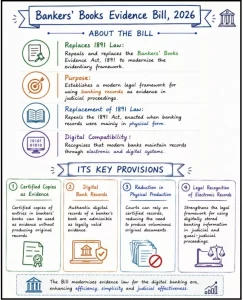
About Bankers’ Books Evidence Bill, 2026

- The Bill seeks to repeal and replace the Bankers’ Books Evidence Act, 1891 and modernise the evidentiary framework for banking records in line with the digitalisation of the banking sector.
- Purpose: The Bill establishes a modern legal framework for using banking records as evidence in judicial proceedings, particularly by recognising digitally maintained records.
- Replacement of 1891 Law: It repeals the Bankers’ Books Evidence Act, 1891, which was enacted when banking records were predominantly maintained in physical form.
- Digital Compatibility: The proposed framework recognises the reality that modern banks maintain records through electronic and digital systems, making the law compatible with contemporary banking practices.
Key Provisions of the Bankers’ Books Evidence Bill, 2026
- Certified Copies as Evidence: The Bill allows certified copies of entries in bankers’ books to be produced as evidence in legal proceedings without requiring the original bank records to be physically produced.
What are ‘Bankers’ Books’?
- “Bankers’ books” refers to the records maintained by a bank in the ordinary course of its business, including traditional accounting records as well as records maintained in electronic or digital form.
- Such records provide evidence of banking transactions, accounts and financial dealings and can be produced before courts as documentary evidence.
Legal Definition and Scope:
- Traditional records: Includes ledgers, account books, cash-books, day-books and other records maintained by banks in the ordinary course of business.
- Digital Records: The concept extends to electronic records and digitally stored banking information, reflecting the increasing digitalisation of banking operations.
- Evidentiary Value: Certified copies or authenticated extracts of bankers’ books may be produced as evidence in judicial proceedings, reducing the need to produce the original physical records.
- Purpose: The framework facilitates the efficient and reliable use of banking records as evidence, particularly in cases involving financial transactions and account-related disputes.
|
- Digital Bank Records: An authentic digital record of a banker’s book is recognised as legally admissible evidence, bringing banking law in line with the digital transformation of financial institutions.
- Hence, the Bill expanded the definition of Bankers’ Books.
- Reduction in Physical Production: Courts can rely on certified records rather than requiring banks to produce voluminous original documents, reducing procedural burdens.
- Legal Recognition of Electronic Records: The Bill strengthens the legal framework for using digitally stored banking information in judicial and quasi-judicial proceedings.
Why is the Bill Needed?
- Outdated Legal Framework: The 1891 Act was designed for a banking environment dominated by physical books and paper records and does not adequately reflect contemporary digital banking.
- Digital Banking Expansion: The rapid growth of internet banking, mobile banking, electronic transactions and computerised accounting has fundamentally changed how banks create and store records.
- Ease of Judicial Proceedings: Requiring original records to be physically produced can cause delays, logistical difficulties and unnecessary administrative burdens.
- Evidence Modernisation: The Bill seeks to harmonise the evidentiary framework for bank records with the broader legal recognition of electronic records.
- Faster Litigation: Greater reliance on certified digital records can facilitate quicker presentation and verification of evidence in courts.
Key Concern associated with the Bill
- Authenticity: Greater reliance on digital records makes authentication and verification mechanisms crucial to prevent manipulation or fabrication.
- Cybersecurity: Banks must ensure strong safeguards against data breaches, cyberattacks and unauthorised alteration of records.
- Privacy: Banking records contain highly sensitive financial and personal information, requiring appropriate safeguards when such records are submitted in legal proceedings.
- Chain of Custody: Clear procedures are necessary to establish the integrity and provenance of digital records used as evidence.
- Implementation Capacity: Banks, courts and investigative agencies may require appropriate technological infrastructure, training and standardised procedures.
Way Forward
- Strong Authentication Standards: Establish robust mechanisms for verifying the authenticity and integrity of digital banking records.
- Cybersecurity Safeguards: Banks should strengthen encryption, access controls, audit trails and cybersecurity systems.
- Privacy Protection: Disclosure of banking records in judicial proceedings should follow appropriate data protection and confidentiality principles.
- Standardised Procedures: Develop uniform protocols for certification, preservation, retrieval and presentation of digital bank records.
- Capacity Building: Courts, banks, regulators and investigative agencies should receive adequate technical training for handling digital evidence.
- Parliamentary Scrutiny: Technological and legal reforms should ideally undergo adequate legislative deliberation and stakeholder consultation to ensure both efficiency and safeguards.
Conclusion
The Bankers’ Books Evidence Bill, 2026 modernises the banking evidence framework for the digital era, enabling efficient use of authenticated digital records. It can enhance judicial efficiency and reduce compliance burdens, provided strong safeguards for authenticity, cybersecurity, privacy and data integrity are ensured.