Subject: GS 2: Polity & Governance
Context: Recently, India’s competitive exam preparation relies heavily on expensive coaching centers, creating inequality based on income and region. Introducing a free AI tutor via Digital Public Infrastructure (DPI) seeks to make personalized learning accessible to all without creating a state-controlled education system.
UPSC Course Fees Online
India’s Education & Coaching Landscape
- Market Size: India’s test preparation sector is valued at $14.8 billion in FY26. The market is projected to grow to between $23 billion and $26 billion by FY30.
- Student Dependence on Coaching: Among the 65 million students enrolled in Classes 9 to 12, between 27% and 30% take private coaching.
- The sector operates through approximately 200,000 physical coaching centres across the country.
- High Reliance: Nearly 17–20 million secondary students (27%–30% of Classes 9–12) rely on private tuition, spanning both urban (30.7%) and rural (25.5%) areas.
- Scalability Gap: Top platforms like PhysicsWallah reach ~4.9 million paid users, leaving over 90% of target students unserved by major providers.
- AI Cost-Efficiency: Open-source AI (e.g., Gemma) can deliver 3.6 million tokens of study material per student annually for ~₹100, where 1 minute of AI interaction matches 1,000 human voice minutes.
AI Tutor
- An AI Tutor is a personalized digital learning assistant powered by Artificial Intelligence that teaches students, answers questions, explains concepts, gives practice exercises, assesses performance, and adapts lessons to the learner’s level, pace and learning gaps.
- Example: A Class 8 student struggling with fractions can ask an AI tutor, “Why is 2/3 greater than 1/2?” The AI can explain the concept step-by-step, use a simple visual example, ask a few practice questions, identify the student’s mistake, and adjust the next lesson accordingly.
|
About the Proposed AI Tutor Model
The core strategy operates on a Public Digital Rails, Private Educational Engines architecture:
- Government’s Role: Acts as the platform maker and trust provider by establishing open digital protocols.
- This includes using DigiLocker for verified identity, APAAR ID for academic record mapping, Data Empowerment and Protection Architecture (DEPA) for data privacy, and managing open content registries mapped to standard curricula.
- Private Sector’s Role: Renowned educators, ed-tech startups, and local tutors participate on an open, competitive network to supply high-quality instructional videos, question banks, and specialized mentorship.
- AI Engine’s Role: The artificial intelligence infrastructure acts as an adaptive diagnostic layer, offering personalized learning pathways, continuous assessment, and real-time doubt resolution to drive the marginal cost of basic tutoring toward zero.
- Initial Priority Area: Priority deployment begins with high-volume, standardized entrance examinations such as JEE and NEET-UG due to their objective scoring criteria, existing digital content, and significant socio-economic impact.
Why India Needs an AI Tutor
- Addressing Socio-Economic Disparities: Students in rural areas, Tier-3 towns, and government schools often lack access to quality teachers or the financial resources to relocate to major coaching hubs like Kota.
- Bridging the Guidance Deficit: While free educational lectures are widely available on open video platforms like YouTube, students struggle with structured guidance—specifically identifying personal academic weaknesses, choosing relevant practice material, and receiving timely feedback.
- Unbundling Coaching Fees: Traditional coaching centers charge exorbitant fees by bundling four distinct services: core content delivery, doubt resolution, peer group discipline, and brand credibility. DPI unbundles these components, allowing high-grade study resources and doubt-solving to be distributed freely.
- Overcoming Classroom Constraints: Conventional school teachers face severe time constraints, making it difficult to offer 24×7 individualized attention or tailored learning paths to large, overcrowded classrooms.
IAS coaching
Critical Challenges & Potential Vulnerabilities
- The Persistent Digital Divide: Students who lack personal smartphones, reliable computing devices, continuous electricity, or affordable internet coverage risk further marginalization (ASER reports continue to highlight significant gaps in digital access among rural youth).
- AI Hallucinations and Conceptual Errors: Large language models can occasionally generate incorrect explanations or flawed step-by-step mathematical derivations, creating serious pedagogical risks in high-stakes competitive examinations.
- Data Misuse and Profiling Risks: Aggregating extensive performance, behavioral, and demographic data creates significant privacy concerns if robust regulatory guardrails are not strictly enforced to prevent commercial exploitation.
- Reinforcing Examination-Centric Rote Learning: An initial focus on exams like JEE and NEET risks narrowing the scope of education toward test-taking strategies rather than fostering holistic development, critical thinking, and creative problem-solving skills.
Global Initiatives & Country Models
Globally, governments and educational organizations are actively testing AI integration to balance human teaching with scalable digital support.
- Khanmigo by Khan Academy (USA & Global): An AI-powered tutor built on Large Language Models (LLMs) that uses Socratic tutoring methods—guiding students step-by-step through mathematical and scientific problems without directly giving out the final answer.
- National AI Strategy for Education (United Kingdom): The UK Department for Education launched targeted AI pilot programs to automate teacher administrative tasks and test domain-specific AI marking tools, prioritizing human teacher workload reduction alongside student support.
- UNESCO’s “Gateways to Public Digital Learning”: A global initiative launched to ensure that public digital learning platforms remain freely accessible globally as a basic human right, providing policy guidelines to prevent public education from becoming dependent on closed, commercial software monopolies.
Way Forward
- Adopting a Human-in-the-Loop Framework: AI platforms should handle routine administrative and diagnostic tasks, such as automated practice generation and basic doubt-solving, while human educators focus on mentorship, motivation, and complex conceptual instruction.
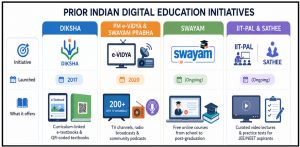
- Ensuring Multi-Channel Accessibility: Distribution must combine online streaming with offline access points, including pre-loaded content on the DIKSHA application, 48 DTH SWAYAM Prabha channels, school computer laboratories, and over 5 lakh Common Service Centres (CSCs).
- Implementing Freemium and Voucher Support: Core learning modules and automated doubt resolution should remain entirely free at the point of access, with optional micro-payments or state-backed e-Shiksha vouchers available for specialized live mentorship sessions.
- Establishing Independent Quality Oversight: Program governance should be anchored in an independent, non-profit entity (modeled after NPCI or IIT Madras’s Bodhan.ai initiative) tasked with auditing AI algorithms, verifying content accuracy, and maintaining provider accreditation.
Click to Know UPSC Coaching Centres in India
Conclusion
Technology alone cannot equalise education, but open Digital Public Infrastructure can remove financial barriers. A neutral state platform with private-sector content and artificial intelligence can turn paywalled coaching into a public good, making opportunity depend on talent, not purchasing power.
 24 Aug 2026